
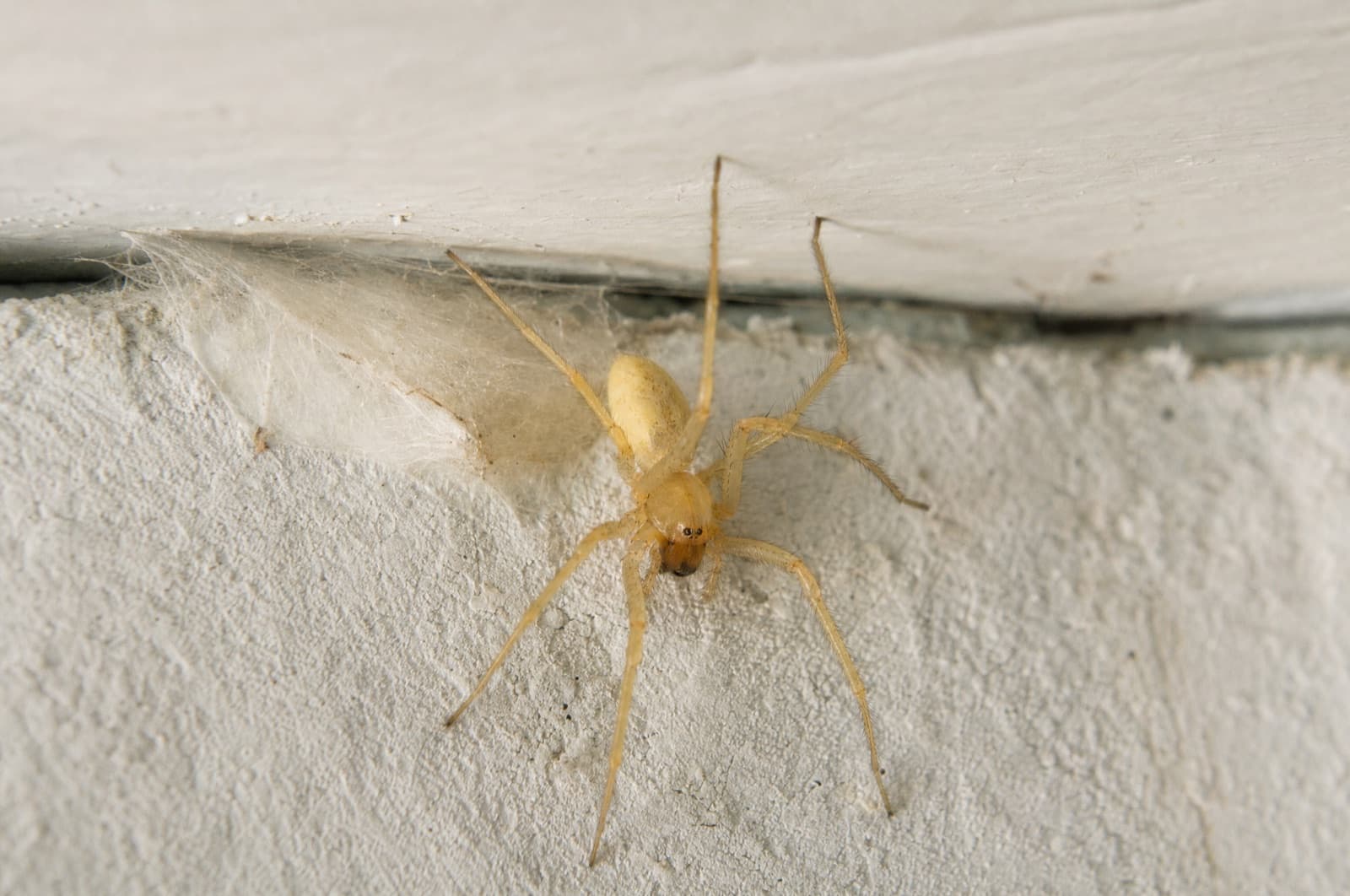
Yellow Sac Spider in NH: ID, Bite & When to Worry
Also called Long-legged sac spider · Cheiracanthium spider
The yellow sac spider (Cheiracanthium mildei indoors, C. inclusum outdoors) is a pale yellow or cream spider, nickel-sized, that hides in a silk sac at wall-ceiling junctions by day and hunts at night. Its bite is the most commonly occurring spider bite in North America — painful and immediate, like a bee sting — but verified bite case studies find no necrosis and no deaths. The widespread belief that sac spiders cause flesh death is not supported by the confirmed-bite evidence. In New Hampshire, the brown recluse is not established; most suspected 'recluse bites' in NH are sac spider bites. If bite symptoms worsen, see a doctor.
- Body size
- ~5–10 mm (nickel-sized with legs)
- WebMD
- Bite
- Painful but mild — bee/wasp-sting-like
- ScienceDirect
- Necrosis?
- None in verified bites
- Vetter 2006; McKeown 2014; ScienceDirect
- Duration
- Minutes to approximately 48 hours
- africansnakebiteinstitute.com
- NH status
- Present; C. mildei common indoors year-round
- WebMD
- Deaths
- None attributed to Cheiracanthium
- ScienceDirect
The most commonly biting spider in your NH home — and less dangerous than the internet says
The yellow sac spider is likely the spider most responsible for the reported 'spider bites' that aren't from a recluse or widow — because it actually bites. Cheiracanthium mildei, the indoor species common across New Hampshire, is a nocturnal hunter that moves freely across walls and ceilings at night, occasionally dropping into bedding or crawling into clothing left on the floor, where it gets trapped and bites defensively. The bite is immediate, real, and painful — no dismissing it. But the medical picture is far milder than most online accounts suggest.
Studies that examined confirmed Cheiracanthium bites — cases where the spider was captured, identified, and the victim's outcome documented — found only local effects: pain, redness, a raised wheal similar to a bee sting, resolving within hours to roughly 48 hours. No case in the verified-bite literature produced necrosis. The necrosis myth attached to sac spiders arose because many 'recluse bites' later proved to be sac spider bites or had other causes entirely — and the dramatic descriptions stuck.
In New Hampshire, the brown recluse is not established. If you were bitten by an unidentified spider in NH, it was almost certainly not a recluse. The yellow sac spider is the most likely candidate. This page gives you the honest picture: a real bite that deserves real attention, calibrated to what verified evidence shows — and clear guidance on when the bite warrants a doctor.
How to identify a yellow sac spider
Three features distinguish the yellow sac spider from other pale indoor spiders: a yellow to cream body with noticeably darker chelicerae (jaws) and leg tips; a silk sac retreat at the junction of a wall and ceiling — not a prey-catching web; and fast, purposeful movement along walls and ceilings at night. The indoor NH species, C. mildei, often has a faint greenish tint to the abdomen.
Yellow sac spider
- Scientific name
- Cheiracanthium mildei (indoor) / Cheiracanthium inclusum (outdoor)
- Family
- Cheiracanthiidae
- Size
- Body ~5–10 mm; appears nickel-sized when legs are spread
- Coloration
- Pale yellow to cream; slightly greenish abdomen in C. mildei; distinctly darker chelicerae and leg tips
- Habitat
- Silk sac at wall/ceiling junctions indoors; vegetation and low shrubs outdoors
- Active season
- Year-round indoors; outdoor C. inclusum primarily warm months
- Diet
- Small insects and other arthropods; active nocturnal hunter with no capture web
- Reproduction
- Female guards an egg sac inside or near the silk retreat; multiple egg sacs per season are possible
- Lifespan
- Approximately 1–2 years
C. mildei introduced from Europe; now common throughout northeastern North America including New Hampshire. C. inclusum native throughout eastern United States.
The tells — key ID features
- Pale yellow to cream body with noticeably darker chelicerae (jaws) and leg tips — the color contrast is the fastest field mark.
- Silk sac retreat at the junction of wall and ceiling or behind picture frames — a tube of loose silk, not a prey web.
- Fast, smooth movement along walls and ceilings at night with no web structure present.
- C. mildei often has a faint greenish tint to the abdomen.
- Eight eyes arranged in two rows of four.
- Found near the ceiling, not on the floor — this separates it from ground-hunting wolf spiders.
Size, to scale
Body ~5–10 mm
About the size of a nickel when legs are spread
Brown recluse (Loxosceles reclusa)
How to tell — Brown recluse is NOT established in New Hampshire. Yellow sac spiders are frequently misidentified as recluses because both are pale and non-descript. Key differences: recluse has a violin-shaped mark on the cephalothorax, only 6 eyes in three pairs, and builds an irregular web. Sac spider has 8 eyes, no violin mark, a silk sac retreat (not a web), and darker chelicerae.
Common house spider (Parasteatoda tepidariorum)
How to tell — Common house spider is typically darker — tan or brown with a mottled abdomen — and builds a tangled cobweb in corners. Yellow sac spiders are uniformly pale and build a silk sac, not a prey-catching web.
Ghost spider (family Anyphaenidae)
How to tell — Ghost spiders are also pale and web-free but are generally more uniformly pale without the darker chelicerae, and they do not construct a structured silk sac retreat. Both are harmless.
Signs of a problem
Yellow sac spider signs are often subtle — the spider is nocturnal and hides in its silk sac by day, so the sac is frequently discovered before the spider itself.
Small silk tube or pouch at the junction of a wall and ceiling
What it means — The signature yellow sac spider retreat. Check where walls meet ceilings at room corners and behind picture frames or shelving. One sac means one resident spider; multiple sacs in different rooms suggest an established population.
A bite occurring after putting on clothing, shoes, or bedding left out overnight
What it means — The most common yellow sac spider bite scenario: the spider sheltered in folded fabric and bit defensively when trapped against skin. Shake out any clothing or bedding that has been left on the floor or in a pile before wearing.
A pale yellow spider moving quickly across a wall or ceiling at night
What it means — Nocturnal yellow sac spider on a hunting run. It does not build a capture web, so it moves freely across surfaces after dark — the most common moment of visual contact.
A bite with immediate, sharp local pain and a visible raised wheal
What it means — Consistent with a yellow sac spider bite. Wash with soap and water and monitor for 48 hours. See a doctor if pain worsens, redness spreads well beyond the bite site, or you develop systemic symptoms such as fever or nausea.
The real risks, calibrated
Yellow sac spider bites cause real, immediate pain but are mild by objective medical measure. Verified bite case studies — where the spider was captured and identified — find only local effects and no necrosis in any confirmed case. The fear attached to this spider significantly exceeds what the evidence supports.
Painful bite
ModerateOnset: Immediate local pain, redness, and raised wheal at the bite site
Symptoms typically peak within the first hour and resolve within hours; maximum duration approximately 48 hours. No necrosis has been documented in any verified bite study (Vetter 2006; McKeown 2014). Wash the bite with soap and water. See a doctor or contact the Northern New England Poison Control Center at 1-800-222-1222 if pain worsens, redness spreads beyond the bite site, signs of infection appear (increasing warmth, swelling, discharge), or you develop systemic symptoms.
Mild systemic symptoms (occasional)
Low riskOnset: Hours after the bite
Occasional mild fever, nausea, or general malaise; self-limiting in documented cases. Monitor and contact a doctor if symptoms worsen or persist beyond 24 hours.
DIY — what works, what backfires
Yellow sac spider control focuses on removing silk sac retreats, reducing indoor insect prey, preventing incidental bite contact, and monitoring any bite that occurs. Treatment is rarely needed if harborage is consistently eliminated.
What actually works
- Vacuum silk sacs at wall/ceiling corners monthly — include behind picture frames, shelving, and curtain rods where sac spiders establish retreats.
- Shake out clothing, shoes, and bedding that have been left on the floor or in piles before putting them on.
- Wash any bite site with soap and water and monitor for 48 hours for worsening pain, spreading redness, or signs of infection.
- Reduce indoor insects — yellow sac spiders follow their prey indoors; fewer insects means fewer spiders.
- Seal gaps around window frames, door frames, and baseboards to reduce fall entry points.
What backfires
- Don't apply folk remedies or home treatments to a bite — soap, water, and monitoring are appropriate. See a doctor if symptoms worsen.
- Don't assume the bite is from a brown recluse — the recluse is not established in New Hampshire, and sac spider bites are the most common source of misdiagnosed 'recluse bite' reports in the Northeast.
- Don't ignore a bite where the pain is spreading or increasing rather than improving — that warrants a medical evaluation, no matter the suspected spider.
Yellow sac spiders in New Hampshire homes
Cheiracanthium mildei — the indoor yellow sac spider — is one of the most common spider species found inside NH homes year-round. Originally introduced from Europe, it is well established throughout the northeastern United States, including all of southern New Hampshire. It moves indoors in fall and establishes silk sac retreats where walls meet ceilings, behind picture frames, and in sheltered corners. C. inclusum, the outdoor species, is found on garden vegetation through summer. Across Manchester, Nashua, and Concord, yellow sac spiders account for a significant share of the indoor spider bite reports that reach pest control providers each year.
Peak season
Year-round indoors; outdoor C. inclusum active warm months (May–October)
You might actually have
- Common house spider (darker mottled body; builds a tangled cobweb)
- Ghost spider (pale; no sac retreat; family Anyphaenidae)
- Cellar spider (very long thin legs; loose web in damp corners)
We serve these communities
- NH-licensed applicator · #782664
- Same-day service
- Family-owned since 2017
Service Area Map
Southern New Hampshire
When to call Anchor about yellow sac spiders
A single yellow sac spider rarely warrants professional treatment. Call us when sacs are recurring in multiple rooms despite regular vacuuming, when bite incidents are repeating in your home, or when you want a professional inspection to confirm the species and eliminate hidden harborage.
When to call a pro
- Recurring silk sacs in multiple rooms despite consistent monthly vacuuming.
- Repeated bite incidents in the home, particularly involving bedding or stored clothing.
- You want a professional identification to confirm the species and rule out any spider of greater concern.
- The property is a rental or has occupants with health vulnerabilities where spider bite risk should be proactively minimized.
Vacuum corner sacs regularly
Check and vacuum wall/ceiling junctions, behind frames, and curtain hardware monthly. Removing the silk retreat removes the spider's home and reduces the chance of incidental bite contact.
Keep clothing off the floor
Yellow sac spider bites most often happen when the spider is trapped in clothing or bedding left on the floor or in a pile. Store laundry in a lidded hamper and shake items out before wearing.
Seal fall entry points
C. mildei moves indoors in fall. Weatherstripping, caulk around window frames, and sealed baseboards reduce entry options before NH temperatures drop.
Not sure it's a yellow sac spider?
A licensed NH technician can confirm the species and tell you honestly whether it's a DIY fix or a job for a pro — free inspection, same-day service across Southern New Hampshire.
Frequently asked questions
Sources(5)
- [1]WebMD — Yellow Sac Spider Bites
body size reference; C. mildei indoor NH status; general bite overview
medicalverified 2026-06-30 - [2]ScienceDirect — Cheiracanthium bite study (Toxicon)
verified bite outcomes — local effects only, no necrosis, no deaths attributed to Cheiracanthium
researchverified 2026-06-30 - [3]African Snakebite Institute — Yellow Sac Spider
bite symptom duration — minutes to approximately 48 hours
webverified 2026-06-30 - [4]PMC / NCBI — Cheiracanthium bite review (PMC2923970)
Vetter and Isbister verified-bite literature review; necrosis absence in confirmed cases
researchverified 2026-06-30 - [5]Get Lost Pest — Yellow Sac Spider
indoor harborage patterns and control guidance
webverified 2026-06-30
Written & reviewed by
VerifiedDaniel Brady
NH-Licensed Pesticide Applicator · License #782664 (NHDAMF, RSA 430)
Daniel Brady is the New Hampshire–licensed applicator behind Anchor Pest Services, a family-owned pest control company serving the Manchester area since 2017.
Last updated 2026-06-30

New Hampshire pest control
Dealing with yellow sac spiders in your home?
Anchor Pest Services identifies and handles yellow sac spider problems across southern and central New Hampshire. Family-owned since 2017, NH license #782664.
- NH-licensed applicators (#782664)
- Same-day service · free inspection
- Family-owned since 2017
Your next step
- Book a NH pro
Spider Control in New Hampshire
Spider sightings peak in fall. We treat hiding spots and seal the gaps they use.
Book now - Next step
Is Home Defense Ant, Roach & Spider Killer by Ortho Safe for Pets?
Read the answer - What to do next
What Attracts Yellow Sac Spiders to Your House?
Read the answer - What to do next
Mechanical Spider Control: Web Removal That Actually Works
Read the answer - Related guide
House Spider in New Hampshire: ID, Webs & Control
Read the answer - Related guide
Common Garden Spider in NH: ID, Web & Is It Dangerous
Read the answer