
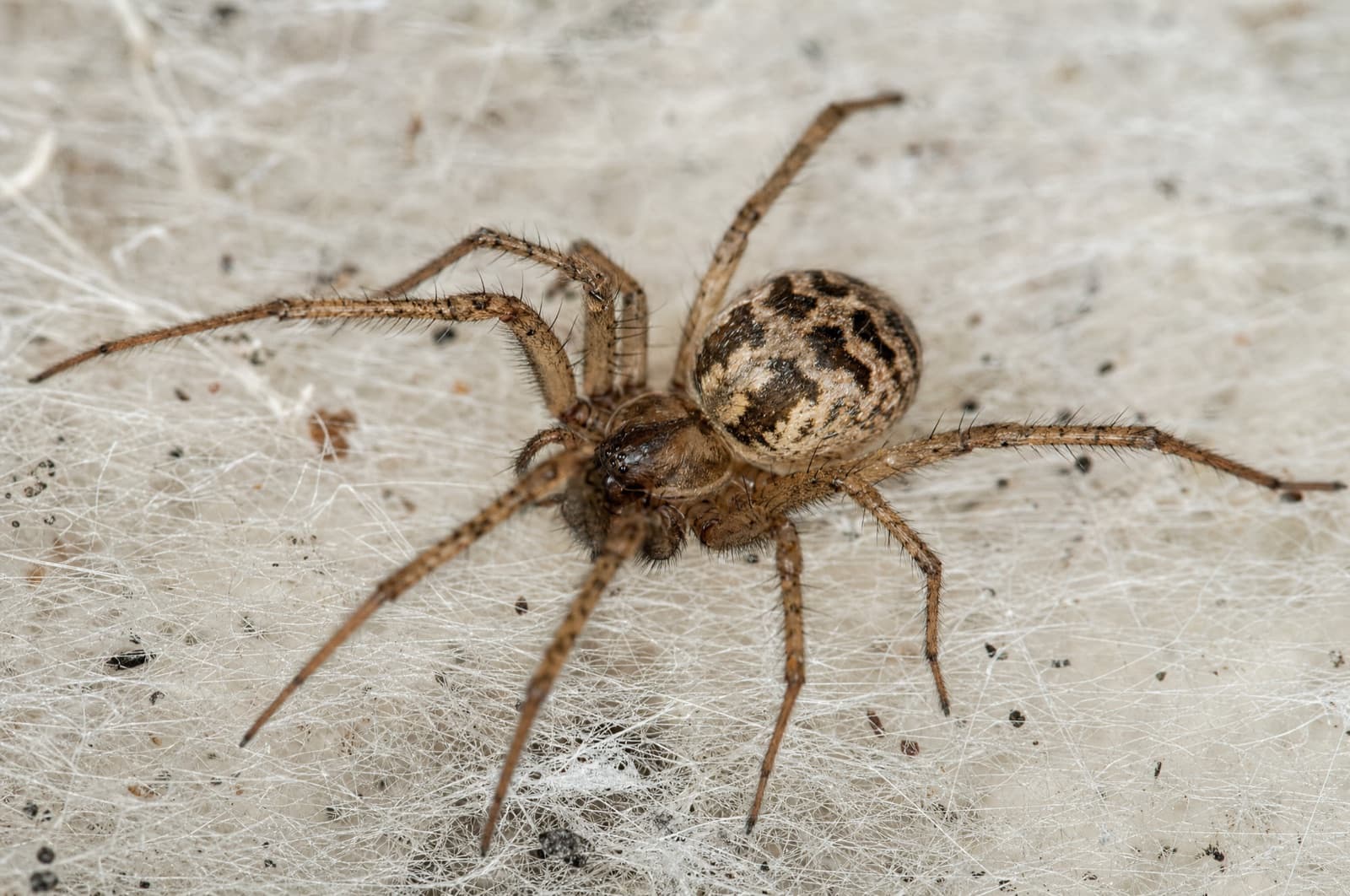
House Spider in New Hampshire: ID, Webs & Control
Also called American house spider · Cobweb spider · Tangle-web spider
The common house spider (Parasteatoda tepidariorum) is the small mottled-brown cobweb spider responsible for most indoor webs in New Hampshire homes year-round. Despite surface-level similarity to black widows that drives many Google searches, it is harmless — no hourglass marking, minor bite risk, and not medically significant. The fastest way to rule out a black widow is to check the underside of the abdomen: no red or orange hourglass means it is almost certainly this harmless species.
- Female body size
- 5–8 mm (sesame–peppercorn)
- male ~4–5 mm; UF/IFAS IN394
- Hourglass?
- None — NOT a black widow
- bugswithmike.com; Penn State Extension
- NH status
- Present, very common year-round
- synanthropic (lives in buildings); UF/IFAS Extension (IN394)
- Bite risk
- Rare and minor
- Penn State Extension
- Egg sac
- Tan papery, 200–300 eggs/cycle
- Penn State Extension
The cobweb spider in your corners — harmless, and definitely not a widow
If you have found a small mottled-brown spider in the corners of your ceilings, basement, or garage, you almost certainly have the common house spider (Parasteatoda tepidariorum) — one of the most abundant and completely harmless spiders in New Hampshire. The one thing that sends people to pest control in a panic is the fear it might be a black widow, and the one check that resolves that fear immediately is looking for an hourglass: if the underside of the abdomen shows no red or orange hourglass marking, it is not a widow.
Parasteatoda tepidariorum belongs to the family Theridiidae (cobweb spiders), the same family as widows — which is why the webs look similar. But the similarities end there. The house spider is much smaller, has a mottled tan-to-brown chevron pattern with no glossy black, and builds its irregular tangled cobwebs in sheltered indoor corners where it waits for small insects.
In southern New Hampshire these spiders are active year-round inside climate-controlled buildings. The papery tan egg sacs they park in the web — each containing 200–300 eggs — are the main reason populations rebuild quickly after cleaning.
How to identify the common house spider
Three features separate the house spider from the spiders people fear: the absence of any red or orange hourglass, the small mottled body pattern, and the irregular tangled cobweb rather than an orb or flat sheet. The hourglass check is the most important — do it on the underside of the abdomen.
Common house spider
- Scientific name
- Parasteatoda tepidariorum
- Family
- Theridiidae
- Size
- Female 5–8 mm; male 4–5 mm
- Coloration
- Mottled tan to medium brown with darker chevron/stripe pattern on abdomen; NOT glossy black. Legs banded brown and cream.
- Habitat
- Indoor and sheltered outdoor spots — ceiling corners, window frames, basements, garages, barns, crawlspaces, and under eaves.
- Active season
- Year-round indoors in New Hampshire; does not require warm temperatures.
- Diet
- Small insects and other arthropods that blunder into the irregular tangle web.
- Reproduction
- Produces multiple egg sacs per year, each containing 200–300 eggs wrapped in tan papery silk; female guards sacs in the web.
- Lifespan
- Females can live over a year; males shorter-lived.
Cosmopolitan worldwide; one of the most common indoor spiders across North America including all of New Hampshire.
The tells — key ID features
- Round abdomen with mottled tan-to-brown chevron pattern and NO red or orange hourglass — the most critical distinguishing feature.
- Tan papery pear-shaped egg sacs parked inside the web — often the most visible part of the nest.
- Messy, irregular tangle cobweb in sheltered corners — no geometric orb or funnel shape.
- Variable coloration from pale tan to medium brown; never glossy black like a widow.
- Frequently abandons and rebuilds webs in slightly different spots nearby when disturbed.
- Small body — sesame seed to peppercorn in size — versus the larger, stouter body of a widow.
Size, to scale
Female 5–8 mm; male 4–5 mm
Body about the size of a sesame seed (small female) to a peppercorn (large female)
Northern black widow (Latrodectus variolus)
How to tell — Black widows are glossy jet-black with a red or orange hourglass on the underside of the abdomen; house spiders are mottled brown with NO hourglass. Widows are rare in NH.
False widow (Steatoda spp.)
How to tell — Darker brown, rounder abdomen, no hourglass; same family as the house spider but slightly more robust. Harmless.
Triangulate cobweb spider (Steatoda triangulosa)
How to tell — Has a distinctive triangular pattern on the abdomen; similar messy web; also harmless.
Signs of a problem
The house spider leaves consistent calling cards. These signs tell you what you have — and how active the population is.
Multiple short-lived cobwebs appearing in ceiling corners, window frames, and basement areas
What it means — An active house spider population tracking small insect prey; frequency of new webs signals population size.
Tan papery pear-shaped egg sacs clustered in or near the web
What it means — A breeding female; removing sacs mechanically is more effective than spraying.
Small mottled brown spider in a corner web with no red or orange hourglass visible
What it means — Almost certainly the harmless common house spider — the defining check is the absent hourglass.
Webs in basements, crawlspaces, or damp garage corners
What it means — House spiders favor humid, sheltered spots with reliable insect traffic; damp areas support both the spider and its prey.
Web abandoned and rebuilt slightly differently nearby within days
What it means — House spiders frequently move short distances when webs are disturbed; the population is not gone, just relocated.
The real risks, calibrated
The common house spider is harmless to people and pets. Its only practical downside is the aesthetic of cobwebs in living spaces.
Defensive bite if pressed against skin
Low riskOnset: Immediate
Minor local irritation — typically less severe than a mosquito bite. Not medically significant; no systemic effects documented for this species.
Cosmetic cobweb accumulation
Low riskOnset: Over days to weeks
Ongoing web-building in corners and window frames requires routine vacuuming; heavy populations can make spaces appear neglected.
DIY — what works, what backfires
House spider control is maintenance work, not an emergency. The goal is reducing prey, removing webs and egg sacs mechanically, and sealing entry points so fewer spiders and insects can enter. Here is what works — and what to skip.
What actually works
- Vacuum webs and egg sacs thoroughly — including the tan papery sacs, which contain 200–300 eggs each; dispose of the vacuum bag promptly.
- Reduce indoor insects (the spiders' food supply) by fixing window screens, sealing door gaps, and reducing lighting that draws moths.
- Seal cracks and gaps around windows, pipes, and the foundation to reduce spider entry from outside.
- Control moisture in basements and crawlspaces — damp areas support both house spiders and the insects they eat.
What backfires
- Don't mistake a mottled brown house spider for a black widow — check for the absent hourglass before taking any action.
- Don't fog or bomb a room for a spider this harmless — aerosol space treatments rarely reach sheltered web sites and are unnecessary.
- Don't ignore egg sacs when cleaning webs; leaving sacs behind means the population rebuilds within weeks.
- Don't assume repeated new webs mean a fresh invasion — the same small population just keeps rebuilding locally.
House spiders in New Hampshire homes, barns, and basements
Parasteatoda tepidariorum is one of the most synanthropic spiders in the world — it thrives almost exclusively in and around human structures. In southern NH it is present year-round in Manchester, Nashua, Concord, and every town in between: basements, crawlspaces, garage corners, window frames, and the upper corners of bedrooms and barns. Unlike seasonal outdoor spiders, it does not depend on warm weather; a damp basement provides everything it needs in January.
Peak season
Year-round indoors; no true peak season in climate-controlled buildings
You might actually have
- Cellar spider / daddy longlegs (Pholcus phalangioides — long wispy legs, pulsating defense behavior)
- Northern black widow (Latrodectus variolus — glossy black, red hourglass, rare in NH)
- False widow (Steatoda spp. — darker, rounder, no hourglass)
We serve these communities
- NH-licensed applicator · #782664
- Same-day service
- Family-owned since 2017
Service Area Map
Southern New Hampshire
When to call a pro for house spiders
Isolated house spiders rarely need professional treatment. If you are seeing persistent cobweb buildup throughout the home despite regular cleaning, have difficulty ruling out a black widow, or want a general spider treatment for the exterior perimeter, Anchor Pest Services can help.
When to call a pro
- Persistent cobweb buildup throughout the home despite regular vacuuming and cleaning.
- You cannot confidently rule out a black widow or other medically significant spider and want a professional ID.
- You want a perimeter spider treatment to reduce the overall spider population entering the home.
- Heavy populations in a crawlspace, basement, or outbuilding that you cannot easily access.
Vacuum routinely including corners and window frames
Regular mechanical removal of webs and egg sacs is the most effective single step; aim for every two weeks in active areas.
Seal gaps and entry points
Caulk gaps around windows, pipes, and the foundation. Install door sweeps. Reducing entry points cuts both spider and insect (prey) populations.
Control nuisance insects indoors
House spiders follow their food. Fixing window screens, replacing white exterior bulbs with yellow LED lights, and keeping drains clean all reduce the insect supply that sustains spider populations.
Not sure it's a common house spider?
A licensed NH technician can confirm the species and tell you honestly whether it's a DIY fix or a job for a pro — free inspection, same-day service across Southern New Hampshire.
Frequently asked questions
Sources(3)
- [1]UF/IFAS Extension — Parasteatoda tepidariorum (IN394)
body size, identification, biology, synanthropic status, cosmopolitan range
extensionverified 2026-06-30 - [2]Penn State Extension — Common House Spider
egg sac (200–300 eggs), bite risk, identification, control
extensionverified 2026-06-30 - [3]Bugs With Mike — House Spider vs. Black Widow
hourglass absence as widow distinguishing feature
educationalverified 2026-06-30
Written & reviewed by
VerifiedDaniel Brady
NH-Licensed Pesticide Applicator · License #782664 (NHDAMF, RSA 430)
Daniel Brady is the New Hampshire–licensed applicator behind Anchor Pest Services, a family-owned pest control company serving the Manchester area since 2017.
Last updated 2026-06-30

New Hampshire pest control
Dealing with common house spiders in your home?
Anchor Pest Services identifies and handles common house spider problems across southern and central New Hampshire. Family-owned since 2017, NH license #782664.
- NH-licensed applicators (#782664)
- Same-day service · free inspection
- Family-owned since 2017
Your next step
- Book a NH pro
Spider Control in New Hampshire
Spider sightings peak in fall. We treat hiding spots and seal the gaps they use.
Book now - Next step
Do spiders cause property damage?
Read the answer - What to do next
Mechanical Spider Control: Web Removal That Actually Works
Read the answer - What to do next
How to Get Rid of House Spiders
Read the answer - Related guide
Common Garden Spider in NH: ID, Web & Is It Dangerous
Read the answer - Related guide
Black Widow Spider in New Hampshire: ID, Risk & Control
Read the answer