
Common Garden Spider in NH: ID, Web & Is It Dangerous
Also called Yellow garden spider · Writing spider · Zigzag spider · Corn spider · Banana spider
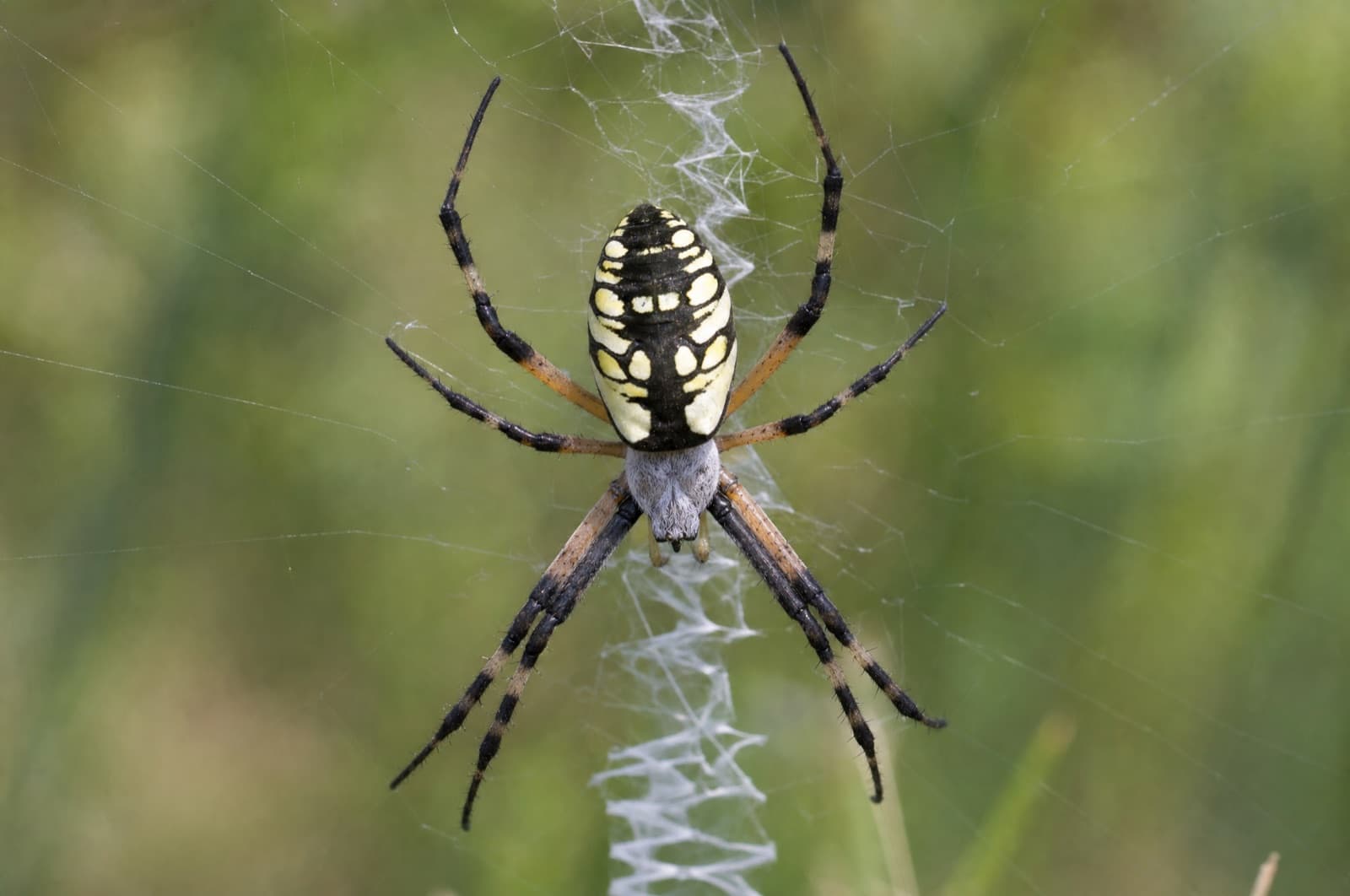
The black-and-yellow garden spider (Argiope aurantia) is a large, bold orbweaver that appears in NH gardens and fields from late summer through the first hard frost. Despite her impressive size — females nearly an inch of body length — she is harmless to humans: the bite is roughly bee-sting mild and occurs only if she is physically grabbed. The instant field ID is the bold yellow-and-black abdomen and the wide zigzag white band (stabilimentum) woven into the center of a large circular orb web.
- Female body size
- ¾–1⅛ inch (19–28 mm)
- males 5–9 mm; UF/IFAS Extension (IN1273)
- Bite
- ≈ bee/bumblebee sting (harmless)
- non-allergic people; NC State Extension
- Web
- Orb up to ~2 ft + zigzag stabilimentum
- UF/IFAS Extension (IN1273)
- Role
- Eats grasshoppers & garden pests
- Animal Diversity Web
- NH status
- Present statewide (late summer–fall)
- throughout continental US; NWF
The big garden spider that's all looks, no danger
If a large yellow-and-black spider has appeared in your garden or on your eaves with an elaborate zigzag web, take a breath — you have one of the most visually striking and beneficial spiders in New Hampshire, and it is completely harmless to people and pets. The black-and-yellow garden spider (Argiope aurantia) bites only in self-defense when physically grabbed, and even then the effect is roughly equivalent to a bee sting.
Argiope aurantia is an orbweaver in the family Araneidae. The female's bold coloration and large size — up to nearly an inch of body length, with a legspan around three inches — make her impossible to miss. By late summer she is the most-reported 'scary spider' in NH, yet she spends her days hanging motionless, head-down, waiting for grasshoppers and flying insects to blunder into her web.
The zigzag white stripe woven through the web center — called a stabilimentum — is her signature, and the single quickest way to confirm the ID from a distance. No other common NH spider builds one.
How to identify a common garden spider
Argiope aurantia is one of the easiest spiders in New Hampshire to identify: the bold yellow-and-black abdomen, the large circular orb web, and the distinctive zigzag white stabilimentum in the web center together form a combination no other local spider matches.
Common garden spider
- Scientific name
- Argiope aurantia
- Family
- Araneidae
- Size
- Female 19–28 mm (¾–1⅛ in); male 5–9 mm
- Coloration
- Female: silvery hairy cephalothorax; abdomen bright yellow and black with white/silver markings. Male: similar but much smaller and paler.
- Habitat
- Open sunny habitats — gardens, meadows, forest edges, tall-grass areas, and exterior eaves or fences near vegetation.
- Active season
- Adults most visible late July through first frost (typically October in southern NH); eggs overwinter in papery sacs.
- Diet
- Flying and jumping insects, especially grasshoppers, bees, wasps, beetles, and moths that blunder into the orb web.
- Reproduction
- Female builds a papery teardrop-shaped egg sac in fall containing hundreds of eggs; eggs overwinter and hatch in spring.
- Lifespan
- Adults live one season; egg sacs survive winter and produce the next generation.
Present throughout the continental United States, including all of New Hampshire, wherever sufficient insect prey and web-anchor points exist.
The tells — key ID features
- Bold yellow-and-black abdomen with white/silver markings — the single most visible ID cue from a distance.
- White zigzag stabilimentum woven through the center of the circular orb web — unique to Argiope in New Hampshire.
- Female hangs motionless head-down at the web center by day, forelegs and hind legs held in an X pattern.
- Silvery, hairy cephalothorax (head region) contrasting with the colorful abdomen.
- Large papery teardrop-shaped egg sac attached nearby in fall.
- Web is clean, geometric, and large — up to roughly two feet across in a sunny, sheltered spot.
Size, to scale
Female body 19–28 mm (¾–1⅛ in); legspan up to ~3 in
Body about the diameter of a US quarter (females); male about the size of a raisin
Banded garden spider (Argiope trifasciata)
How to tell — Similar body shape and web style but abdomen has silver-and-white banding rather than bold yellow patches; less common in NH.
Orchard orbweaver (Leucauge venusta)
How to tell — Much smaller, green and silver coloration, horizontal web with no stabilimentum.
Other orbweavers (Neoscona, Larinioides spp.)
How to tell — Typically brown or gray with no yellow; build orb webs without a stabilimentum.
Signs of a problem
The common garden spider announces herself clearly. These signs confirm you have Argiope aurantia — and that you have a beneficial predator at work in your garden.
Large zigzag orb web in a sunny garden, fence line, or eave
What it means — The stabilimentum is Argiope's signature — no other common NH spider builds one, making this a near-certain ID from a safe distance.
Bold yellow-and-black spider hanging head-down in the web center
What it means — Almost certainly Argiope aurantia — the coloration is unmistakable and the spider is harmless.
Spider holding its legs in an X pattern around the stabilimentum
What it means — Classic daytime resting posture of a female Argiope; she is waiting for prey, not threatening you.
Papery teardrop-shaped egg sac attached to a plant stem or fence in fall
What it means — Next year's generation overwintering; eggs will hatch in spring and should be left undisturbed.
Web rebuilt slightly differently in the same area each morning
What it means — Argiope typically eats and rebuilds the center of her web daily; she is a permanent resident until frost.
The real risks, calibrated
The common garden spider is harmless to people and pets. The risks below are real but rare and minor — context is everything for this dramatically misunderstood spider.
Defensive bite if grabbed or pressed against skin
Low riskOnset: Immediate
Local pain and redness approximately equal to a bumblebee sting; resolves without treatment in non-allergic individuals. No systemic or neurological effects documented.
Allergic reaction (rare)
Low riskOnset: Minutes after bite
A small number of people with severe sensitivities to insect venom could have a stronger local reaction; this is uncommon and not specific to this species.
DIY — what works, what backfires
Because Argiope aurantia is harmless and consumes large numbers of garden pests, the best DIY approach is almost always to leave it alone. Here is what actually makes sense — and what to avoid.
What actually works
- Leave the spider in place — she is consuming grasshoppers, beetles, and flying insects for free all season.
- If the web blocks a high-traffic path, gently relocate the spider to a nearby shrub using a stick — she will rebuild within hours.
- Leave fall egg sacs in place on plant stems; removing them eliminates next year's beneficial population.
- Point the web out to children as a teaching moment — the stabilimentum is one of nature's most recognizable structures.
What backfires
- Don't destroy the web — the spider will rebuild and remain on site until frost.
- Don't assume large size means danger; Argiope is one of the most benign spiders in the Northeast.
- Don't spray pesticides — doing so eliminates a beneficial predator without any safety justification.
- Don't confuse this spider with any medically significant species — no common NH spider resembles Argiope.
Common garden spiders in New Hampshire gardens and fields
Across southern NH — Manchester, Nashua, Derry, and Bedford — Argiope aurantia peaks in late August and September, when females are full-grown and egg sacs appear. You will find them on tall perennials, ornamental grasses, garden fences, and the eaves of sheds and houses wherever prey insects are abundant. They disappear after the first hard frost, which typically arrives around October 19 in Manchester. Egg sacs overwinter on plant stems and hatch the following spring.
Peak season
Late summer through first hard frost (August–October in southern NH)
You might actually have
- Banded garden spider (Argiope trifasciata — banded pattern, less bold yellow)
- Orchard orbweaver (Leucauge venusta — much smaller, horizontal web, green/silver)
- Other orbweavers (Neoscona spp. — brown/gray, no stabilimentum)
We serve these communities
- NH-licensed applicator · #782664
- Same-day service
- Family-owned since 2017
Service Area Map
Southern New Hampshire
When to call a pro about garden spiders
A common garden spider rarely warrants professional pest control. If webs are repeatedly built across doorways or walkways despite relocation attempts, or if you are uncertain of the spider's identity and concerned it could be a black widow, Anchor Pest Services can assess and address the situation.
When to call a pro
- Webs are blocking a doorway or walkway repeatedly despite relocation attempts.
- You are uncertain of the spider's ID and want confirmation it is not a black widow or brown recluse.
- You have a large number of spiders on the exterior of the home and want a general spider treatment.
Trim vegetation back from the structure
Argiope prefers anchor points on tall plants close to a structure. Trimming shrubs and tall perennials within a few feet of the house removes ideal web sites along the eaves.
Reduce exterior night lighting
Lights attract moths and other flying insects, which in turn attract spiders. Switching to yellow or warm LED exterior lights reduces the insect prey that draws Argiope to your eaves and siding.
Not sure it's a common garden spider?
A licensed NH technician can confirm the species and tell you honestly whether it's a DIY fix or a job for a pro — free inspection, same-day service across Southern New Hampshire.
Frequently asked questions
Sources(4)
- [1]Animal Diversity Web — Argiope aurantia
diet, ecological role, predation of grasshoppers and garden pests
academicverified 2026-06-30 - [2]NC State Extension — Black-and-Yellow Garden Spider
identification, habitat, life cycle, key features, stabilimentum, bite severity comparable to a bee sting
extensionverified 2026-06-30 - [3]UF/IFAS Extension — Argiope aurantia (IN1273)
size (female 19–28 mm, male 5–9 mm), coloration, web structure, web diameter, egg sac
extensionverified 2026-06-30 - [4]National Wildlife Federation — Black-and-Yellow Garden Spider
range (continental US including NH), ecological role
ngoverified 2026-06-30
Written & reviewed by
VerifiedDaniel Brady
NH-Licensed Pesticide Applicator · License #782664 (NHDAMF, RSA 430)
Daniel Brady is the New Hampshire–licensed applicator behind Anchor Pest Services, a family-owned pest control company serving the Manchester area since 2017.
Last updated 2026-06-30

New Hampshire pest control
Dealing with common garden spiders in your home?
Anchor Pest Services identifies and handles common garden spider problems across southern and central New Hampshire. Family-owned since 2017, NH license #782664.
- NH-licensed applicators (#782664)
- Same-day service · free inspection
- Family-owned since 2017
Your next step
- Book a NH pro
Spider Control in New Hampshire
Spider sightings peak in fall. We treat hiding spots and seal the gaps they use.
Book now - Next step
Is Home Defense Ant, Roach & Spider Killer by Ortho Safe for Pets?
Read the answer - What to do next
How to Get Rid of Common Garden Spiders
Read the answer - What to do next
What Attracts Common Garden Spiders to Your House?
Read the answer - Related guide
House Spider in New Hampshire: ID, Webs & Control
Read the answer - Also relevant
Why Are My Leaves Covered in Webs?
Read the answer