
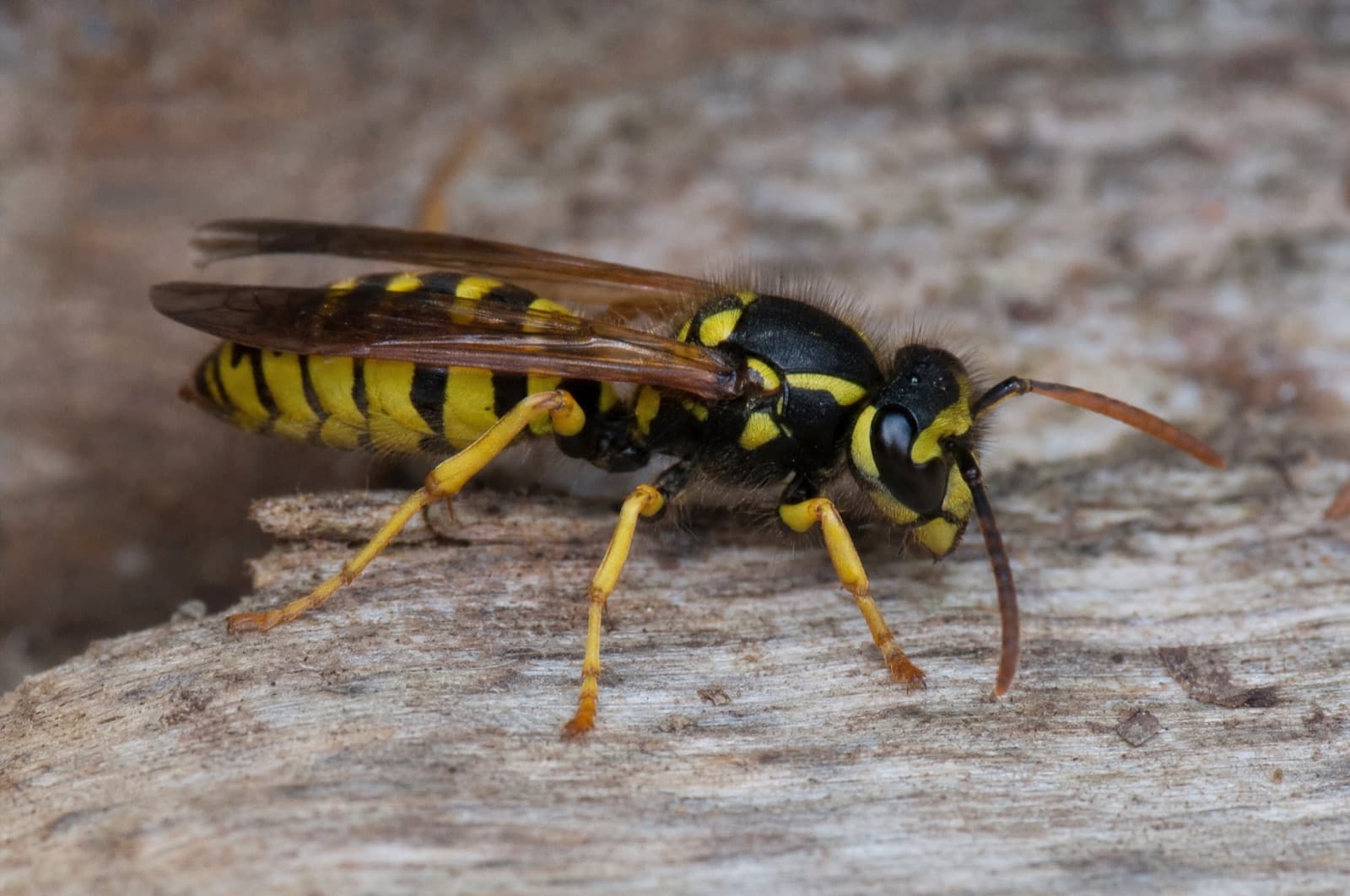
Yellowjacket — Quick ID for New Hampshire Homeowners
Also called Yellow jacket · Meat bee
Yellowjackets are stocky black-and-yellow colony wasps that nest in concealed spots — ground burrows, wall voids, and under decks. They are NH's most aggressive late-summer stinger. This is the fast identifier; for nest removal, sting safety, and late-summer behavior, see the full Yellowjackets guide.
- Size
- 10–16 mm
- stocky; Vespula and Dolichovespula spp.
- Nest
- Hidden — ground, void, or under deck
- never open like paper wasp
- Peak aggression
- Late summer
- large colony, food-competing
- Sting
- Repeated; no barb lost
- can sting multiple times
Is it a yellowjacket?
Yellowjackets are NH's most aggressive late-summer stinger and the wasp most likely to crash your cookout or nest inside your wall. Their concealed nests in the ground or wall voids make them especially hazardous to disturb without proper equipment.
This page is a fast identifier. For nest removal, sting safety, and late-season behavior, see the full Yellowjackets guide linked above.
Quick yellowjacket ID
A few features immediately distinguish yellowjackets from the paper wasps and hornets they're often confused with.
Yellowjacket
- Scientific name
- Vespula spp. and Dolichovespula spp.
- Family
- Vespidae
- Size
- 10–16 mm
- Coloration
- Crisp black and bright yellow banded abdomen; no hair; shiny
- Habitat
- Ground burrows, wall and soffit voids, under decks, sheds, in trash receptacles
- Active season
- Spring colony founding through first hard frost (peak late summer)
- Diet
- Protein (insects, meat, carrion) for larvae; adults also seek sweets and sugary drinks
- Lifespan
- Colony lives one season; only fertilized queens overwinter
Common throughout New Hampshire; peak colony size and activity late July through October.
The tells — key ID features
- Stocky, compact body — chunky compared to the slim-waisted paper wasp — with legs tucked in fast flight.
- Crisp bright yellow and black banding; shiny, no hair.
- Concealed nest: in the ground, a wall void, or under a deck/shed — never an open comb.
- Bold at outdoor food and drinks; stings repeatedly without losing a barb.
Paper wasp
How to tell — Paper wasps are slimmer with a narrow pinched waist, dangle long legs in flight, and build an open umbrella comb — no outer shell.
Bald-faced hornet
How to tell — Bald-faced hornets are larger and black-and-white, and build a distinctive enclosed gray football nest in trees or eaves.
Signs of a problem
Watch for steady traffic at a hidden entry point.
Steady wasp traffic flying in and out of a ground hole or a gap in siding, soffit, or deck
What it means — Concealed yellowjacket nest below or inside — colony is established.
Wasps swarming a soda can, grill, or trash bin in late summer
What it means — Foraging yellowjacket workers — a colony is somewhere nearby.
Yellowjacket removal in New Hampshire
Yellowjacket nests in walls, voids, and the ground are best handled by a professional — disturbing a concealed nest triggers mass defensive stinging. Same-day service is available across southern NH. The full guide covers nest types, removal options, and sting safety.
When to call a pro
- A nest is in the ground, a wall void, or near an entry point.
- Aggressive activity near people or pets, especially in late summer.
- Anyone in the household has a known stinging-insect allergy.
- You cannot locate the nest entrance safely.
Not sure it's a yellowjacket?
A licensed NH technician can confirm the species and tell you honestly whether it's a DIY fix or a job for a pro — free inspection, same-day service across Southern New Hampshire.
Frequently asked questions
Sources(2)
- [1]UNH Cooperative Extension — Yellowjackets
NH presence, biology, sting behavior
extensionverified 2026-06-30 - [2]Anchor Pest — Yellowjackets Guide
full NH identification, removal, sting safety
industryverified 2026-06-30
Written & reviewed by
VerifiedDaniel Brady
NH-Licensed Pesticide Applicator · License #782664 (NHDAMF, RSA 430)
Daniel Brady is the New Hampshire–licensed applicator behind Anchor Pest Services, a family-owned pest control company serving the Manchester area since 2017.
Last updated 2026-06-30
New Hampshire pest control
Dealing with yellowjackets in your home?
Anchor Pest Services identifies and handles yellowjacket problems across southern and central New Hampshire. Family-owned since 2017, NH license #782664.
- NH-licensed applicators (#782664)
- Same-day service · free inspection
- Family-owned since 2017
Your next step
- Book a NH pro
Wasp Nest Removal in New Hampshire
Late-season nests are at their largest and most defensive. Safe, professional removal.
Book now - Next step
Can yellowjackets build nests inside walls?
Read the answer - Also relevant
Ground Wasps in NH — What's Nesting in Your Lawn?
Read the answer - Related guide
Paper Wasp — Quick ID for New Hampshire Homeowners
Read the answer - Also relevant
How Big Can Hornet Nests Get Before They Become a Serious Threat?
Read the answer - Also relevant
What happens if you leave a wasp nest in place?
Read the answer