
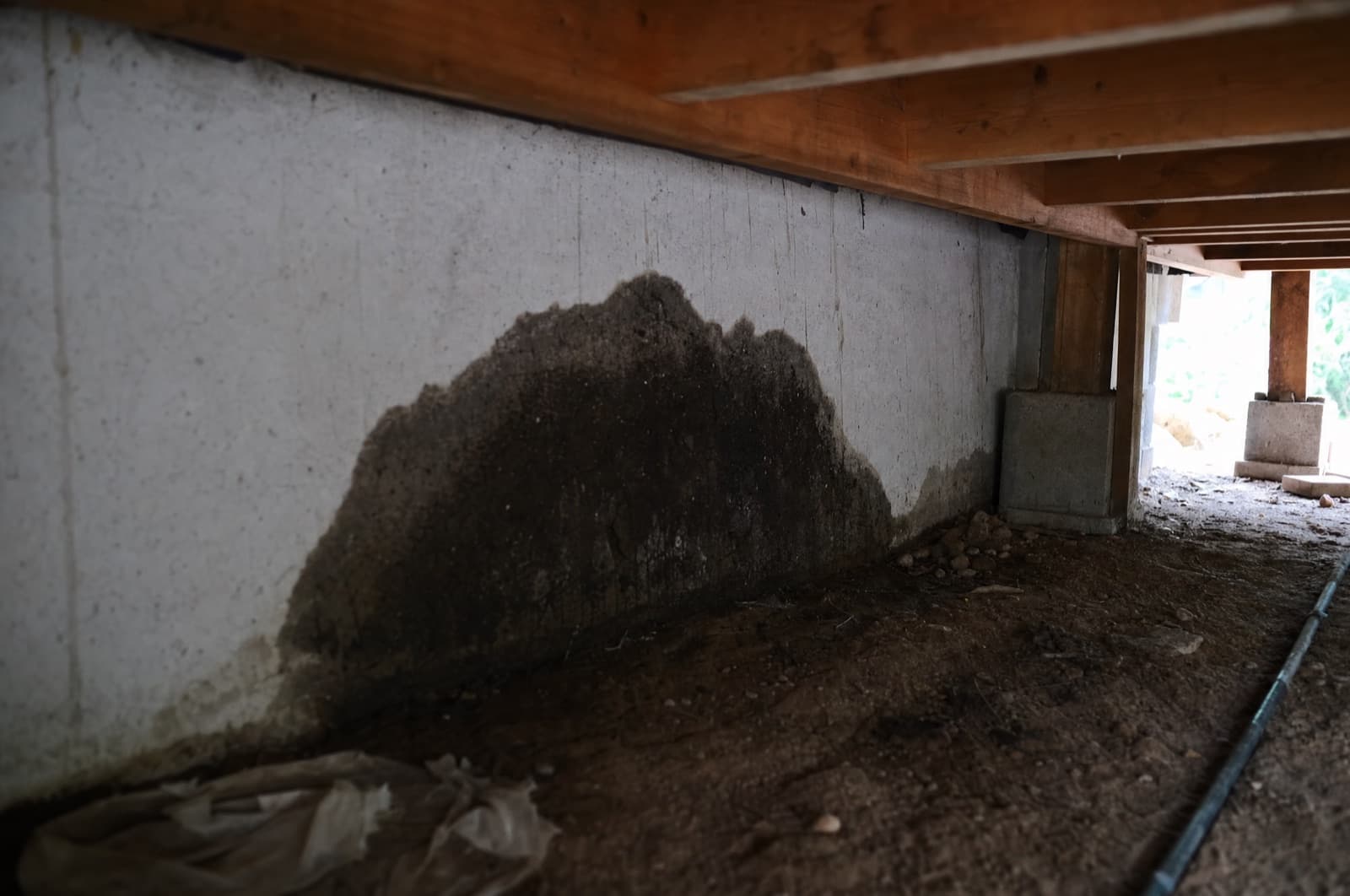
How to Prevent Termites in Homes with Mulch Piled Against the Foundation
This is a real but commonly overstated scenario — mulch does not 'attract' termites from a distance or feed a colony the way popular advice claims; university field research has found termites at equal rates under mulch and bare soil, and termites actually survive poorly on wood-based mulch as a food source.
Real risk, honestly graded: the actual problem with deep mulch against a wall is that it keeps soil moist and can bridge over the exposed inspection zone at the foundation — not that mulch is somehow a termite magnet. A simple clearance band fixes the real issue without giving up mulch in the yard.
At a glance
- What it is: Real termite risk
- The driver: Moisture retention and bridging over the inspection zone — not mulch as food
- Who fixes it: You can handle this
This is a real but commonly overstated scenario — mulch does not 'attract' termites from a distance or feed a colony the way popular advice claims; university field research has found termites at equal rates under mulch and bare soil, and termites actually survive poorly on wood-based mulch as a food source.
Real risk, honestly graded: the actual problem with deep mulch against a wall is that it keeps soil moist and can bridge over the exposed inspection zone at the foundation — not that mulch is somehow a termite magnet. A simple clearance band fixes the real issue without giving up mulch in the yard.
Pull the right lever, not the sprayer
The organism is downstream of one condition. Remove that condition and it has no foothold — which is why prevention here is rarely a pesticide.
The driver
Moisture retention and bridging over the inspection zone — not mulch as food
A University of Maryland structural IPM field study found termites detected at equal frequency beneath eucalyptus, hardwood, pine bark, pea gravel, and bare uncovered soil alike, with mulch-fed termites actually showing lower survivorship than controls — the genuine mechanism is that any mulch layer can hold soil moisture near the foundation, and mulch piled thicker than about 4 to 6 inches can physically bridge over a treated or inspectable perimeter band.
Source:University of Maryland (via Iowa State Extension)— Does landscape mulch lead to termites?
3 levers, honestly ranked
Sorted by what actually moves the driver — primary first, theatre last. Effort is graded so you know what's a five-minute fix and what's a real project.
- Primary — moves the driverQuick DIY
Maintain a mulch-free clearance band at the foundation
Keep at least a 12-inch-wide area next to the foundation free of mulch or other ground cover, per University of Florida IFAS Extension guidance. Within that zone, if you do use any mulch, hold it to about an inch thick and never pile it against the siding. This preserves the visible inspection gap, lets the perimeter soil actually dry between rain events, and prevents mulch from bridging over a treated or exposed foundation band — the specific, research-supported action, not 'avoid mulch everywhere.'
- SupportingQuick DIY
Keep mulch below the siding line and off any wood
Make sure mulch never actually touches wood siding, trim, or the sill plate, and keep at least 6 inches of the foundation itself exposed above any mulch bed elsewhere in the yard.
- OptionalWeekend project
Prefer inorganic ground cover directly next to the wall
Gravel or stone within that 12-inch clearance band eliminates the organic moisture layer entirely while still being easy to rake back for an inspection, if you want a lower-maintenance option than checking mulch depth each season.
Whose job is this, really?
Who actually fixes it
You can handle this
Adjusting mulch depth and clearance is ordinary yard maintenance, not a structural or pest-treatment task — a homeowner can fully manage this driver without hiring anyone.
A mud tube appears on the foundation behind or under mulch, or siding shows rot where mulch has been in contact with it — get a professional inspection at that point, since those are signs of activity, not just landscaping upkeep.
How this calibrates for NH
Northern climates like New Hampshire's already carry lower baseline termite pressure than the Southeast, but the 12-inch clearance rule is inexpensive insurance in the state's moderate termite-probability zone, and it prevents wood-siding decay regardless of whether termites are ever involved.
NH-licensed applicator #782664 (NHDAMF, RSA 430) · NEPMA member · family-owned since 2017.
Frequently asked
Sources(3)
- [1]University of Florida IFAS Extension
Termites and Mulch (Pinellas County)
- [2]Iowa State University Extension
Does landscape mulch lead to termites? (summarizing University of Maryland field study)
- [3]UF/IFAS (Oi)
Mulch and termite Q&A
Written & reviewed by
VerifiedDaniel Brady
NH-Licensed Pesticide Applicator · License #782664 (NHDAMF, RSA 430)
Daniel Brady is the New Hampshire–licensed applicator behind Anchor Pest Services, a family-owned pest control company serving the Manchester area since 2017.
Your next step
Anchor Pest Services
Have a different pest question?
This one may not be a pesticide job — but if you're facing something that is, we serve Southern New Hampshire with a free inspection and same-day service.
- NH-licensed applicator
- Same-day service
- Pet & family-conscious
NH License #782664 · No obligation · We answer in person