
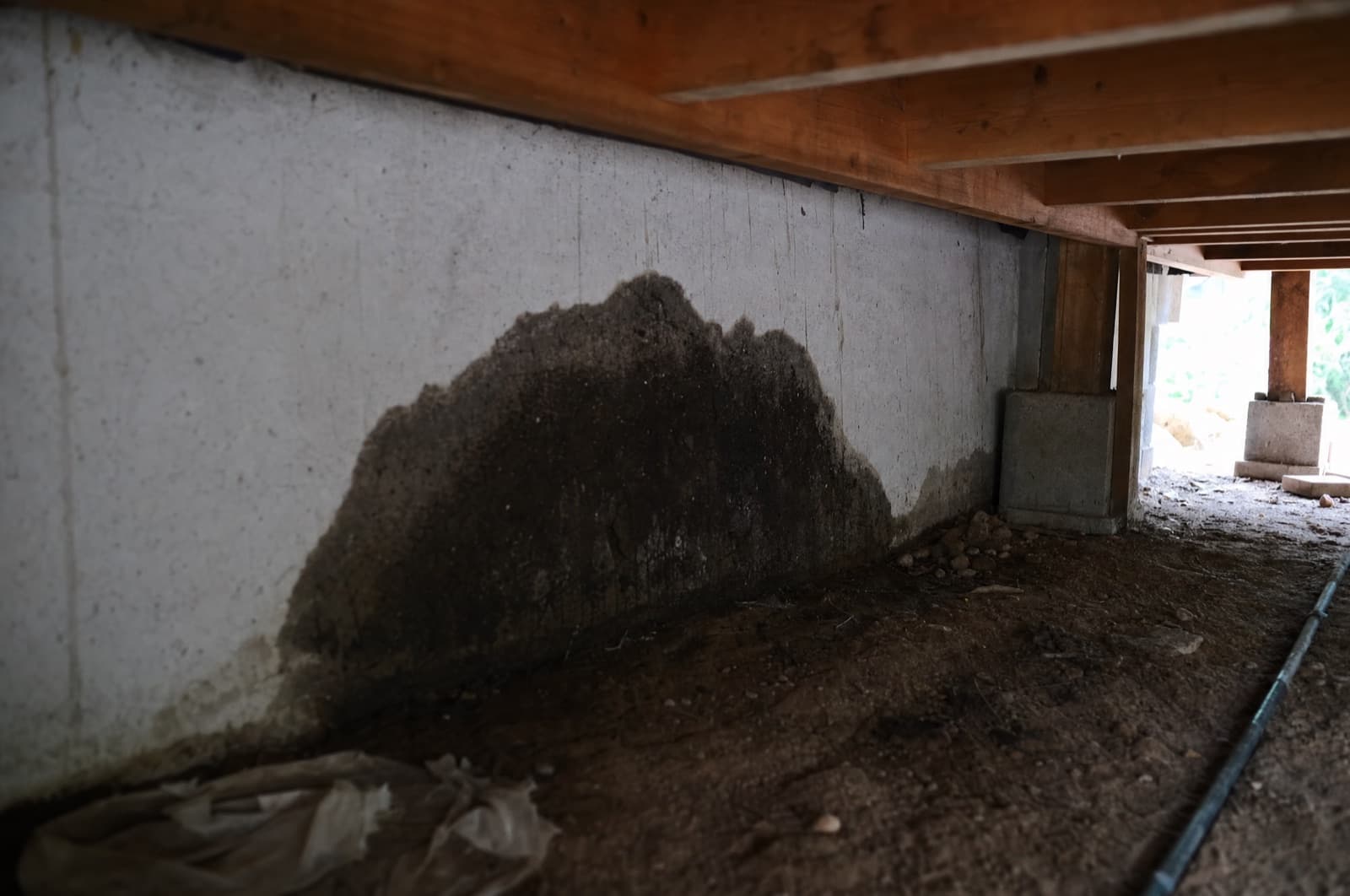
How to Prevent Termites When Replacing Subflooring and Floor Joists
This is a genuine risk, and replacing subfloor or joists usually means you've already found rot or damage — which makes this the definitive open-structure moment to determine whether termites contributed, remove the moisture cause, and design the replacement to stay dry and off the soil.
Real risk, but the replacement work itself is the prevention opportunity — the goal is making sure the new wood doesn't fail the same way the old wood did.
At a glance
- What it is: Real termite risk
- The driver: Moisture plus wood proximity to soil at the crawlspace or rim joist
- Who fixes it: A moisture or building pro
This is a genuine risk, and replacing subfloor or joists usually means you've already found rot or damage — which makes this the definitive open-structure moment to determine whether termites contributed, remove the moisture cause, and design the replacement to stay dry and off the soil.
Real risk, but the replacement work itself is the prevention opportunity — the goal is making sure the new wood doesn't fail the same way the old wood did.
Pull the right lever, not the sprayer
The organism is downstream of one condition. Remove that condition and it has no foothold — which is why prevention here is rarely a pesticide.
The driver
Moisture plus wood proximity to soil at the crawlspace or rim joist
Subfloor and joists over crawlspaces or near grade are the classic subterranean termite target — foraging workers build mud tubes up foundation walls to reach the sill and joists where wood stays damp. Extension entomology notes termites reach structural wood via tubes running from soil all the way up to sill plates and joists.
Source:University of Kentucky Entomology— ENT-605: Protecting Your Home Against Termites
4 levers, honestly ranked
Sorted by what actually moves the driver — primary first, theatre last. Effort is graded so you know what's a five-minute fix and what's a real project.
- Primary — moves the driverHire a pro
Identify and eliminate the moisture source driving the failure
Before installing new wood, find and fix why the old joists or subfloor failed — crawlspace humidity, plumbing or roof leaks, poor drainage, or a missing vapor barrier — because new wood placed into the same wet conditions will fail the same way. Install or repair a crawlspace vapor barrier and improve ventilation and grading so the space stays dry. Drying the space removes the condition subterranean termites need, not just the symptom you're replacing.
- Primary — moves the driverHire a pro
Maintain code clearances and inspect the exposed structure
With the floor open, probe remaining joists, the sill, and the rim joist for galleries and mud tubes, and set the replacement to standard clearance guidance — beams and joists at least eighteen inches above crawlspace soil, more in higher-hazard areas. This is the moment a licensed inspector can confirm whether the original damage was termite activity, decay, or both.
- SupportingHire a pro
Use treated wood for at-risk members and consider borate treatment via a pro
Treated wood in sills, joists, and subfloor elements provides additional protection, but Extension entomology is explicit that it should not be viewed as a stand-alone method. Borate treatment of new, dry framing is a recognized supplemental step, applied by a licensed applicator, that complements — rather than replaces — moisture control and clearance.
- SupportingHire a pro
Seal foundation cracks and utility penetrations
Reduce hidden entry routes from soil to the new framing by sealing foundation cracks and utility penetrations while the area is accessible, rather than leaving them for after the floor is closed back up.
Whose job is this, really?
Who actually fixes it
A moisture or building pro
A contractor or moisture professional handles the structural replacement and the underlying moisture fix; a pest professional's role is confirming whether termites were involved and making any treatment decisions before new wood is installed.
Active galleries, mud tubes, or swarmers are found during teardown — get a pest professional's assessment before installing new wood over the same conditions.
How this calibrates for NH
Crawlspace moisture control is the dominant prevention lever in New Hampshire's climate — it addresses decay, mold, and the subterranean termite's moisture requirement all in one fix, which matters in a region where the termite persists but only where sustained dampness and wood-to-soil contact allow it.
NH-licensed applicator #782664 (NHDAMF, RSA 430) · NEPMA member · family-owned since 2017.
Frequently asked
Sources(4)
- [1]University of Kentucky Entomology
ENT-605: Protecting Your Home Against Termites
- [2]University of Maryland / Maryland Dept. of Agriculture
Termites and Ants
- [3]Building America Solution Center (DOE/PNNL)
Termite-Resistant Foundations and Walls
- [4]Mississippi State University Extension
Methods of Termite Control
Written & reviewed by
VerifiedDaniel Brady
NH-Licensed Pesticide Applicator · License #782664 (NHDAMF, RSA 430)
Daniel Brady is the New Hampshire–licensed applicator behind Anchor Pest Services, a family-owned pest control company serving the Manchester area since 2017.
Your next step
- termite-mite-prevention-guides
Preventing termites during a kitchen remodel involving cabinets and subfloor
Read the answer - termite-mite-prevention-guides
Preventing termites in a crawl space
Read the answer - termite-mite-prevention-guides
Preventing termites with crawl space insulation and a vapor barrier
Read the answer - faq-pest-damage-and-risks
Can termites damage flooring or wall supports?
Read the answer
Anchor Pest Services
Have a different pest question?
This one may not be a pesticide job — but if you're facing something that is, we serve Southern New Hampshire with a free inspection and same-day service.
- NH-licensed applicator
- Same-day service
- Pet & family-conscious
NH License #782664 · No obligation · We answer in person