
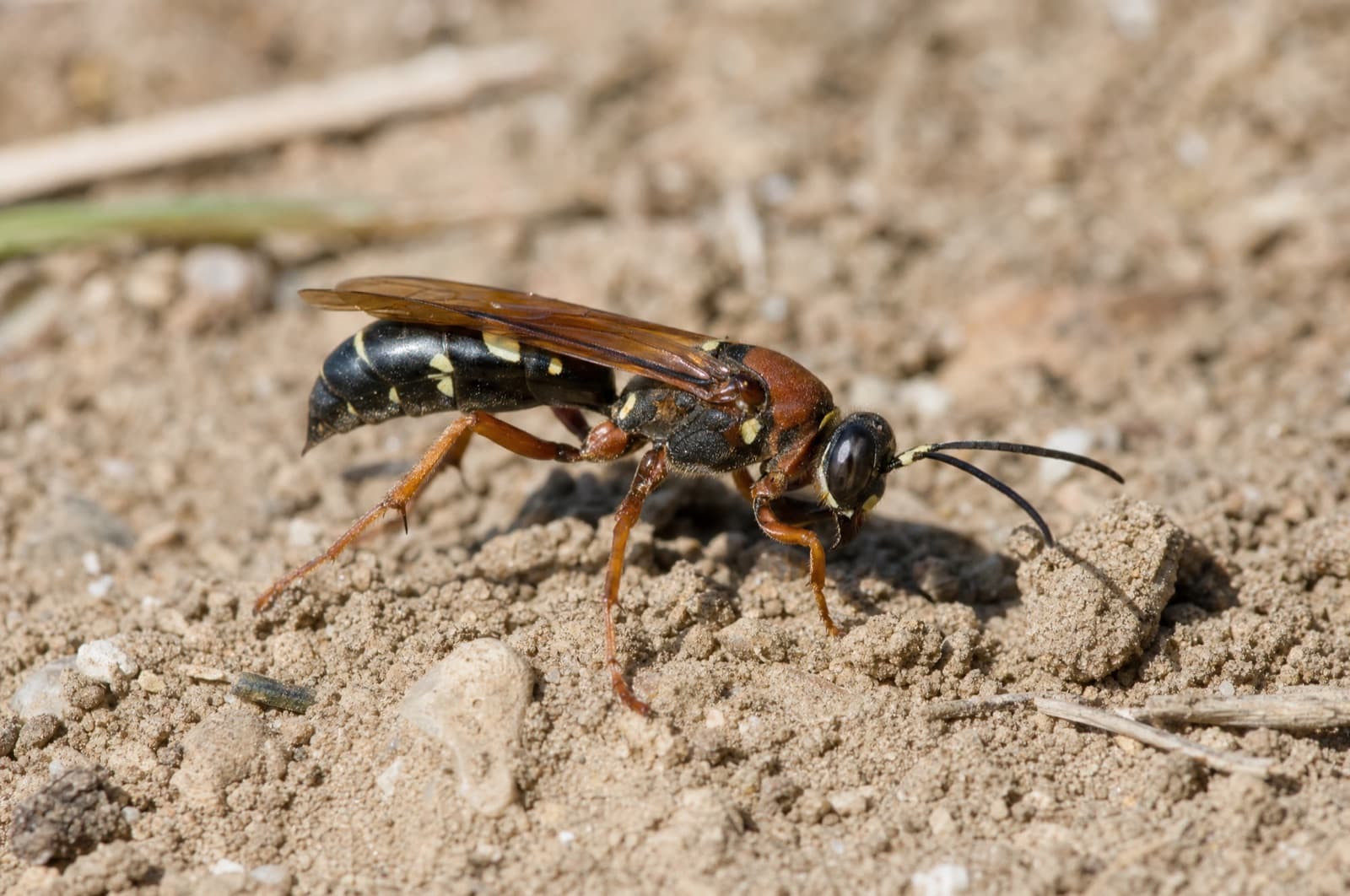
What Attracts Cicada Killer Wasps to Your House?
At a glance
- Short answer: Cicada killer wasps aren't drawn to your house — they're drawn to bare, sandy soil in full sun nearby.
- The verdict: Something specific
The attractant verdict
Four possible answers to why this species turned up. Three stay unlit — and that's the argument: the honest answer could have been any of them, and for this species it wasn't.
Cicada killer wasps aren't drawn to your house — they're drawn to bare, sandy soil in full sun nearby.
Our own previous page said cicada killer wasps are attracted ‘primarily because of the environment and resources they need for survival and reproduction’ — true but vague. The specific condition that matters is soil, not the house.
Female cicada killers dig individual nesting burrows exclusively in well-drained, light-textured (often sandy) soil in full sun — bare patches along driveways, in thin lawns, sandy garden beds, or open slopes. Dense turf makes digging difficult and largely excludes them, which is why nests cluster in exactly the bare, sunny spots a lawn doesn't quite cover.
“Cicada killer wasps don't want your house. They want bare, sun-baked, sandy soil to dig into — and a thin patch of lawn gives them exactly that.”
Bare, well-drained, light-textured soil in full sun — the one substrate female cicada killers will dig a nesting burrow into.
It reframes the question from ‘what does the house offer’ to ‘what does the yard's soil and turf condition offer’ — dense, healthy turf essentially excludes them, so the fix is a soil and lawn-cover question, not a structural one.
Calibrated from: Purdue University Extension Entomology, Publication E-254, 'Cicada Killers': females 'dig a burrow in well drained, light textured soil, in an area with full sunlight.'
Why it's here, in full
Why soil, not the house, is the actual attractant
Cicada killer wasps are solitary — each female digs and provisions her own burrow rather than joining a colony — and the deciding factor in where she digs is the soil itself: loose, well-drained, light-textured ground in full sun, the kind found in bare patches along a driveway, a thinning lawn, or an exposed slope. Dense, well-established turf is difficult to excavate and largely keeps them out, which is why burrows cluster in exactly the spots where grass cover has thinned rather than spreading evenly across a yard. None of this has anything to do with the house; a structure next to a patch of bare sandy soil in full sun will see cicada killer activity regardless of anything about the building itself.
How to tell it's actually this species
Real signs only — a species with four honest tells gets four, and stops. Where a sign is weak on its own, we say so.
A roughly 1.5-inch round burrow entrance in bare or thinning soil, often with a small mound of excavated dirt beside it
Large wasps, an inch or more long, flying low patrol routes over bare soil or thin turf through mid-to-late summer
Several burrows clustered together in the same bare, sunny patch of ground, sometimes numbering a few dozen in one area
Could be something else: Clustered ground burrows can also belong to other solitary ground-nesting bees or wasps; the sandy, sun-exposed location is the stronger clue for cicada killers specifically.
Want cicada killer wasps gone?
This page only answers why it's here. Every removal step for this exact species — what to seal, what to set, what actually works — lives on its own dedicated guide.
Two questions, two pages
Here: why it turned up at all — the honest answer, blame removed.
There: the step-by-step removal guide for this exact species.
Already dealing with cicada killer wasp?
This page is about why it's there. Getting rid of it is covered at /top-diy-methods/cicada-killer-wasp.
Frequently asked
Sources(2)
- [1]Purdue University Extension Entomology — Cicada Killers (E-254)
Females dig burrows in well-drained, light-textured soil in full sun; dense turf excludes them
extensionverified 2026-07-17 - [2]NC State Extension — Cicada Killer Wasps in Turf
Bare or thinning turf in sunny areas is the preferred nesting substrate
extensionverified 2026-07-17
Written & reviewed by
VerifiedDaniel Brady
NH-Licensed Pesticide Applicator · License #782664 (NHDAMF, RSA 430)
Daniel Brady is the New Hampshire–licensed applicator behind Anchor Pest Services, a family-owned pest control company serving the Manchester area since 2017.
Last updated Jul 2026
Food, water, warmth, shelter — the usual four
If it's already inside, we handle the rest
Same-day inspections across southern and central New Hampshire.
- Family-owned in Manchester since 2017
- NH commercial applicator #782664, category F1
- We will tell you when the answer is do nothing
NH License #782664 · No obligation · We answer in person
Your next step
- What to do next
Cicada Killer Wasp — Quick ID for New Hampshire
Read the answer - What to do next
Ground Wasps in NH — What's Nesting in Your Lawn?
Read the answer - What to do next
What Do Wasps Eat? Wasp Diet & Why They Crash NH Cookouts
Read the answer - In your area
Where Do Wasps Go in the Winter? NH Wasp Timing Guide
Read the answer