
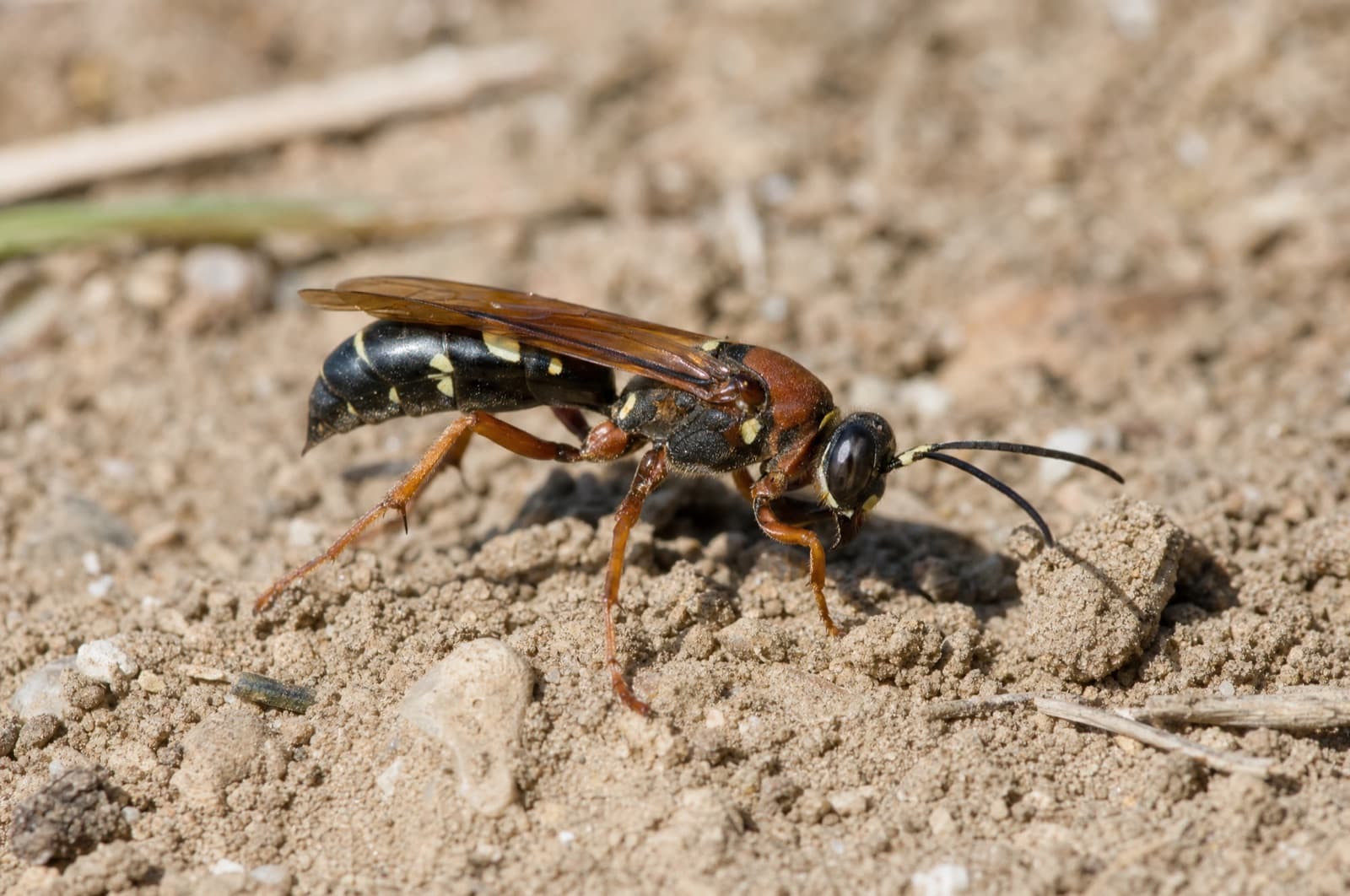
How to Get Rid of Cicada Killer Wasps
At a glance
- Difficulty: Beginner
- Time: An afternoon of lawn care, or none at all if you choose to tolerate them
- Cost: Low — grass seed, mulch, or nothing
- Success: High — tolerance or simple turf/soil changes resolve most situations
Can you DIY Cicada Killer Wasp?
The verdict on Cicada Killer Wasp DIY
DIY-friendly — and often the honest answer is you don't need to do anything at all.
The eastern cicada killer is one of North America's largest wasps at 1.5–2 inches, and that size scares people into thinking it's dangerous — it's the opposite. This is a SOLITARY, ground-burrowing wasp that doesn't defend its burrow the way social wasps do. The large males that patrol and dive-bomb people have no stinger at all; entomologist Justin Schmidt calls the species "gentle giants of the wasp world." Females have a stinger used to paralyze cicadas but sting only if mishandled or stepped on. For most homeowners, tolerating a burrow or two, or making the lawn less attractive to nesting, is all that's needed.
The 5 DIY methods — honestly graded
Every approach graded for this species, in IPM order — prevention first, chemistry late. Pick a method to see how it works, the steps, and what it actually takes.
Prevention / Exclusion
Works wellThe most reliable fix if you want fewer of them nesting — cicada killers strongly prefer bare, dry, sandy soil in full sun.
Cicada killers select bare, loose, well-drained soil for their burrows. Thickening turf, watering regularly, and mulching bare patches removes the soil conditions they're looking for, encouraging them to nest elsewhere.
Best for: Reducing nesting in a lawn or garden bed over a season
Thicken and water your turf
Overseed bare or thin patches and water regularly through summer — cicada killers avoid consistently moist, dense-turf areas.
Mulch bare, sandy patches
Cover bare soil near walkways, patios, or garden beds with mulch to remove attractive nesting substrate.
Fix drainage issues
Correct low spots or drainage problems that leave soil dry and loose in a way that draws nesting females.
Tools & materials
Why DIY falls short here
Not scare tactics — the specific, proportionate reasons a home attempt can stall for this species.
Fear-driven overreaction
People treat this "gentle giant" as a serious threat because of its size, spending effort and chemicals on a species that's genuinely low-risk and beneficial.
Recurring bare, sandy soil
Without turf and drainage fixes, the same bare patches re-attract new females year after year, undoing any one-time treatment.
Misidentification as the "murder hornet"
Cicada killers are sometimes confused with the Asian giant hornet, which causes needless alarm — the Asian giant hornet is not established in New Hampshire or the eastern U.S. at all.
How risky is it, really?
An honest read — most nuisance species are genuinely low risk, and we say so.
This species' size dramatically overstates its actual danger. Males cannot sting under any circumstances, and females — despite carrying a stinger built to paralyze cicadas — sting people only if handled or stepped on. Entomologist Justin Schmidt describes them as "gentle giants of the wasp world," and per National Geographic, a female's rare sting reportedly hurts less than a sweat bee's.
- Female sting if handled or accidentally stepped onRare
Reported as milder than a sweat bee sting; cicada killers do not defend their burrows the way social wasps do
Justin Schmidt (University of Arizona) / National Geographic
- Male "dive-bombing" that feels threatening but is harmlessOccasional
Territorial display only — males have no stinger and cannot sting under any circumstances
Purdue Extension
- Soil displacement from burrowing in lawns/gardensOccasional
The primary genuine nuisance — a cosmetic lawn issue, not a safety one
University of Kentucky Entomology
Even Low-Risk Pests Deserve an Honest Answer
Cicada killer wasps look alarming but are among the safest stinging insects to have in your yard. If you'd still like an assessment, Anchor Pest Services serves southern and central New Hampshire. Family-owned since 2017, NH license #782664.
Call a pro when…
- A large aggregation of burrows directly beside a walkway, patio, or play area you can't route around
- You'd prefer a professional turf/soil assessment to discourage nesting long-term
- Anyone in the household has a known stinging-insect allergy and wants extra caution (though baseline risk here is genuinely low)
General Pest Control
Most homeowners never need a pro for cicada killers — tolerance or simple turf changes resolve the situation. Anchor is available if a large aggregation sits somewhere you truly can't avoid.
Keep them out
- Maintain thick, well-watered turf through summer
- Mulch bare, sandy patches near walkways and beds
- Fix drainage issues that leave soil dry and loose
Cicada killer wasps in New Hampshire
In New Hampshire, cicada killer females dig burrows in bare, sunny, well-drained soil through mid-to-late summer (roughly July–September), provisioning each with paralyzed cicadas for their larvae. Activity winds down well before the first hard frost, around October 19–29 in Manchester (NOAA), and burrows can simply be filled and the turf improved once activity stops for the season.
Peak season
Mid-to-late summer (July–September)
First-frost anchor
Manchester first hard frost ~Oct 19 (50%) / Oct 29 (80%), NOAA 1991–2020
Make sure it's a Cicada Killer Wasp
Two quick detours worth taking — confirm the ID, then learn what drew it in so it doesn't come back.
Frequently asked
Sources & further reading(4)
- [1]Purdue Extension (E-254) — Cicada Killer Wasps
Males cannot sting, solitary non-defensive behavior
extensionverified 2026-07-13 - [2]University of Kentucky Entomology (EF004) — Cicada Killer Wasps
Biology, soil preference, nuisance from burrowing
extensionverified 2026-07-13 - [3]Missouri Department of Conservation — Eastern Cicada Killer Wasp
Species biology, tolerance guidance
govverified 2026-07-13 - [4]National Geographic — Cicada Killer Wasps Are Here
"Gentle giants" characterization; sting severity vs. sweat bee
newsverified 2026-07-13
Written & reviewed by
VerifiedDaniel Brady
NH-Licensed Pesticide Applicator · License #782664 (NHDAMF, RSA 430)
Daniel Brady is the New Hampshire–licensed applicator behind Anchor Pest Services, a family-owned pest control company serving the Manchester area since 2017.
Last updated July 2026
Other species you can tackle
Same category — the dot shows each one's DIY verdict at a glance (green = friendly, amber = doable with care, red = call a pro).
Professional Pest Control
Even Low-Risk Pests Deserve an Honest Answer
Cicada killer wasps look alarming but are among the safest stinging insects to have in your yard. If you'd still like an assessment, Anchor Pest Services serves southern and central New Hampshire. Family-owned since 2017, NH license #782664.
- Licensed NH applicators (#782664)
- Honest, non-fearmongering pest assessments
- Free inspection — same-day service across southern NH
NH License #782664 · No obligation · We answer in person
Your next step
- What to do next
Cicada Killer Wasp — Quick ID for New Hampshire
Read the answer - What to do next
Ground Wasps in NH — What's Nesting in Your Lawn?
Read the answer - What to do next
What Do Wasps Eat? Wasp Diet & Why They Crash NH Cookouts
Read the answer - Also relevant
What Attracts Cicada Killer Wasps to Your House?
Read the answer