
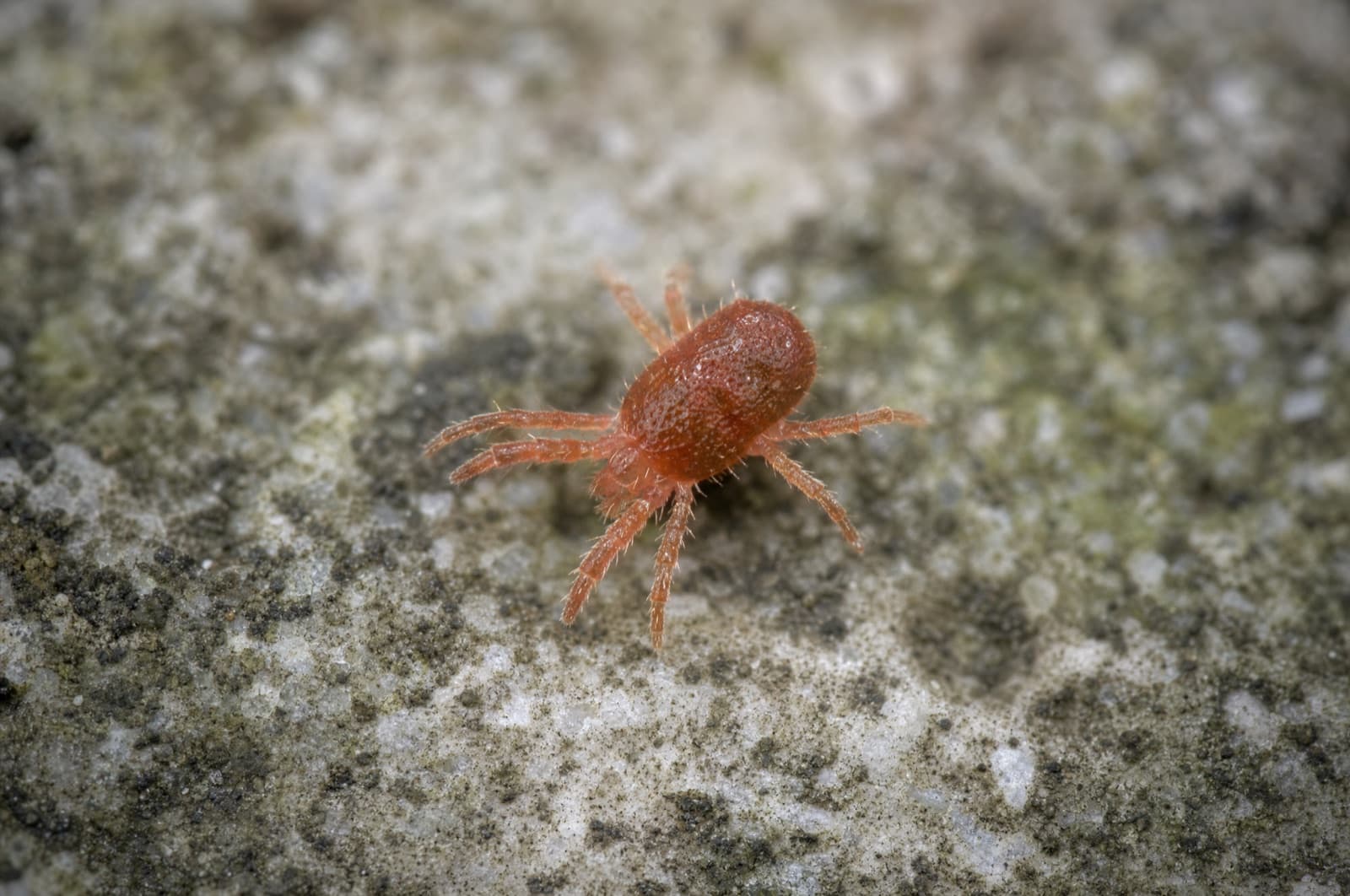
What Attracts Clover Mites to Your House?
At a glance
- Short answer: Clover mites are drawn to lush, well-fertilized grass right against the foundation — not the house itself.
- The verdict: Something specific
The attractant verdict
Four possible answers to why this species turned up. Three stay unlit — and that's the argument: the honest answer could have been any of them, and for this species it wasn't.
Clover mites are drawn to lush, well-fertilized grass right against the foundation — not the house itself.
Our own previous page said clover mites are attracted ‘mainly due to warmth, moisture, and the availability of food sources’ — vague enough to miss the one detail that actually predicts an infestation: the grass right at the foundation.
A dense, well-fertilized lawn growing directly against the foundation is the food source clover mites feed on. When that grass triggers a seasonal mass migration — commonly in spring and fall — mites move in huge numbers onto the nearest sun-exposed wall, and some end up squeezing through cracks, gaps, and window seals into the house.
“Clover mites don't want your house. They want the lush grass touching its foundation — and the wall next to that grass is just what they happen to climb.”
Heavily fertilized, lush grass or clover growing directly against the foundation — the mites' actual food source.
It moves the fix from the house to the yard: a bare strip or reduced fertilization right at the foundation line removes the food source driving the mass migration onto the wall in the first place.
Calibrated from: University of Missouri Extension, G7358, 'Clover Mites': 'A heavy growth of well-fertilized grass growing against the foundation of a house is often the source of an infestation.'
Why it's here, in full
Why the grass at the foundation is the real story
Clover mites feed on the sap of grass and clover, and populations build fastest in lawns that are lush, heavily fertilized, and growing in full sun — conditions gardeners often create deliberately right along a foundation for curb appeal. When a hard freeze, a dry spell, or simple seasonal timing pushes the population to migrate, huge numbers move off the grass and onto the nearest vertical surface, which is usually the sun-warmed wall of the house. A few then find their way in through window seals, cracks, or gaps. None of this depends on anything inside the house; it depends entirely on what's growing a few feet outside it.
How to tell it's actually this species
Real signs only — a species with four honest tells gets four, and stops. Where a sign is weak on its own, we say so.
Tiny reddish mites, visible mainly as moving reddish specks, massing on a sun-warmed wall in spring or fall
Small red or rust-colored stains on windowsills, curtains, or walls where crushed mites have left a mark
Could be something else: Similar small red stains can come from other tiny mites or insects; the timing (spring/fall) and the nearby lush grass are the stronger clues.
A noticeably thick, well-fertilized patch of lawn or clover growing right against the foundation on the sunniest side of the house
Want clover mites gone?
This page only answers why it's here. Every removal step for this exact species — what to seal, what to set, what actually works — lives on its own dedicated guide.
Two questions, two pages
Here: why it turned up at all — the honest answer, blame removed.
There: the step-by-step removal guide for this exact species.
Already dealing with clover mite?
This page is about why it's there. Getting rid of it is covered at /top-diy-methods/clover-mite.
Frequently asked
Sources(2)
- [1]University of Missouri Extension — Clover Mites (G7358)
Well-fertilized grass against the foundation as the primary source of infestation
extensionverified 2026-07-17 - [2]Iowa State University Extension — Clover Mite
Seasonal mass migration onto sun-exposed walls in spring and fall
extensionverified 2026-07-17
Written & reviewed by
VerifiedDaniel Brady
NH-Licensed Pesticide Applicator · License #782664 (NHDAMF, RSA 430)
Daniel Brady is the New Hampshire–licensed applicator behind Anchor Pest Services, a family-owned pest control company serving the Manchester area since 2017.
Last updated Jul 2026
Food, water, warmth, shelter — the usual four
If it's already inside, we handle the rest
Same-day inspections across southern and central New Hampshire.
- Family-owned in Manchester since 2017
- NH commercial applicator #782664, category F1
- We will tell you when the answer is do nothing
NH License #782664 · No obligation · We answer in person
Your next step
- Next step
Chemical Tick Control: Permethrin, Yard Sprays & Cat Safety
Read the answer - What to do next
Clover Mites in NH: Tiny Red Bugs That Don't Bite
Read the answer - What to do next
Bird Mites in New Hampshire: Bites Mean a Nest Nearby
Read the answer - Also relevant
Clover Mites in NH: Tiny Red Bugs That Don't Bite
Read the answer - Also relevant
How to Get Rid of Clover Mites
Read the answer - Also relevant
Do Mites Die in the Winter? NH Mite Activity Guide
Read the answer