
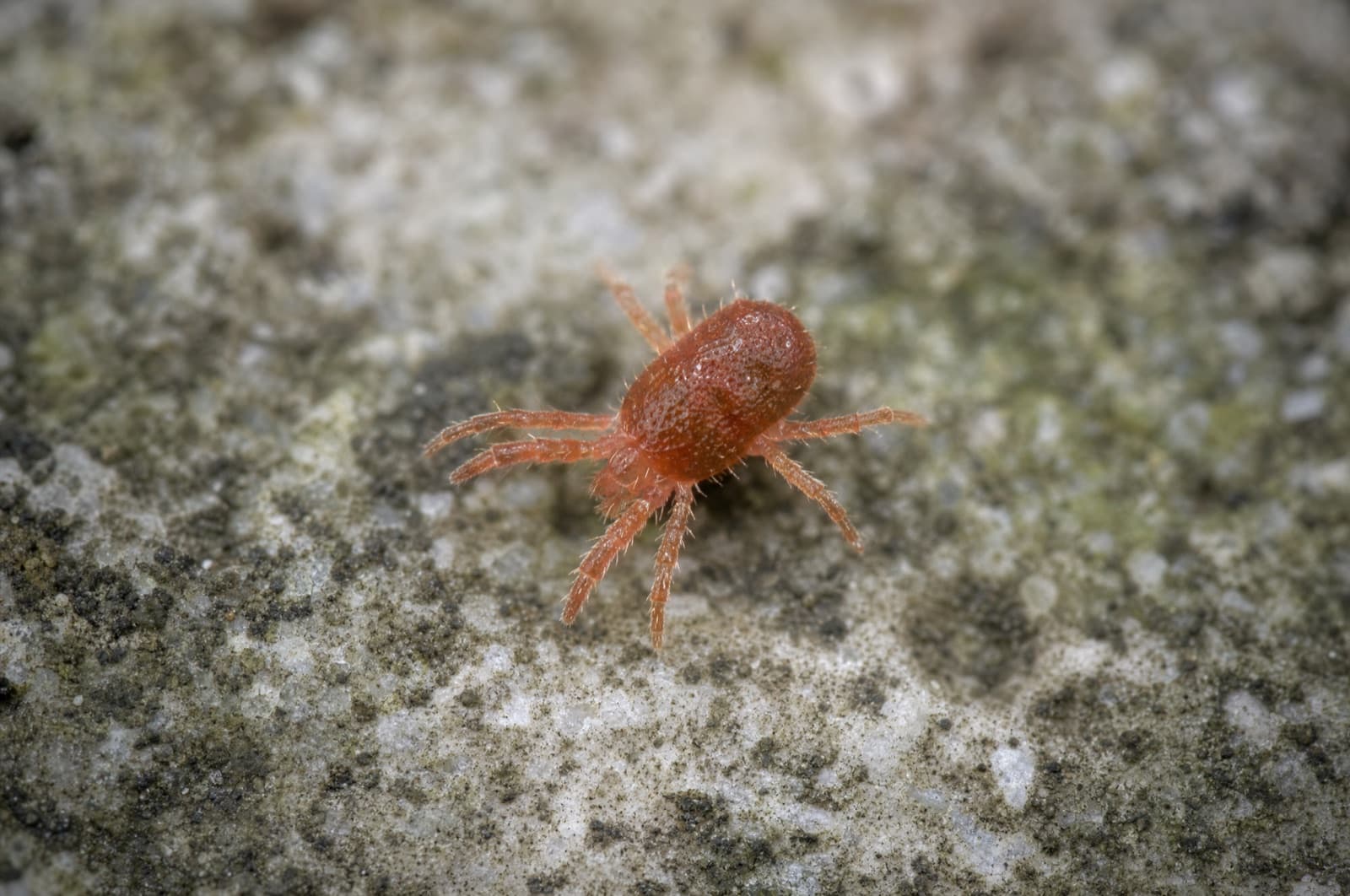
Clover Mites in NH: Tiny Red Bugs That Don't Bite
Clover mites (Bryobia praetiosa) are harmless reddish plant-feeders that swarm sunny NH foundations and windowsills in spring and fall. They do not bite, carry disease, or damage your home. The red smear left when they are crushed is their own body pigment — not blood — and the fix is vacuuming rather than swatting plus an 18–24-inch plant-free barrier at the foundation.
- Size
- <1 mm (a moving 'period')
- landscapeipm.tamu.edu
- Bite/disease?
- Neither — harmless plant-feeder
- does not feed indoors; landscapeipm.tamu.edu
- Red smear
- Body pigment, NOT blood
- emoyer.com
- Active range
- ~45–80°F (spring & fall)
- extension.umd.edu
- Reproduction
- Parthenogenetic, ~70 eggs per female
- no males known; extension.missouri.edu
The tiny red dots on your foundation — harmless, not a biting bug
Clover mites (Bryobia praetiosa) are harmless reddish plant-feeders that swarm sunny south- and west-facing foundations and windowsills in spring and fall in New Hampshire. They look alarming in large numbers but pose no threat — they don't bite, don't carry disease, and can't damage your home or belongings. Their only "harm" is the red stain left when they're crushed, which is the mite's own body pigment, not blood.
The fix is simple and non-toxic: vacuum them (don't swat), seal gaps around windows and the foundation sill, and maintain an 18–24-inch plant-free gravel or mulch band between the lawn and the wall. Classic NH scenario: masses of red specks on cedar siding or a sunny brick foundation in April or October, especially where a lush lawn meets the wall. They die indoors within days without breeding.
How to identify clover mites
Clover mites are tiny reddish-brown to greenish specks less than 1 mm across — about the size of a printed period — that move across sunny windowsills and foundations in spring and fall. Under magnification, their front pair of legs is distinctively longer than the rest and held forward, distinguishing them from spider mites (on plants), chiggers (which bite), and red velvet mites (much larger). They do not bite and leave a red stain when crushed.
Clover mite
- Scientific name
- Bryobia praetiosa
- Family
- Tetranychidae
- Size
- <1 mm
- Coloration
- Reddish-brown to greenish; long front legs
- Habitat
- Lawns, foundations, sunny south/west walls, windowsills
- Active season
- Spring and fall (approximately 45–80°F); inactive in summer heat and winter cold
- Diet
- Plant sap (grasses, clover, ornamentals)
- Reproduction
- Parthenogenetic; females lay ~70 eggs; no males known
- Lifespan
- Several weeks per generation (~30 days)
Throughout the US and southern Canada
The tells — key ID features
- Tiny reddish-brown moving dots on sunny walls and windowsills — the first thing homeowners notice
- Front pair of legs distinctively much longer than the rest, held forward — the definitive ID feature under magnification
- Congregate on south- and west-facing foundations, cedar siding, and window frames in spring and fall
- Leave a red stain (their own body pigment, not blood) when crushed — vacuum instead of swatting
Size, to scale
<1 mm
A speck of red dust or a 'moving period' on a printed page
Spider mite
How to tell — Spider mites live on plant leaves and cause stippling damage to foliage; they are found on plants, not on building foundations or interior windowsills.
Chigger
How to tell — Chiggers (Trombiculidae) are found in grassy, wooded areas and actually bite, causing intensely itchy welts. Clover mites do not bite.
Red velvet mite
How to tell — Red velvet mites are much larger (2–4 mm), velvety-textured, and typically found in garden soil; they are also harmless but noticeably bigger than clover mites.
Signs of a problem
Clover mites are a nuisance, not a threat. Here is what you are seeing and what it means.
Thousands of tiny red specks swarming a sunny foundation or windowsill in spring or fall
What it means — Harmless seasonal migration — clover mites are moving from the lawn toward wall cracks or escaping temperature extremes, not establishing an indoor infestation.
Red specks concentrated on the south- or west-facing wall
What it means — That wall receives the most sun and warms first in spring and fall — clover mites are drawn to warm surfaces in their 45–80°F activity range.
Migration heaviest where a lush lawn or dense ground cover meets the foundation
What it means — Over-fertilized or thick turf right at the wall edge provides abundant food and close proximity; the 18–24-inch bare-zone fix targets this directly.
Red stains on window frames or siding after swatting
What it means — Body pigment from crushed mites — not blood. Vacuum rather than swat to avoid staining.
The real risks, calibrated
Clover mites pose no health or structural risk. The only concern is cosmetic staining from crushing.
Cosmetic staining
Low riskOnset: Immediate when mites are crushed
The red pigment in their bodies stains window frames, painted siding, and light-colored surfaces. Vacuum instead of swatting to avoid marks.
DIY — what works, what backfires
Clover mite control is non-chemical and straightforward — focus on exclusion and a foundation barrier.
What actually works
- Vacuum clover mites indoors rather than swatting; immediately empty or seal the vacuum bag so they cannot escape.
- Install an 18–24-inch plant-free gravel or crushed-stone barrier between the lawn edge and the foundation — this removes both their food source and entry highway at the wall.
- Caulk gaps around windows, door frames, and foundation sill plates to reduce entry points.
- Avoid over-fertilizing lawn grass within several feet of the foundation, as dense, lush turf feeds larger mite populations.
What backfires
- Do not swat or crush clover mites on window frames or light-colored siding — the red pigment stains.
- Do not fog wall voids or spray insecticide indoors; the residue can stain more than the mites themselves (emoyer.com; extension.missouri.edu).
- Do not panic — clover mites die indoors within days and will not establish a breeding population inside your home.
Clover mites in New Hampshire homes
Clover mites are a classic spring and fall nuisance in southern NH. They are most visible on sun-warmed south- and west-facing foundations, cedar siding, and window frames — particularly around Manchester, Nashua, and Concord — when temperatures pass through the 45–80°F range. They die indoors within days and will not establish a breeding population inside. Over-fertilized or lush turf right at the foundation edge creates the largest populations.
Peak season
Spring and fall, when temperatures are in the 45–80°F range
You might actually have
- Spider mites (on plant leaves — these need separate control)
- Chiggers (actually bite; found in grassy areas)
- Red velvet mites (much larger; harmless)
We serve these communities
- NH-licensed applicator · #782664
- Same-day service
- Family-owned since 2017
Service Area Map
Southern New Hampshire
When to call a pro for clover mites
For persistent spring or fall swarms despite a foundation barrier and exclusion work, Anchor's General Pest Control team can apply a targeted perimeter treatment to interrupt the seasonal migration cycle.
When to call a pro
- Recurring spring and fall swarms despite installing a foundation barrier and sealing entry points.
- Large-scale migration entering through multiple gaps in an older or multi-unit building.
Maintain an 18–24-inch bare zone at the foundation
Keep a gravel or crushed-stone band — free of lawn, mulch, or dense ground cover — between the wall and turf. This single step eliminates both the food source and the entry highway.
Avoid over-fertilizing near the foundation
Thick, fertilized turf right at the wall edge supports large mite populations. Keep grass back from the foundation and moderate fertilizer use in that zone.
Seal foundation cracks and window gaps before spring
Caulk any gap at the sill plate, foundation, or window frame before the spring migration — typically as temperatures first hit 45°F in March or April in southern NH.
Not sure it's a clover mite?
A licensed NH technician can confirm the species and tell you honestly whether it's a DIY fix or a job for a pro — free inspection, same-day service across Southern New Hampshire.
Frequently asked questions
Sources(6)
- [1]Texas A&M AgriLife Extension — Clover Mites
size; no biting; no indoor feeding; harmless plant-feeder
extensionverified 2026-06-30 - [2]emoyer.com — Clover Mite Control
red smear is body pigment not blood; avoid crushing/fogging
industryverified 2026-06-30 - [3]University of Maryland Extension — Clover Mites
active temperature range ~45–80°F; spring and fall peaks
extensionverified 2026-06-30 - [4]University of Missouri Extension — Clover Mites
parthenogenetic; ~70 eggs; die indoors; 18–24-inch barrier
extensionverified 2026-06-30 - [5]University of Florida IFAS — Clover Mite (IN776)
die indoors within days; cannot breed inside
extensionverified 2026-06-30 - [6]NC State Extension — Clover Mite in Turf
turf biology and lawn-edge connection
extensionverified 2026-06-30
Written & reviewed by
VerifiedDaniel Brady
NH-Licensed Pesticide Applicator · License #782664 (NHDAMF, RSA 430)
Daniel Brady is the New Hampshire–licensed applicator behind Anchor Pest Services, a family-owned pest control company serving the Manchester area since 2017.
Last updated 2026-06-30

New Hampshire pest control
Dealing with clover mites in your home?
Anchor Pest Services identifies and handles clover mite problems across southern and central New Hampshire. Family-owned since 2017, NH license #782664.
- NH-licensed applicators (#782664)
- Same-day service · free inspection
- Family-owned since 2017
Your next step
- Fall guide
Fall Pest Control in New Hampshire
What matters before frost: the fall invader window, mice at the foundation, and what to seal first.
Read the answer - What to do next
How to Get Rid of Clover Mites
Read the answer - What to do next
What Attracts Clover Mites to Your House?
Read the answer - What to do next
Do Mites Die in the Winter? NH Mite Activity Guide
Read the answer - Related guide
Bird Mites in New Hampshire: Bites Mean a Nest Nearby
Read the answer - Related guide
Dust Mites in NH: The Allergen You Can't See or Find
Read the answer