
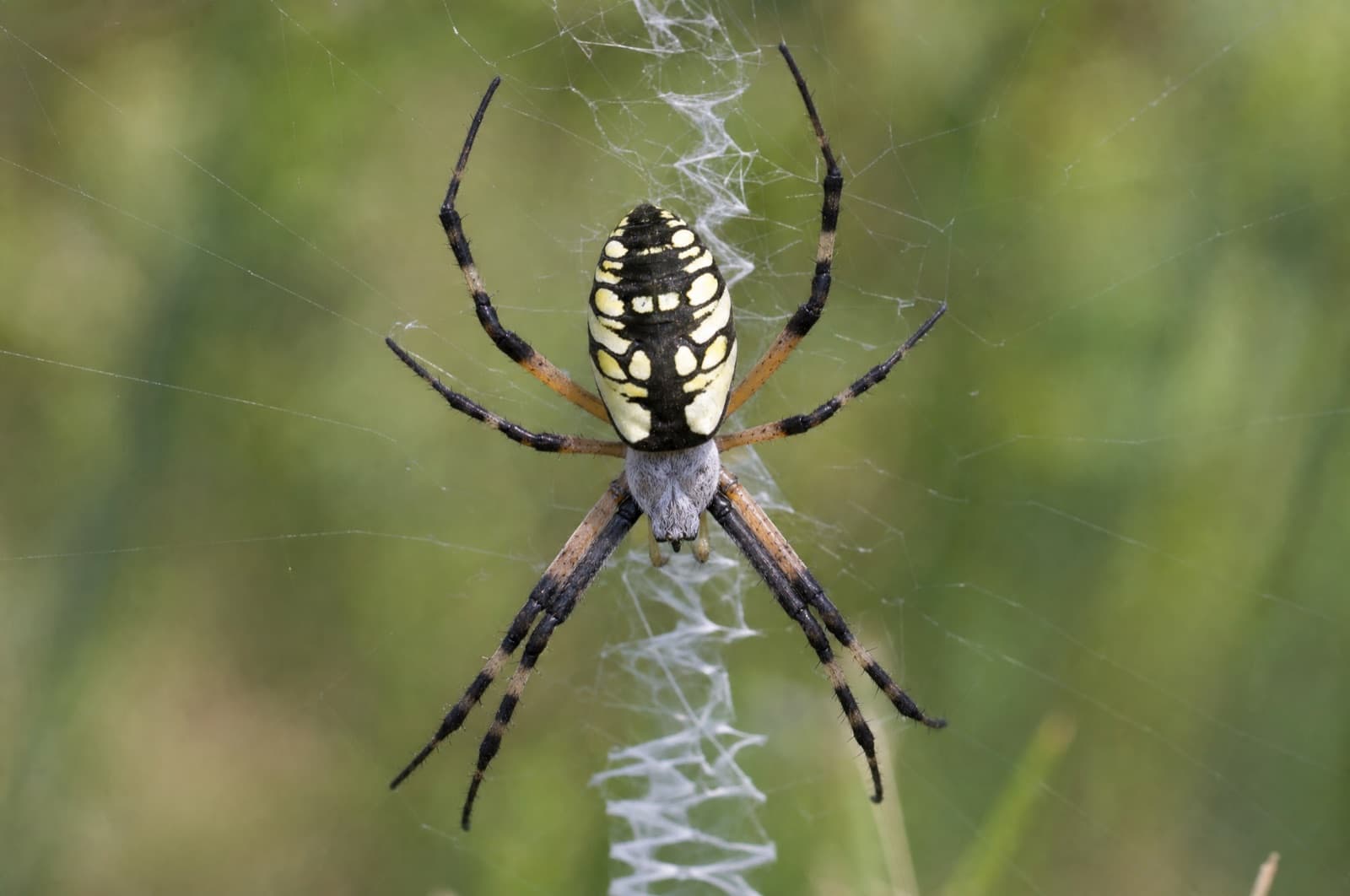
What Attracts Common Garden Spiders to Your House?
At a glance
- Short answer: Common garden spiders want prey and a web anchor point — nothing else is going on.
- The verdict: The usual four
The attractant verdict
Four possible answers to why this species turned up. Three stay unlit — and that's the argument: the honest answer could have been any of them, and for this species it wasn't.
This is the most common answer in this hub — an answer, not a shortfall.
Common garden spiders want prey and a web anchor point — nothing else is going on.
Our own previous page said the common garden spider is attracted ‘mainly because of the availability of food, shelter, and suitable environmental conditions’ — accurate, if vague; we're keeping the substance and tightening it.
A stable anchor point for a large orb web — between two plants, a porch railing and a post, eaves near an outdoor light — positioned where flying insects are plentiful. Outdoor lighting in particular concentrates the night-flying insects these spiders rely on, which is why webs often appear near porch lights.
“Nothing about a common garden spider is special. It wants a place to hang a web and insects flying past it — a porch light does both jobs at once.”
Why it's here, in full
Why food and a web anchor point explain it
Common garden spiders build large, semi-permanent orb webs and rely entirely on flying or jumping insects blundering into the sticky spiral, so they position webs wherever two things line up: a stable anchor between two fixed points, and a steady supply of insects nearby. Outdoor lighting is a frequent factor, since porch and yard lights draw in night-flying insects that then end up in a nearby web; dense garden vegetation does the same job during the day. Neither of those things is a property of the house itself — they're properties of the yard and the lighting around it, which is why a web often reappears in almost the same spot night after night.
How to tell it's actually this species
Real signs only — a species with four honest tells gets four, and stops. Where a sign is weak on its own, we say so.
A large, circular orb web with a dense zigzag pattern of silk in the center, usually rebuilt in the same spot each night
A web anchored between two fixed points — porch railings, plant stems, eaves — positioned near outdoor lighting or dense vegetation
The web's owner sitting head-down in the center of the web during the day, largely motionless
Want common garden spiders gone?
This page only answers why it's here. Every removal step for this exact species — what to seal, what to set, what actually works — lives on its own dedicated guide.
Two questions, two pages
Here: why it turned up at all — the honest answer, blame removed.
There: the step-by-step removal guide for this exact species.
Already dealing with common garden spider?
This page is about why it's there. Getting rid of it is covered at /top-diy-methods/common-garden-spider.
Frequently asked
Sources(2)
- [1]NC State Extension — Black and Yellow Garden Spider
Orb web construction and prey-based feeding behavior
extensionverified 2026-07-17 - [2]University of Florida IFAS — Yellow Garden Spider (EENY-743)
Web-site selection and beneficial predatory role
extensionverified 2026-07-17
Written & reviewed by
VerifiedDaniel Brady
NH-Licensed Pesticide Applicator · License #782664 (NHDAMF, RSA 430)
Daniel Brady is the New Hampshire–licensed applicator behind Anchor Pest Services, a family-owned pest control company serving the Manchester area since 2017.
Last updated Jul 2026
Food, water, warmth, shelter — the usual four
If it's already inside, we handle the rest
Same-day inspections across southern and central New Hampshire.
- Family-owned in Manchester since 2017
- NH commercial applicator #782664, category F1
- We will tell you when the answer is do nothing
NH License #782664 · No obligation · We answer in person