
Skip to content
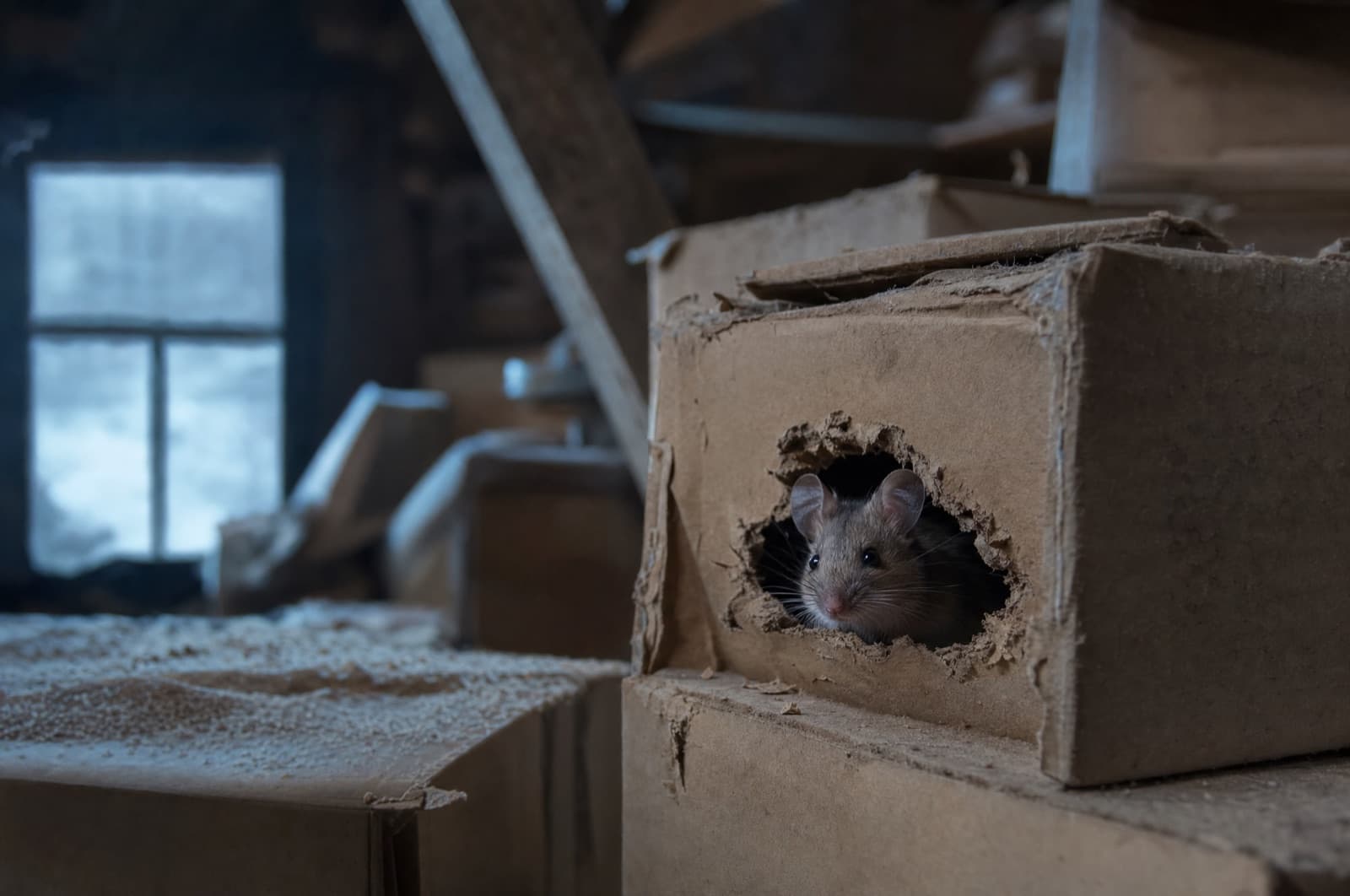
A house mouse in a gnawed cardboard storage box in a cold New Hampshire attic
Daniel Brady · NH-Licensed Pesticide Applicator · License #782664
Reviewed by Daniel Brady

How can I tell if I have rodents in my walls during winter?

Partial picture
In-wall rodents announce themselves by sound (scratching, scurrying, or gnawing concentrated after dark), by droppings and grease marks at wall exits -- along pipes, behind appliances, at foundation sill plates -- and sometimes by a pet repeatedly fixating on one spot.You can confirm activity is happening in or near a specific wall, but the interior of the cavity is invisible without opening it. The honest answer is that you monitor the exits, not the wall itself, and that's a real, useful partial picture rather than a full one.

At a glance

  • The verdict: Partial picture
The honest answer

The short of it

The verdict
Partial picture

You can confirm rodents are active inside a wall -- you cannot see into it. Sound and exit-point sign tell you where; the cavity stays invisible.

What you would actually see

The signs — and the honest limit

How much warning you get
Partial warning
  • Nocturnal scratching or scurrying localized to one wall or ceiling

    First weeks

    Rodents are nocturnal, so activity concentrated after dark is itself a diagnostic detail, not just an annoyance. A consistent location night after night suggests a runway or nest is nearby, even though the sound alone can't tell you exactly where inside the cavity.

    Easily confused with

    HVAC ductwork expanding and contracting with heat cycles, house settling, water pipes knocking, or squirrels and birds in an attic or soffit -- daytime activity points more toward squirrels or birds than rodents.

  • Droppings and grease marks at wall penetrations, sill plates, and along pipes

    Already established

    Extension guidance specifically recommends monitoring where mice exit walls -- along pipes, above drop ceilings, and on foundation sill plates -- because that's where evidence accumulates even though the interior stays hidden. Grease marks form from repeated contact with a rodent's oily fur along the same travel path.

    Easily confused with

    Construction debris left from original framing or plumbing work, or old staining unrelated to any current activity.

  • A pet repeatedly staring or pawing at one wall spot

    First weeks

    Pets can hear or smell activity behind a wall well before a person notices anything. Repeated, specific attention to one location -- not general curiosity -- is the pattern worth taking seriously.

    Easily confused with

    A pet reacting to an outdoor sound, another animal outside, or ordinary attention-seeking behavior unrelated to anything inside the wall.

What you cannot see
3
  • No one can see through drywall. You cannot see the nest, count the animals, or verify chewed wiring inside the cavity without opening it up or using a scope or thermal-imaging tool.
  • You cannot verify how the rodents are getting into that specific wall from sound or exit-point sign alone -- that requires tracing the exterior for the actual entry gap.
  • Any company that promises to tell you exactly "how many" rodents are in a wall from the outside is overselling. Confirming the species and the rough location is realistic; a wall-cavity census is not.
How often to actually look
Listen at the suspected wall for two to three evenings in a row to confirm the pattern is consistent rather than a one-off. Place non-toxic monitoring blocks or snap traps at the likely exit points -- along pipes, sill plates, behind appliances -- and check every few days. In New Hampshire, in-wall activity typically peaks following the first sustained cold, roughly November onward.
In depth

The full picture

01

What you can actually confirm from outside the wall

Sound is usually the first tip-off, and it carries real information: because rodents are nocturnal, scratching or scurrying concentrated after dark and localized to one section of wall or ceiling is a meaningfully different signal than random daytime noise. Extension guidance also directs attention to where mice exit walls rather than the wall itself -- along pipes, above drop ceilings, and on foundation sill plates -- because that's where droppings and grease marks accumulate even though the cavity interior never becomes visible.

A pet's behavior is an underrated sign. Dogs and cats can hear and smell activity a person can't detect, and repeated, specific attention to one wall spot -- not general curiosity -- often precedes a homeowner noticing anything themselves.

02

Why the wall cavity stays invisible, and why that's honest to say

No inspection method available to a homeowner, and few available to a professional without invasive tools, lets anyone see through drywall. That means you cannot get a population count, a precise nest location, or confirmation of chewed wiring inside the cavity from sign alone -- and any source that claims otherwise from the outside is overselling what's actually knowable.

What you can do is treat the exit points as a monitoring station: place snap traps or non-toxic monitoring blocks along pipes, sill plates, and behind appliances, and check them every few days. A caught rodent, or bait activity, confirms the population is using that exit -- which is useful, real information, just not a full picture of what's behind the drywall.

03

When a wall problem needs a professional look

Confirmed in-wall activity that persists despite trapping at the exit points, multiple walls showing sign at once, or activity you suspect has reached the attic or a wider void, are all past the point where sound and exit-point monitoring alone will resolve things. That's a fundamentally different job: locating the actual entry point from the exterior, and in some cases opening a section of wall or using a scope to confirm what's there -- work that requires tools and experience a homeowner typically doesn't have on hand.

Key takeaways
5 points
  • Nocturnal scratching localized to one wall, plus droppings or grease marks at pipes and sill plates, is real confirming evidence of in-wall activity.
  • Extension guidance specifically directs monitoring to wall EXIT points -- pipes, sill plates, drop ceilings -- since the cavity interior can't be inspected directly.
  • A pet repeatedly fixating on one wall spot is a useful early sign, since pets hear and smell activity before people do.
  • Nobody can see through drywall. Population size, exact nest location, and in-wall wiring damage require opening the cavity or a professional inspection to answer with confidence.
  • Confirming species and rough location from sound and exit sign is realistic; a wall-cavity census from the outside is not.
New Hampshire context

In-wall activity in a New Hampshire winter

In-wall rodent activity in southern New Hampshire typically picks up following the first sustained cold snap, roughly November onward, as the temperature differential between an unheated wall void and the warm interior of the house becomes more attractive to a rodent seeking shelter. Listening for two or three consecutive evenings once you notice anything unusual is a reasonable way to confirm a pattern before deciding how to respond.

If exit-point trapping over a week or two doesn't slow the activity, or if you're hearing sign in more than one wall, that's a reasonable point to bring in a professional inspection rather than keep monitoring exits that aren't resolving the underlying entry point.

  • NH-licensed #782664

    Southern New Hampshire

  • Family-owned

    Since 2017

  • Honest routing

    Even when it isn’t us

We serve these communities

ManchesterNashuaConcordDerryBedfordSalemHudsonAmherst

Hearing the same wall noise for more than two nights running?

That's a real pattern worth acting on. Exit-point trapping is a good first step; persistent activity despite trapping is worth a professional inspection.

Follow-up questions

Frequently asked

Sources & citations(3)
  1. University of Nebraska–Lincoln Extension — House Mouse (G1105)

    Monitoring at wall-exit points — pipes, sill plates, drop ceilings

    extensionverified 2026-07-16
  2. UNH Extension — How Can I Get Rid of the Mice in My House?

    Pet behavior as an early indicator of in-wall activity; sealing at entry points

    extensionverified 2026-07-16
  3. UC Statewide IPM Program — House Mouse

    Nocturnal behavior pattern used to distinguish rodent noise from mechanical noise

    extensionverified 2026-07-16

Written & reviewed by

Verified

Daniel Brady

NH-Licensed Pesticide Applicator · License #782664 (NHDAMF, RSA 430)

Daniel Brady is the New Hampshire–licensed applicator behind Anchor Pest Services, a family-owned pest control company serving the Manchester area since 2017.

Verify license

Last updated Jul 2026

Honest pest help for New Hampshire homes

We Won't Pretend to See Through Your Walls.

Nobody can tell you exactly how many rodents are behind your drywall from the outside -- we won't claim otherwise. Where Anchor Pest Services is genuinely useful is finding the actual entry point and confirming activity level with tools and experience a homeowner doesn't have. Family-owned since 2017, NH license #782664, serving Manchester, Nashua, Concord and nearby towns.

  • Honest advice — we'll tell you what's knowable and what simply isn't
  • NH-licensed applicators (#782664) — free inspection, same-day service
  • Rodent inspection and exclusion across southern and central New Hampshire

NH License #782664 · No obligation · We answer in person