
Are Asian Lady Beetles Good for My Garden?
At a glance
- The short answer: Both things are true
- How to tell: Behaviour, not colour — see The Split
- Where removal lives: We route it out — this hub owns identity
One animal, one honest answer
The verdict on Are Asian lady beetles good for my garden?
It's a genuinely effective aphid predator and a documented invasive that displaces native ladybugs — both are true at once, and neither cancels the other out.
Native ladybug vs. the Asian lady beetle
Two names, one animal. Both columns always render — and they always converge on the same resolution. The tell is behaviour, not colour.
The native ladybug
(the one you're picturing)
- Also an aphid predator, but present in the garden in far smaller numbers than it once was in many parts of the Northeast
- Does not aggregate on or inside houses to overwinter — it isn't the beetle massing on your siding each fall
The Asian lady beetle
(Harmonia axyridis)
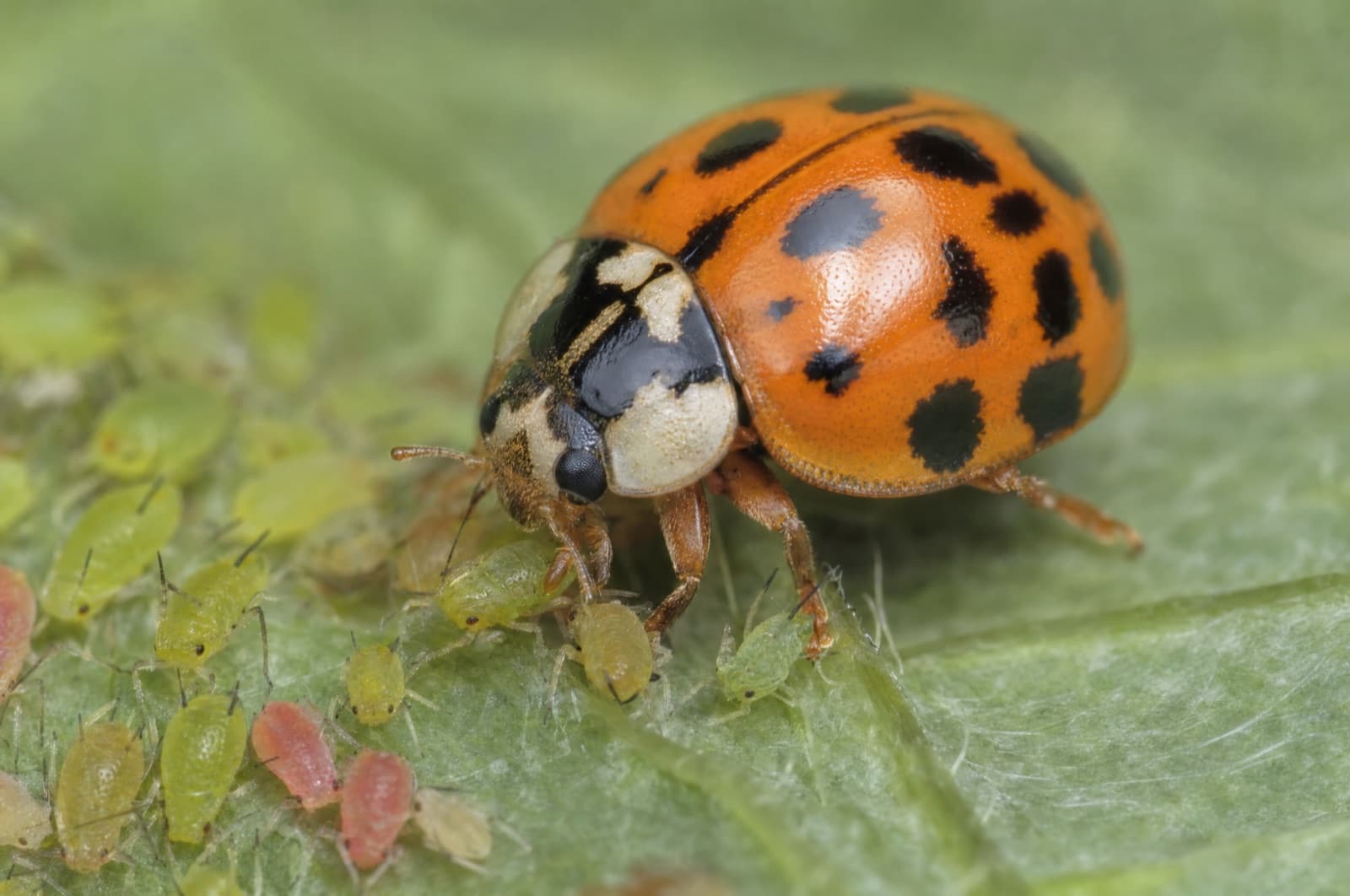
- An adult can eat roughly 90 to 270 aphids a day, and a single larva can consume 600 to 1,200 over its development — a real, deliberately introduced biological-control agent
- Colour runs pale yellow-orange to deep red to fully black — colour alone is a weak tell, not a diagnosis, and it says nothing about which garden role you're seeing
Whichever name you use, it's the same insect doing both things in the same garden: eating aphids effectively, and out-competing the native ladybugs that used to do the same job.
What's actually going on
Yes — it's a genuinely effective predator, and that's not spin
Harmonia axyridis is a generalist predator of aphids and other soft-bodied insects, and the underlying biology is well documented. Per the University of California Statewide IPM Program, because adults can live more than a year, a single individual can consume over 5,000 aphids or similarly sized prey across its larval and adult lifespan; a Cornell/Maine Department of Agriculture, Conservation and Forestry factsheet puts the daily rate at roughly 90 to 270 aphids for an adult and 600 to 1,200 over a larva's full development. This is not incidental — it's frequently the single most abundant predator attacking soybean aphid in North American fields, capable of both preventing and suppressing outbreaks, and a 2016 review in BioControl catalogued numerous documented cases of the species delivering real agricultural benefit, including historical control of pecan aphid complexes and strawberry, rose, and pine-scale infestations (Koch 2003). It was introduced to North America deliberately, more than once, specifically because this predation is real.
Also yes — it's a documented invasive that displaces native ladybugs
The same beetle is a strong intraguild predator and competitor: it preys on the eggs and larvae of other lady beetle species more often than the reverse, and its spread has coincided with sharp declines in natives. Coccinella novemnotata, the nine-spotted lady beetle, was once the most common lady beetle in the northeastern United States and is New York's state insect — comprehensive USDA APHIS surveys across eleven northeastern states in 1993 found none at all, a decline the New York Department of Environmental Conservation and the Xerces Society both track as part of a broader native-ladybug collapse coinciding with Harmonia axyridis's establishment. A 31-year Maine potato-field study (Alyokhin & Sewell 2004) documented significant declines in native lady beetles following the arrival of alien species, and long-term Swiss monitoring found Harmonia axyridis rising to 60 to 80 percent of hedge-ladybird communities while a once-dominant native, the two-spot lady beetle, nearly disappeared. Displacement, alongside effective predation, is the honest second half of this answer — not a footnote to soften.
Key takeaways
Both things are true: it's a genuinely effective aphid predator, and a documented invasive that displaces native ladybugs.
An adult can eat roughly 90 to 270 aphids a day; a larva can consume 600 to 1,200 over its development — real, deliberately introduced biological control.
Its spread has coincided with sharp native declines, including the near-disappearance of the nine-spotted lady beetle from the northeastern U.S.
This page replaces 13 of our own legacy pages that asked the beneficial and harmful questions separately instead of holding both at once.
These questions all land here
We asked this more than once, under more than one name, and printed more than one answer. There was only ever one — so here's what this page replaces.
Our old site asked whether they help gardens and whether they harm crops as if those were two different animals answering two different questions — including one page asking whether ladybugs eat 'Asian beetles,' a question that dissolves once you know they're the same family. Thirteen pages, one honestly two-sided answer.
Looking to get rid of them?
This hub answers what it is — not how to remove it. Most people who land here actually want one of these next steps, so we hand you straight to the hub that owns it.
Good for the garden, unwelcome on the wall.
Its aphid appetite is real and so is the fall aggregation on your siding — you don't have to pick a side on the ecology to want the second one handled.
Frequently asked
Sources & further reading(9)
- [1]UC Statewide Integrated Pest Management Program — "Multicolored Asian Lady Beetle"
An adult can consume over 5,000 aphids or similar-sized prey across its larval and adult lifespan
extensionverified 2026-07-17 - [2]Koch 2003 — Journal of Insect Science, "The Multicolored Asian Lady Beetle, Harmonia axyridis: A Review"
Documented biological control of pecan aphid complex, strawberry/rose aphids, and pine scale
academicverified 2026-07-17 - [3]Riddick 2016 — BioControl, "Reaping benefits from an invasive species"
Harmonia axyridis as the most abundant predator of soybean aphid, capable of preventing and suppressing outbreaks
academicverified 2026-07-17 - [4]New York State DEC — Species of Greatest Conservation Need Assessment, Nine-Spotted Lady Beetle
1993 USDA APHIS surveys found no nine-spotted lady beetles across eleven northeastern states
stateverified 2026-07-17 - [5]Xerces Society — Species Profile, Nine-Spotted Lady Beetle
Native lady beetle decline coinciding with the spread of invasive coccinellids
academicverified 2026-07-17 - [6]Roy et al. 2020 — Insects, long-term Swiss ladybird monitoring
Harmonia axyridis rising to 60-80% of hedge ladybird communities while Adalia bipunctata nearly disappeared
academicverified 2026-07-17 - [7]Alyokhin & Sewell 2004 — Biological Invasions, "Changes in a Lady Beetle Community Following the Establishment of Three Alien Species"
31-year Maine potato-field study documenting significant declines in native lady beetles following the arrival of alien species
academicverified 2026-07-22 - [8]Iowa State University Extension — "Ladybug, Multicolored Asian Lady Beetle"
Colour and spot-count variability of Harmonia axyridis
extensionverified 2026-07-17 - [9]UNH Cooperative Extension — Multicolored Asian Ladybug fact sheet
Beetles most numerous on sunny sides of NH buildings mid-September through early November; seal before mid-September
extensionverified 2026-07-17
Written & reviewed by
VerifiedDaniel Brady
NH-Licensed Pesticide Applicator · License #782664 (NHDAMF, RSA 430)
Daniel Brady is the New Hampshire–licensed applicator behind Anchor Pest Services, a family-owned pest control company serving the Manchester area since 2017.
Last updated July 2026
Honest pest ecology for New Hampshire homes
Thirteen Pages, One Two-Sided Answer
It's a real aphid predator and a real threat to native ladybugs — both are true, and we're not going to pretend otherwise to make a tidier headline. Family-owned since 2017, NH license #782664, based at 700 Harvey Rd in Manchester.
- NH-licensed applicators (#782664) — free inspection, same-day service
- We consolidated 13 of our own pages rather than answer 'beneficial' and 'harmful' as if they were different animals
- Family-owned, Manchester NH, since 2017
NH License #782664 · No obligation · We answer in person
Your next step
- Fall guide
Fall Pest Control in New Hampshire
What matters before frost: the fall invader window, mice at the foundation, and what to seal first.
Read the answer - What to do next
When Are Asian Lady Beetles Active? NH Ladybug Timing
Read the answer - What to do next
What Attracts Asian Lady Beetles to Your House?
Read the answer - What to do next
What do Asian lady beetles look like indoors?
Read the answer - Also relevant
Asian Lady Beetle in New Hampshire: Honest ID & What to Do
Read the answer