
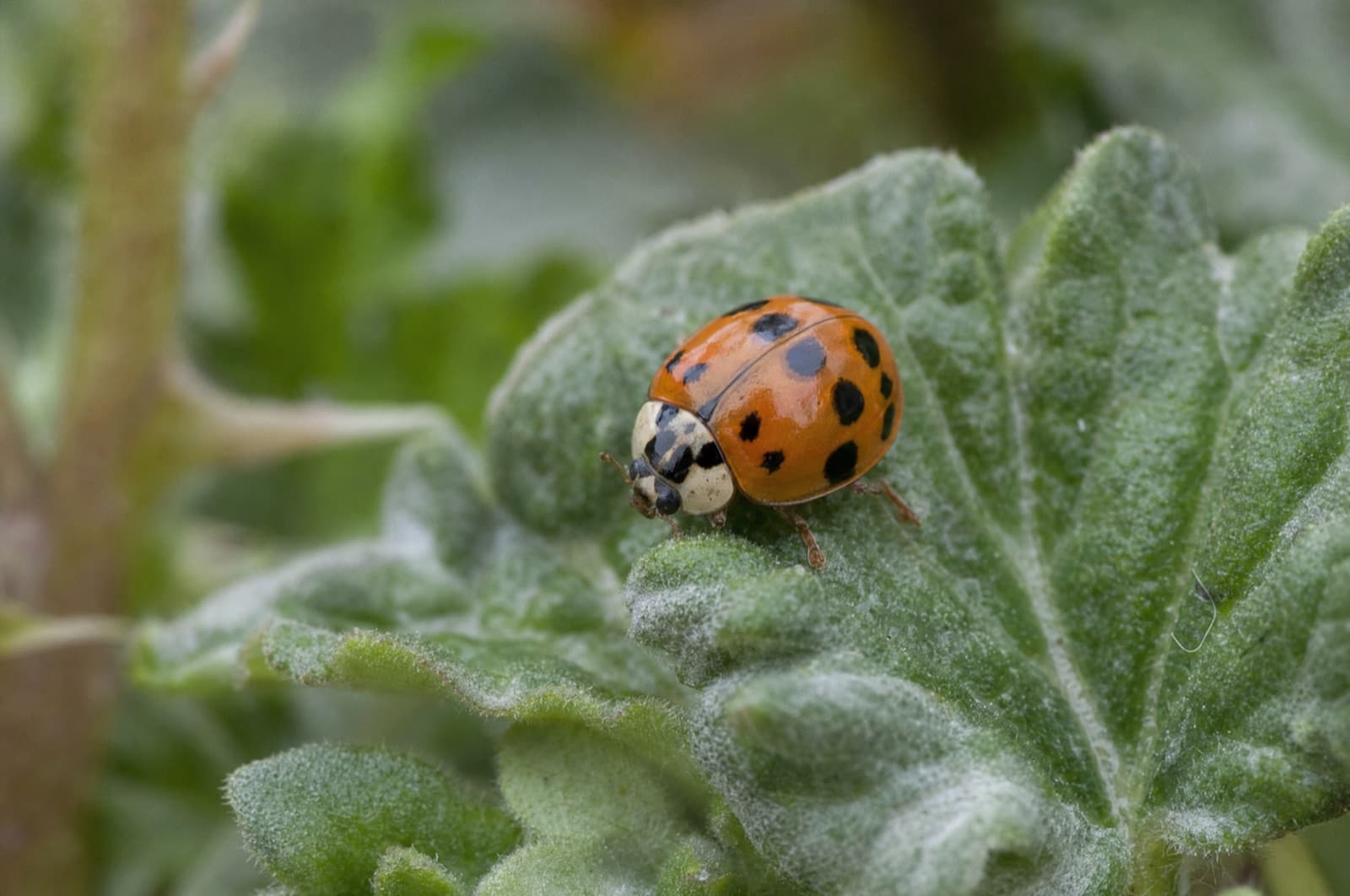
What Attracts Asian Lady Beetles to Your House?
At a glance
- Short answer: Asian lady beetles aren't chasing your house's warmth or your porch light. They're keying on visual contrast on a sunlit wall.
- The verdict: The belief is wrong
The attractant verdict
Four possible answers to why this species turned up. Three stay unlit — and that's the argument: the honest answer could have been any of them, and for this species it wasn't.
Asian lady beetles aren't chasing your house's warmth or your porch light. They're keying on visual contrast on a sunlit wall.
Our own previous page said Asian lady beetles are drawn to homes "primarily seeking shelter during the colder months," which is directionally right about the goal but silent on the actual mechanism — and the popular belief that fills that gap is usually that they're chasing warmth radiating off the wall, or your porch light.
A sun-exposed wall — commonly facing south or west — carrying high-contrast, dark-on-light linear features: painted trim against siding, gutters, drainpipes, or window frames. The beetle is seeking an overwintering site, and a peer-reviewed study found visual contrast, not warmth or light itself, is the cue that draws it to land there.
“It isn't your porch light, and it isn't heat coming off the wall. It's the contrast — a dark line against a light one — that tells the beetle where to land.”
High-contrast, dark-on-light linear silhouettes — painted trim against siding, gutters, drainpipes, window frames, or architectural shadows — on a sun-exposed wall. A controlled behavioral study found beetles are not visually attracted to the color white or to reflective surfaces per se, and questioned the older belief that bright, reflective walls themselves are the draw.
It means radiant heat is not the actual landing cue — the folk belief that lady beetles chase warmth off a sunny wall, or are drawn like moths to a porch light, misses the real mechanism. Warmth only explains when the beetles fly on a given afternoon, not where they choose to land.
Calibrated from: Nalepa, C.A., Kennedy, G.G. & Brownie, C. (2005), "Role of Visual Contrast in the Alighting Behavior of Harmonia axyridis (Coleoptera: Coccinellidae) at Overwintering Sites," Environmental Entomology 34(2):425-431, https://academic.oup.com/ee/article/34/2/425/461324
Why it's here, in full
The correction: contrast, not heat and not light
The most-cited peer-reviewed study on this exact question — Nalepa, Kennedy & Brownie (2005), published in Environmental Entomology — tested what actually draws Asian lady beetles to land on a surface at overwintering time. The result: beetles preferentially land on and near high-contrast, dark-on-light linear features — the seam where trim meets siding, a gutter line, a window frame, an architectural shadow — not simply on bright, light-colored, or reflective surfaces as the older belief held. The paper explicitly states the beetles are "not visually attracted to the color white per se," and calls into question the earlier assumption that shiny, reflective walls are themselves the draw.
That's a real, sourced correction to a common belief. It's also not what our own old page implied by leaving the mechanism unstated — readers left to fill in the gap usually land on "it's warm" or "it's the porch light," and the controlling study says neither is the operating cue for where a beetle lands.
Warmth still matters — just for timing, not for aim
None of this erases warmth from the picture; it just moves warmth to a different part of the explanation. Extension sources describe Asian lady beetle flights to buildings as happening on warm, sunny afternoons — often specifically after a cold snap — because that combination of temperature and light triggers the flight behavior in the first place. So warmth gates *when* the beetles take flight to look for overwintering sites; it is not what tells an already-flying beetle *where* to land. Once inside a wall void or attic, they don't feed and don't reproduce there — they're simply waiting out the winter, and midwinter heating can rouse dormant individuals into living spaces, which is often mistaken for a fresh infestation rather than the same population waking up.
How to tell it's actually this species
Real signs only — a species with four honest tells gets four, and stops. Where a sign is weak on its own, we say so.
Clusters of orange-to-red, black-spotted beetles gathering on an exterior wall on a sunny fall afternoon, especially near trim, corners, or window frames
Beetles found indoors along windowsills, in attics, or in wall voids during winter, especially after the heat comes on
Could be something else: Beetles rousing indoors during winter reflects an already-established overwintering population being warmed by household heat, not a new arrival.
A faint, unpleasant odor and occasional yellowish staining where clusters have been disturbed or crushed
Repeated fall aggregations concentrated on the same south- or west-facing section of the house year after year
Want asian lady beetles gone?
This page only answers why it's here. Every removal step for this exact species — what to seal, what to set, what actually works — lives on its own dedicated guide.
Two questions, two pages
Here: why it turned up at all — the honest answer, blame removed.
There: the step-by-step removal guide for this exact species.
Key takeaways
- It isn't your porch light, and it isn't heat coming off the wall. It's the contrast — a dark line against a light one — that tells the beetle where to land.
- It doesn't feed or breed indoors — it's only there for winter shelter.
- What actually matters: shelter, warmth.
- If it's already inside, removal is a different question — see /top-diy-methods/asian-lady-beetle.
Seeing lady beetle clusters on your walls each fall?
This page is about why they land there. Exclusion and removal options are covered at /top-diy-methods/asian-lady-beetle.
Frequently asked
Sources(2)
- [1]Nalepa, Kennedy & Brownie (2005) — Environmental Entomology 34(2):425-431
Visual contrast, not radiant heat or color, as the cue that draws Asian lady beetles to alight at overwintering sites
academicverified 2026-07-17 - [2]UF/IFAS Entomology — Multicolored Asian Lady Beetle (EENY-204)
Aggregation on south- and west-facing walls and flight timing tied to cold weather onset
extensionverified 2026-07-17
Written & reviewed by
VerifiedDaniel Brady
NH-Licensed Pesticide Applicator · License #782664 (NHDAMF, RSA 430)
Daniel Brady is the New Hampshire–licensed applicator behind Anchor Pest Services, a family-owned pest control company serving the Manchester area since 2017.
Last updated Jul 2026
It's the contrast, not the heat or the light
Dealing with lady beetle clusters every fall?
Same-day inspections across southern and central New Hampshire — we'll help identify entry points, honestly.
- Family-owned in Manchester since 2017
- NH commercial applicator #782664, category F1
- We will tell you when the answer is do nothing
NH License #782664 · No obligation · We answer in person
Your next step
- What to do next
Asian Lady Beetle in New Hampshire: Honest ID & What to Do
Read the answer - Also relevant
When Are Asian Lady Beetles Active? NH Ladybug Timing
Read the answer - In your area
What do Asian lady beetles look like indoors?
Read the answer - In your area
Do lady beetles bite or cause reaction?
Read the answer - Related guide
Are Asian Lady Beetles Good for My Garden?
Read the answer - Related guide
Why Do They Gather at Windows, Ceilings and Corners?
Read the answer