
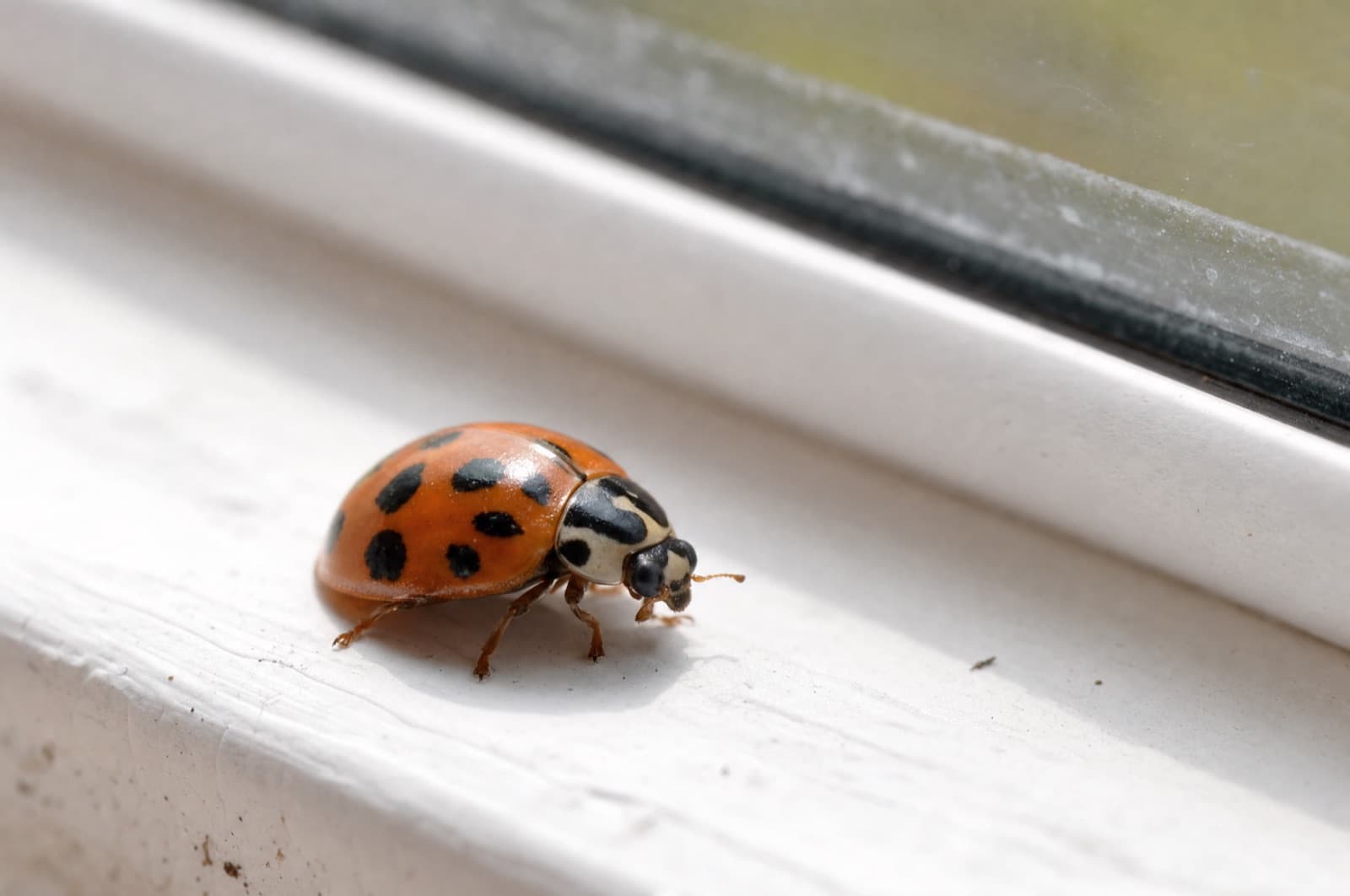
Do They Breed Indoors?
At a glance
- The short answer: No — they don't breed indoors
- How to tell: Behaviour, not colour — see The Split
- Where removal lives: We route it out — this hub owns identity
One animal, one honest answer
The verdict on Do they breed indoors?
The beetles in your wall void aren't raising a family in there — they entered winter dormant, on stored fat, with reproduction switched off.
Native ladybug vs. the Asian lady beetle
Two names, one animal. Both columns always render — and they always converge on the same resolution. The tell is behaviour, not colour.
The native ladybug
(the one you're picturing)
- Overwinters outdoors in leaf litter, under bark, or under rocks — it was never inside your house to begin with, breeding or otherwise
- Does not aggregate on or inside structures to spend the winter
The Asian lady beetle
(Harmonia axyridis)
- Shelters inside wall voids and attics over winter, but enters that shelter with an empty digestive tract and undeveloped reproductive organs
- Colour runs pale yellow-orange to deep red to fully black — colour alone is a weak tell, not a diagnosis
Whichever name you use, the beetle in your wall void isn't raising a family in there. Both are ladybugs, and neither one breeds indoors.
What's actually going on
No — overwintering is dormancy, not a breeding season
Harmonia axyridis enters winter in a physiological state called reproductive diapause: development of the internal reproductive organs is suppressed, and the beetle builds an enlarged fat body and empties its digestive tract beforehand (a peer-reviewed comparison of pre-diapause and diapausing internal organs, PMC). Koch's 2003 review in the Journal of Insect Science is explicit about what that means in practice — diapause is entered with an empty digestive tract, an enlarged fat body, and most females overwinter unmated, with mating deferred until spring. Extension guidance draws the same conclusion for homeowners: UNH Cooperative Extension states plainly that overwintering beetles do not breed or lay eggs inside of buildings, and University of Illinois Extension confirms that indoors they do not reproduce, nor do they feed on wood or other household objects. A wall void is shelter, not a nursery — nothing is being built, fed, or hatched in there over the winter months.
Why this matters: spring beetles aren't a new infestation
This single fact quietly invalidates a whole set of common assumptions. If beetles are not breeding indoors, then a growing count of beetles from one winter to the next isn't evidence of an indoor population expanding — it more likely reflects the same building being targeted again, since earlier arrivals leave surface residues that help guide the next fall's beetles back to it. That re-entry happens on a predictable schedule: Ohio State University Extension explains beetles are prompted to search out overwintering sites on the first mild day following a sharp drop in temperature toward freezing, and in New Hampshire UNH Cooperative Extension puts the resulting fall push on the sunny side of buildings on mild days from mid-September through early November — which is why exclusion work aimed at that window, before mid-September, does more than any indoor measure once the beetles are already dormant behind the drywall. It also means beetles seen in late winter or early spring are not proof that fall exclusion work failed: they are the dormant survivors of last fall's arrival, reactivated by a warm afternoon, working toward a window rather than multiplying behind the drywall. For the full mechanism of what that dormancy actually looks like day to day, see /winter-pests-shift/beetles; for what to do about beetles already inside, /top-diy-methods/asian-lady-beetle owns the removal guidance this hub deliberately doesn't repeat.
Key takeaways
No — beetles overwintering in a wall void do not breed, mate, or lay eggs indoors; they enter a dormant, non-reproductive state (diapause) before winter.
They enter that dormancy with an empty gut and undeveloped reproductive organs, living off fat reserves built up in late summer.
Beetles seen reactivating on a mild winter day are last fall's cohort waking up — not a new generation and not evidence that fall treatment failed.
This page replaces 6 of our own legacy pages that asked the same no-indoor-breeding question across four life-cycle framings and two species names.
These questions all land here
We asked this more than once, under more than one name, and printed more than one answer. There was only ever one — so here's what this page replaces.
Our old site asked whether they reproduce, lay eggs, mate, or multiply indoors — four life-cycle framings, split once more across two species names. Every version has the same answer: no, they don't.
Looking to get rid of them?
This hub answers what it is — not how to remove it. Most people who land here actually want one of these next steps, so we hand you straight to the hub that owns it.
No breeding indoors — still don't want them there.
Whether you call it a ladybug or an Asian beetle, if it's aggregating on your house this fall, we handle the entry, not just the myth.
Frequently asked
Sources & further reading(7)
- [1]Koch 2003 — Journal of Insect Science, "The Multicolored Asian Lady Beetle, Harmonia axyridis: A Review"
Diapause entered with an empty digestive tract and enlarged fat body; most females overwinter unmated
academicverified 2026-07-17 - [2]Differences in the Development of Internal Reproductive Organs — PMC
Suppressed development of internal reproductive organs before and during overwintering diapause
academicverified 2026-07-17 - [3]UNH Cooperative Extension — "How Can I Get Rid of Asian Ladybugs in My House?"
Overwintering beetles do not breed or lay eggs inside of buildings
extensionverified 2026-07-17 - [4]University of Illinois Extension — "Ladybugs Everywhere! Preventing and Managing Multicolored Asian Lady Beetles"
Indoors they do not reproduce, nor feed on wood or household objects
extensionverified 2026-07-17 - [5]Iowa State University Extension — "Ladybug, Multicolored Asian Lady Beetle"
Colour and spot-count variability of Harmonia axyridis
extensionverified 2026-07-17 - [6]Ohio State University Extension — "Multicolored Asian Lady Beetle" (ENT-44)
Beetles prompted to seek overwintering sites on the first mild day following a sharp temperature drop toward freezing
extensionverified 2026-07-17 - [7]UNH Cooperative Extension — Multicolored Asian Ladybug fact sheet
NH fall aggregation window: most numerous on sunny building sides mid-September through early November; seal before mid-September
extensionverified 2026-07-17
Written & reviewed by
VerifiedDaniel Brady
NH-Licensed Pesticide Applicator · License #782664 (NHDAMF, RSA 430)
Daniel Brady is the New Hampshire–licensed applicator behind Anchor Pest Services, a family-owned pest control company serving the Manchester area since 2017.
Last updated July 2026
Honest pest biology for New Hampshire homes
One Answer, Six Pages We Deleted
The beetles overwintering in your walls aren't breeding in there — they're dormant on stored fat, and spring sightings are last fall's cohort, not a treatment failure. Family-owned since 2017, NH license #782664, based at 700 Harvey Rd in Manchester.
- NH-licensed applicators (#782664) — free inspection, same-day service
- We consolidated 6 of our own pages rather than keep two answers to one question
- Family-owned, Manchester NH, since 2017
NH License #782664 · No obligation · We answer in person
Your next step
- Fall guide
Fall Pest Control in New Hampshire
What matters before frost: the fall invader window, mice at the foundation, and what to seal first.
Read the answer - What to do next
How do lady beetles survive until spring indoors?
Read the answer - What to do next
When Are Asian Lady Beetles Active? NH Ladybug Timing
Read the answer - Also relevant
Where Do Beetles Go In The Winter?
Read the answer - Also relevant
Asian Lady Beetle in New Hampshire: Honest ID & What to Do
Read the answer - Related guide
What Are They Doing in My Walls All Winter?
Read the answer