
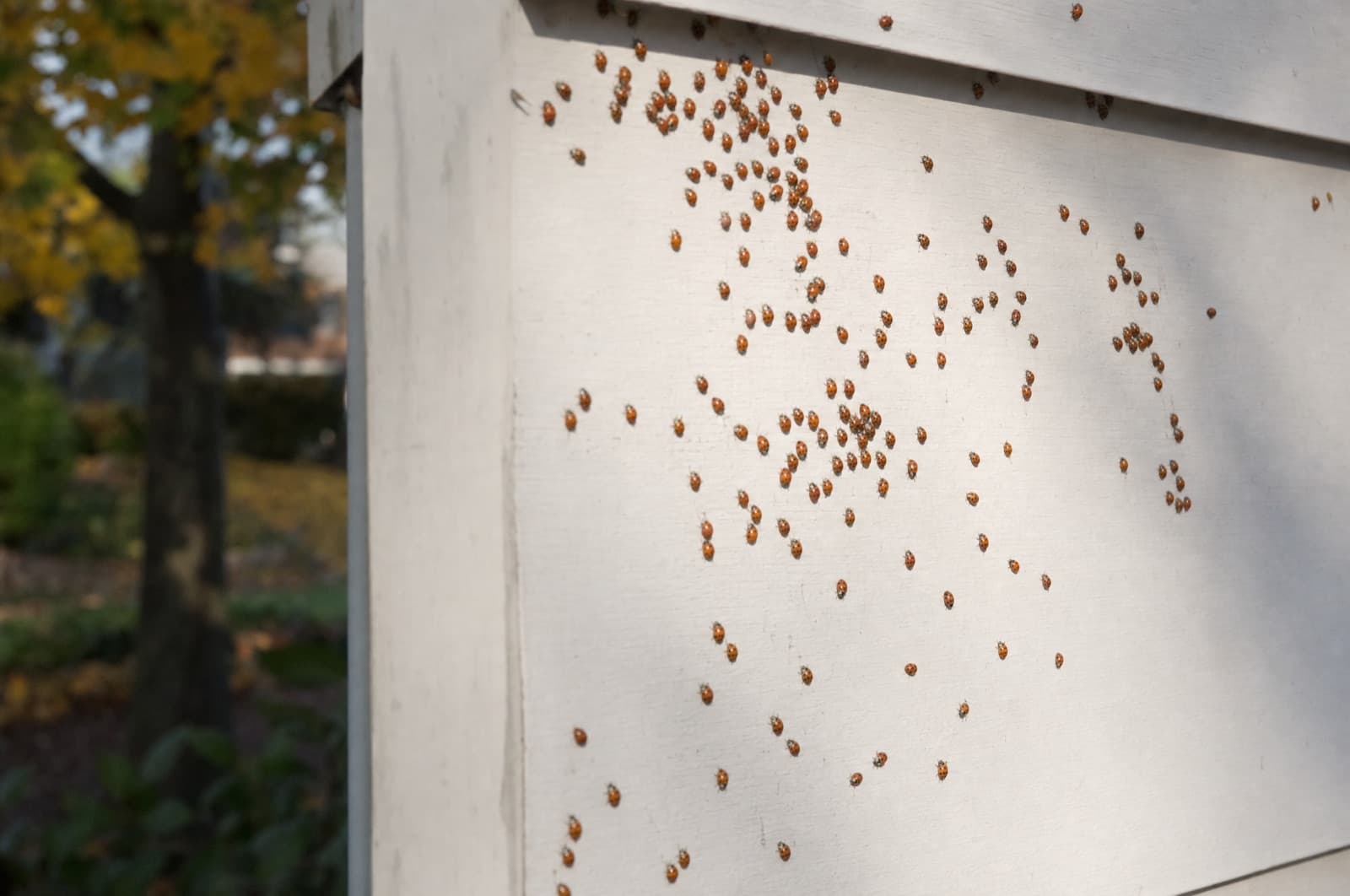
Why Do They Gather at Windows, Ceilings and Corners?
At a glance
- The short answer: One mechanism: warmth-seeking aggregation that recruits itself
- How to tell: Behaviour, not colour — see The Split
- Where removal lives: We route it out — this hub owns identity
One animal, one honest answer
The verdict on Why do they gather at windows, ceilings and corners?
They gather wherever it's warm, sheltered, and already marked by last year's beetles — never in anything that could fairly be called a nest.
Native ladybug vs. the Asian lady beetle
Two names, one animal. Both columns always render — and they always converge on the same resolution. The tell is behaviour, not colour.
The native ladybug
(the one you're picturing)
- Overwinters in leaf litter, under bark, or under rocks — not at windows, ceilings, or in wall voids
- Does not form the large indoor aggregations this page describes
- Any indoor sighting tends to be a single wandering individual, not a cluster
The Asian lady beetle
(Harmonia axyridis)
- Searches out cracks and crevices after staging on a sun-warmed wall
- Moves toward light and upward toward high points once indoors — hence windows, ceilings, upper corners
- Recruits later arrivals to the same building using surface chemical cues left by earlier beetles
If beetles are clustering at your windows, ceilings, or corners in numbers, it's the Asian lady beetle. Both are ladybugs; only one aggregates like this.
What's actually going on
One mechanism explains every surface
Site selection follows a documented sequence, not sixteen separate habits. Beetles orient in flight to large, sunlit landmarks — often capable of covering considerable distance to reach a promising building — then alight on warm, high-contrast walls, and from there walk in search of "cracks, crevices, recesses, or other acceptable microhabitats," in the words of the peer-reviewed study that first documented the sequence (Nalepa, Kennedy & Brownie, Environmental Entomology). That is how beetles end up working through soffit and attic vents, siding gaps, and utility penetrations into wall voids and attics: those spaces are simply the concealed, temperature-buffered microhabitats the search sequence is built to find. None of it is nest-building. Nothing here is constructed, provisioned, or maintained the way "nest" implies — it is passive aggregation in whatever crevice happens to be warm, dark, and already occupied.
That last point matters: beetles don't find these spots independently. Non-volatile, long-chain cuticular hydrocarbons left on a surface by earlier arrivals persist for weeks and guide later beetles to the same crevice, a chemical marking effect documented in Frontiers in Ecology and Evolution's review of Coccinellid aggregation chemistry. That is also why the same building gets recolonized year after year — UF/IFAS Extension notes overwintering sites are frequently reused annually — and why what looks like "a group" from one description and "a colony" from another is the same recruitment mechanism, not two different social behaviors. In New Hampshire the recruitment plays out on a predictable calendar: UNH Cooperative Extension reports the beetles are most numerous on the sunny side of buildings on mild days from mid-September through early November, the window in which these clusters form on and then inside a home.
Why windows, ceilings, and corners specifically
Once beetles are inside a wall void, the specific surfaces homeowners notice follow directly from the same search behavior. Ceilings and upper corners collect beetles because warm air rises and because those are the last stops on a path toward an exit that, from inside a finished room, doesn't exist. Windows collect beetles for a related but distinct reason: once beetles are active indoors, they move toward light as they search for a way back outside — a real behavior, but a separate, secondary one from the warmth-and-contrast cue that got them onto the exterior wall in the first place. Outdoors, pale or sun-facing walls draw larger clusters than shaded or dark ones because they run warmer and read as a stronger visual landmark, the same mechanism this hub's page on why they're in your house explains in full. And an individual beetle landing on a jacket or curtain near a sunlit window is incidental contact with a beetle that was already moving toward that light — not a preference for fabric or people. None of this is a structural problem to fix on this page; for what to do about entry points, see /fall-invaders-faq.
Key takeaways
One mechanism — warmth-seeking, recruited by chemical cues from earlier arrivals — explains windows, ceilings, corners, attics, vents, and walls alike.
They do not build nests: nothing here is constructed or maintained, just passive aggregation in an already-warm, already-marked crevice.
Indoors, beetles move toward light and upward toward high points, which is why windows and ceilings collect the most beetles.
This page replaces 16 of our own legacy pages that each described one surface or one grouping word for the same underlying behavior.
These questions all land here
We asked this more than once, under more than one name, and printed more than one answer. There was only ever one — so here's what this page replaces.
We asked this question twice — once about "ladybugs", once about "Asian beetles" — and printed two answers. There was only ever one.
Looking to get rid of them?
This hub answers what it is — not how to remove it. Most people who land here actually want one of these next steps, so we hand you straight to the hub that owns it.
One void, not a nest — but still worth closing off.
If beetles are recruiting each other to the same window or corner every fall, we can help find and close the gaps they're using to get in.
Frequently asked
Sources & further reading(5)
- [1]Nalepa, Kennedy & Brownie 2005 — Environmental Entomology, alighting and microhabitat-search behavior
Documented sequence of orientation, alighting, and crevice-search behavior
academicverified 2026-07-17 - [2]Frontiers in Ecology and Evolution — Coccinellid aggregation chemistry review
Cuticular hydrocarbon surface marking guiding later arrivals to the same site
academicverified 2026-07-17 - [3]University of Florida IFAS Extension — Multicolored Asian Lady Beetle publication IN361
Overwintering sites frequently reused by the same building annually
extensionverified 2026-07-17 - [4]UNH Cooperative Extension — Seasonal Insect Invaders of New Hampshire Homes fact sheet
General New Hampshire context for indoor-aggregating seasonal invaders
extensionverified 2026-07-17 - [5]UNH Cooperative Extension — Multicolored Asian Ladybug fact sheet
NH fall aggregation window: most numerous on sunny building sides mid-September through early November
extensionverified 2026-07-17
Written & reviewed by
VerifiedDaniel Brady
NH-Licensed Pesticide Applicator · License #782664 (NHDAMF, RSA 430)
Daniel Brady is the New Hampshire–licensed applicator behind Anchor Pest Services, a family-owned pest control company serving the Manchester area since 2017.
Last updated July 2026
Honest pest ID for New Hampshire homes
One Mechanism, Sixteen Pages We Deleted
Windows, ceilings, corners, attics, vents, and walls all trace back to one warmth-seeking, chemically-recruited aggregation behavior — never a nest. Family-owned since 2017, NH license #782664, based at 700 Harvey Rd in Manchester.
- NH-licensed applicators (#782664) — free inspection, same-day service
- We consolidated 16 of our own pages that each described one surface for the same behavior
- Family-owned, Manchester NH, since 2017
NH License #782664 · No obligation · We answer in person
Your next step
- Fall guide
Fall Pest Control in New Hampshire
What matters before frost: the fall invader window, mice at the foundation, and what to seal first.
Read the answer - What to do next
How to remove lady beetles from windows?
Read the answer - What to do next
When Are Asian Lady Beetles Active? NH Ladybug Timing
Read the answer - What to do next
What Attracts Asian Lady Beetles to Your House?
Read the answer - What to do next
How to Get Rid of Asian Lady Beetles
Read the answer - Also relevant
Where Do Beetles Go In The Winter?
Read the answer