
Why Are They in My House?
At a glance
- The short answer: One mechanism: visual contrast, not light
- How to tell: Behaviour, not colour — see The Split
- Where removal lives: We route it out — this hub owns identity
One animal, one honest answer
The verdict on Why are they in my house?
They're staging on the sunniest, highest-contrast wall your house happens to have, then working through gaps into the wall void — not chasing your porch light.
Native ladybug vs. the Asian lady beetle
Two names, one animal. Both columns always render — and they always converge on the same resolution. The tell is behaviour, not colour.
The native ladybug
(the one you're picturing)
- Overwinters outdoors in leaf litter, under bark, or under rocks — not on building exteriors
- Does not stage on walls or work into structures looking for winter shelter
- Largely absent from the fall wall-clustering behavior this page describes
The Asian lady beetle
(Harmonia axyridis)
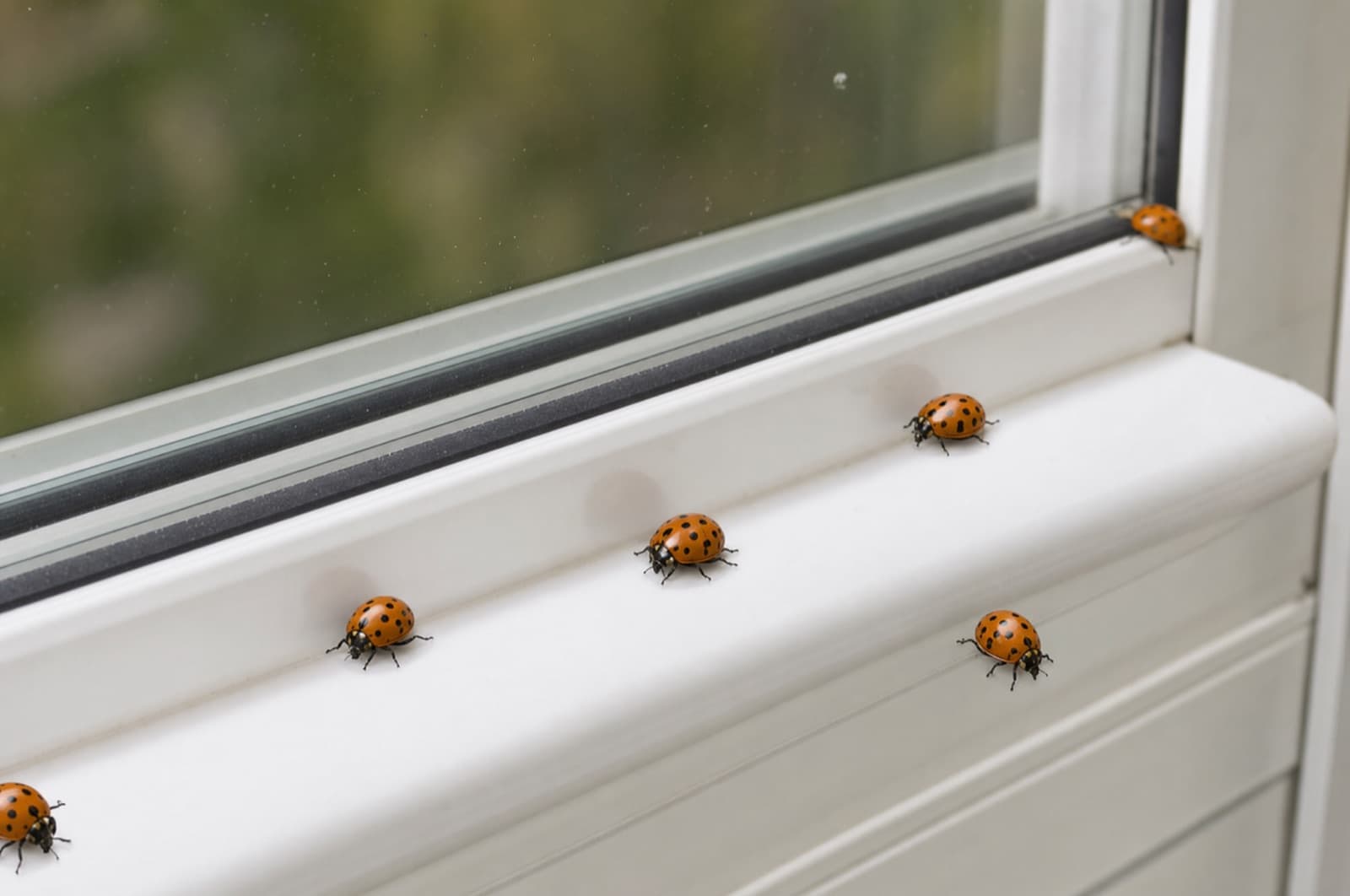
- Stages on sun-warmed south- and west-facing walls on mild fall afternoons
- Favors pale, high-contrast exteriors that read as a prominent landmark from a distance
- Works through gaps and seams into wall voids, attics, and living space once staged
If it's staging on or entering your house each fall, it's the Asian lady beetle. Both are ladybugs; only one treats your wall as a winter substitute for a cliff face.
What's actually going on
The real driver: visual contrast, not radiant heat or light
As days shorten and temperatures drop, Harmonia axyridis adults leave their summer feeding grounds and fly toward prominent, sunlit structures, and Koch's standard review of the species' biology notes these overwintering aggregations form "often on walls with a southern or western exposure" (Koch 2003, Journal of Insect Science). The mechanism behind that pattern has been studied directly: Nalepa, Kennedy and Brownie found the beetles orient to large, contrasting silhouettes on the horizon, then alight based on dark-on-light visual contrast, and explicitly reported the species is "not visually attracted to the color white per se" (Nalepa et al. 2005, Environmental Entomology). Warmth governs the timing, not the orientation — flight happens mainly on calm, clear afternoons once temperatures climb into the low-to-mid 20s Celsius, which is why staging clusters appear on mild days in the weeks bracketing Manchester's first hard frost, not on the coldest ones. In their native range, these beetles aggregate on sun-facing rock crevices and cliff faces; a light-coloured house with the right exposure is simply the nearest equivalent (University of Illinois Extension).
That also settles whether a porch light or a lit window is what pulls them in: outdoors, before they've arrived, the pull is visual contrast, not illumination — warmth's role is limited to triggering the flight on a mild afternoon, not to marking the landing spot. The genuine light-seeking behavior people describe happens later, once beetles are already inside and searching for a way back out — a separate, secondary phase, not the reason they chose your house in the first place.
What that means for the specific things homeowners notice
Several of the old site's questions turn out to be the same mechanism seen from different angles. A pale or light-coloured exterior draws more beetles than a dark one, not because of the colour itself but because it reads as a stronger visual landmark against darker surroundings — the same wall also runs warmest in the afternoon sun, which is why beetles are flying on that particular afternoon in the first place, not why they pick that wall. The late-September-through-October timing lines up with the run of mild, sunny afternoons that bracket the season's first cold snaps, which is also why activity often seems to spike right after a stretch of unsettled weather breaks into a clear, warm afternoon. As for a "smell" drawing beetles from a distance — the evidence doesn't support a long-range airborne attractant; once beetles have found a building, they leave low-volatility surface chemical cues that help later arrivals find the same spot, but that's a short-range recruitment effect, not something a homeowner could smell from across the yard, and it's covered in more depth on this hub's page about where they gather. None of this describes an "infestation" in the sense of a breeding population — it's the same seasonal staging-and-entry behavior, and what to actually do about entry points belongs to /fall-invaders-faq, not this page.
Key takeaways
One mechanism explains fall entry: staging on sun-warmed, high-contrast walls, then working through gaps into the structure.
The trigger is visual contrast on the wall itself — not radiant heat, and not a porch light or bulb.
Pale, sun-facing exteriors draw more beetles because they stand out as a high-contrast landmark, not because of colour for its own sake or because the wall runs warm.
This page replaces 13 of our own legacy pages that asked this same question under different attractants and both species names.
These questions all land here
We asked this more than once, under more than one name, and printed more than one answer. There was only ever one — so here's what this page replaces.
We asked this question twice — once about "ladybugs", once about "Asian beetles" — and printed two answers. There was only ever one.
Looking to get rid of them?
This hub answers what it is — not how to remove it. Most people who land here actually want one of these next steps, so we hand you straight to the hub that owns it.
It's not your lights. It's your wall.
If Asian lady beetles are staging on a sunny exterior wall this fall, we can help you close the gaps before they settle in for winter.
Frequently asked
Sources & further reading(4)
- [1]Koch 2003 — Journal of Insect Science, "The Multicolored Asian Lady Beetle, Harmonia axyridis: A Review"
Overwintering aggregations forming on walls with southern or western exposure
academicverified 2026-07-17 - [2]Nalepa, Kennedy & Brownie 2005 — Environmental Entomology 34(2):425–431, "Role of Visual Contrast in the Alighting Behavior of Harmonia axyridis (Coleoptera: Coccinellidae) at Overwintering Sites"
Beetles orient to dark-on-light visual contrast when alighting at overwintering sites, not to radiant heat; not visually attracted to the color white per se
academicverified 2026-07-17 - [3]University of Illinois Extension — Good Growing: Ladybugs Everywhere
Buildings as a substitute for native sun-facing rock-crevice overwintering sites
extensionverified 2026-07-17 - [4]University of Florida IFAS Extension — Multicolored Asian Lady Beetle publication IN361
Preference for light-coloured, sun-exposed exterior surfaces as overwintering sites
extensionverified 2026-07-17
Written & reviewed by
VerifiedDaniel Brady
NH-Licensed Pesticide Applicator · License #782664 (NHDAMF, RSA 430)
Daniel Brady is the New Hampshire–licensed applicator behind Anchor Pest Services, a family-owned pest control company serving the Manchester area since 2017.
Last updated July 2026
Honest pest ID for New Hampshire homes
One Mechanism, Thirteen Pages We Deleted
Visual contrast on a sun-warmed wall — not radiant heat, not a porch light — is why Asian lady beetles stage on New Hampshire homes each fall. Family-owned since 2017, NH license #782664, based at 700 Harvey Rd in Manchester.
- NH-licensed applicators (#782664) — free inspection, same-day service
- We consolidated 13 of our own pages rather than keep printing the light-attraction myth
- Family-owned, Manchester NH, since 2017
NH License #782664 · No obligation · We answer in person
Your next step
- Fall guide
Fall Pest Control in New Hampshire
What matters before frost: the fall invader window, mice at the foundation, and what to seal first.
Read the answer - What to do next
When Are Asian Lady Beetles Active? NH Ladybug Timing
Read the answer - What to do next
What Attracts Asian Lady Beetles to Your House?
Read the answer - What to do next
Will crushing lady beetles attract more?
Read the answer - Also relevant
Where Do Beetles Go In The Winter?
Read the answer - In your area
Asian Lady Beetle in New Hampshire: Honest ID & What to Do
Read the answer