
Skip to content
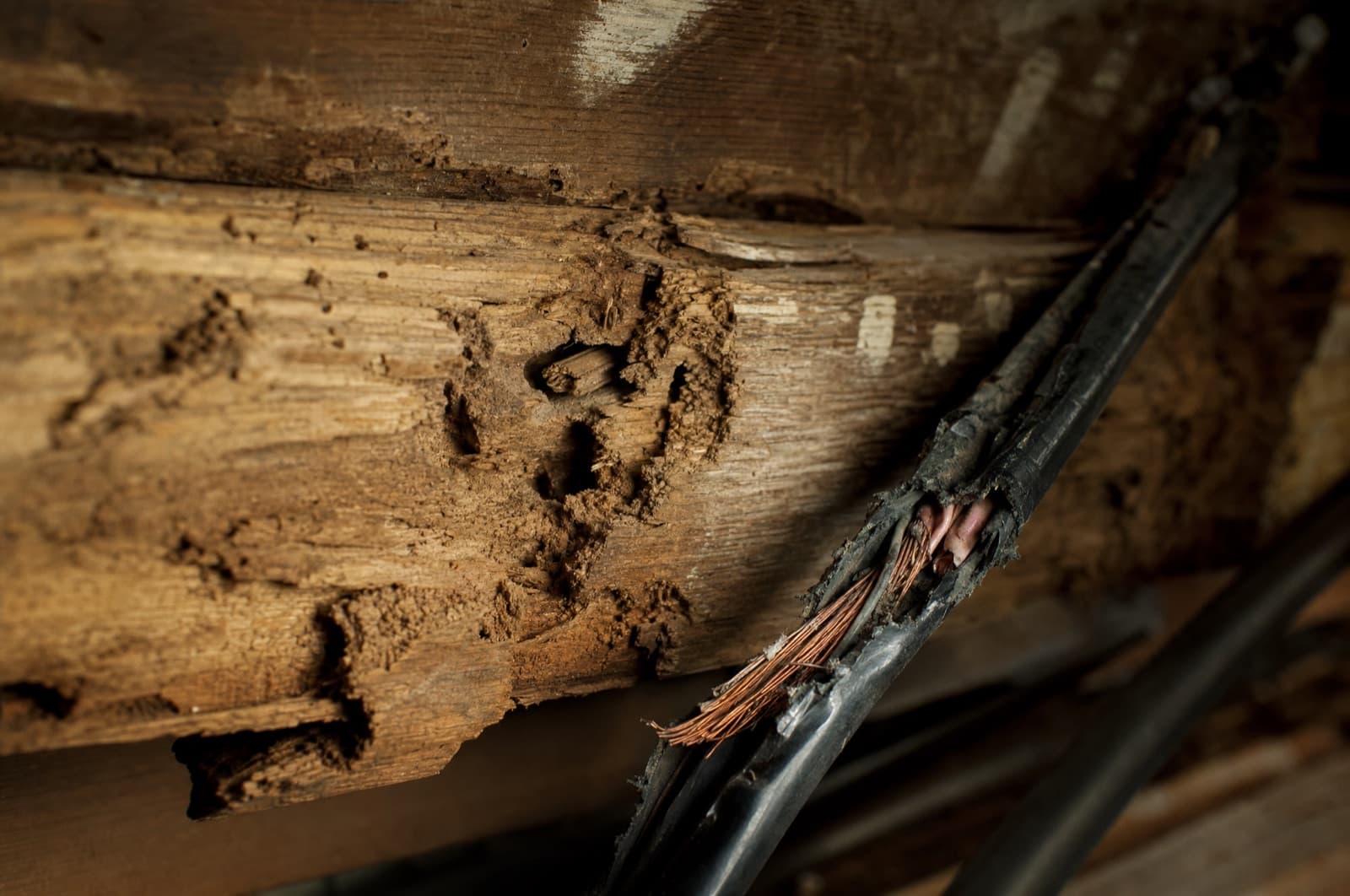
Pest damage evidence — a gnawed structural beam and a chewed electrical wire
Daniel Brady · NH-Licensed Pesticide Applicator · License #782664
Reviewed by Daniel Brady

Can pests cause hidden damage behind walls?

Functional — with a structural ceiling for a short, named list of pests
Yes, but only for a specific, named list of pests, not for anything that happens to end up inside a wall cavity. Subterranean termites can hollow framing from soil contact, carpenter ants excavate wood that's already moisture-damaged, an established yellowjacket colony can thin drywall from a wall void, and rodents gnaw wiring and insulation as they travel wall cavities. Each of those mechanisms is real and documented. What isn't documented is the blanket idea that any insect behind drywall is quietly destroying your home — most incidental bugs that end up in a wall cavity do nothing to it at all, and the honest limit is that nobody, including a professional, can see inside a closed cavity without opening it.

At a glance

  • Can it?: Yes, but
  • How common: Occasional
  • Hype: Overstated
  • Evidence: Plausible, under-documented
The honest answer

The short of it

The verdict
Functional — with a structural ceiling for a short, named list of pests

Yes, for a specific short list — subterranean termites, moisture-fed carpenter ants, wall-void yellowjackets, and rodents — but the honest ceiling is termites reaching structural significance after years undetected, not every wall cavity silently rotting from whatever happens to be inside it.

The correction

What they claim vs. what the evidence supports

One shared severity track, two markers. The span between them is the hype delta — named out loud.

The claim — pests causing damage hidden inside wall cavities

That anything found near a wall — an ant, a beetle, a scratching sound — means catastrophic, invisible destruction is already underway behind the drywall, and that opening the wall will reveal serious ruin.

Where the claim comes from: Viral home-inspection horror stories and pest-marketing copy that treat 'hidden damage' as one universal threat rather than naming which specific pests actually cause it.

Severity, 0–100
Hype says85
50Evidence says
Hype delta35point gapPlausible, under-documented
The evidence

Only a short list of pests genuinely damage what's inside a wall: subterranean termites hollowing framing from soil contact, carpenter ants excavating wood that's already moisture-damaged, yellowjackets thinning drywall from an established void colony, and rodents gnawing wiring or insulation along their travel routes. Most incidental insects that end up inside a wall cavity — an occasional ant, a stray beetle, an old cobweb — do nothing to the structure at all.

The gap

The mechanisms are real and worth knowing — but they belong to four specific, named pests, not to 'something might be behind your wall.' A dead mud dauber tube in a void and an active termite colony get flattened into the same scary sentence, and they are not remotely the same problem.

Damage assessment

What is actually harmed

Damage verdict
Functional — with a structural ceiling for a short, named list of pests
FunctionalCan it?Yes, but
The specimen
Pest
Subterranean termites, carpenter ants, wall-void yellowjackets, and rodents — the pests that genuinely reach a wall cavity's contents
What is in question
Framing lumber, drywall's interior paper facing, wiring insulation, and cavity insulation
How common
Occasional
Evidence
Plausible, under-documented
Mechanism

Each named pest reaches a wall cavity by a different, specific route. Termites tunnel up from soil contact and hollow framing along the grain. Carpenter ants excavate galleries in wood that is already softened by a hidden leak — they do not eat the wood, they clear it out to nest. Yellowjackets that establish inside an existing void gap can thin the drywall's interior paper facing as the colony grows through a season. Rodents travel wall cavities as highways and gnaw wiring insulation, cavity insulation, and drywall along the way. None of this happens because a wall is dark — it happens because a specific pest found a specific resource (soil contact, existing moisture, an entry gap, a travel corridor) inside that particular cavity.

Actually at risk4
  • Framing and sill plates where termites or moisture-following carpenter ants are actively established
  • The interior paper facing of drywall directly behind an established yellowjacket wall-void colony
  • Wiring insulation and duct or pipe insulation along active rodent travel routes
  • Insulation loft and cleanliness where rodents nest inside a cavity
Not at risk — despite the myth4
  • Any wall cavity without one of those four specific pests actively present — an occasional spider, ant, or beetle behind drywall does nothing to the structure
  • Masonry, concrete, and steel framing components, regardless of what's nesting nearby
  • Wall cavities in homes with no moisture problem and no soil-contact wood — termites and carpenter ants need that condition to get started in the first place
  • The idea that 'something is probably eating your walls' without a specific, confirmed pest — nobody can see inside a closed cavity, and unconfirmed suspicion is not evidence of damage
Worst realistic case
An undetected termite colony or a chronic-leak-fed carpenter ant colony compromising framing over several years, or a rodent gnawing an energized wire inside a wall run. All are real and all warrant specialist attention — none of them happen invisibly overnight, and none of them are the default state of an ordinary wall cavity.

Assessed from: UNH Cooperative Extension carpenter ants fact sheet; Connecticut Agricultural Experiment Station Eastern Subterranean Termite fact sheet; eXtension yellowjacket wall-void guidance

The compounding clock

Does it get worse if you ignore it?

Over time
Compounds slowly

Compounds slowly — and only for whichever specific pest is actually present; nothing compounds inside a wall that doesn't have one of the four named problems.

The timeline
4 stages
  1. WeeksReversible

    A new entry point or moisture source appears, and whichever pest is present is just establishing — termite scouts, an early carpenter-ant satellite colony, a rodent travel route, or a young yellowjacket void nest. Nothing has weakened yet.

  2. One seasonReversible

    A wall-void yellowjacket colony, if present, reaches peak size and may thin drywall; rodent gnawing accumulates along its route. Termite and carpenter-ant activity is still in its early, low-consequence phase.

  3. YearsReversible

    Termites or moisture-fed carpenter ants can meaningfully weaken framing if the moisture source was never addressed — this is the multi-year process that marketing compresses into 'invisible ruin.'

  4. DecadesReversible

    The worst untreated endpoint: significant structural compromise in a chronically wet, undetected wall. Still a rare outcome, and still addressable, but now a genuine contractor-scale project.

What stops the clock
Fixing the moisture source — the common accelerant behind both termites and carpenter ants — excluding rodents, and resolving any active wall-void colony. For termites and carpenter ants specifically, the pest must be professionally treated; the clock does not stop on its own.
Repair scope

Who actually fixes this

Scope, not dollars — the honest answer to “how expensive is it,” routed to the right trade.

Who fixes it
Pest pro first
Effort
A project

Whichever pest turns out to be present — a termite colony, carpenter ants, a wall-void yellowjacket nest, or rodents — has to be resolved before anyone opens or repairs the wall. Opening a cavity with an active colony inside makes the situation worse, not better.

The right order
  1. 1
    Get a professional determination of which pest, if any, is actually present — don't assume from a sound or a stray insect sighting
  2. 2
    Resolve the pest first: termite treatment, carpenter-ant colony elimination, yellowjacket removal, or rodent exclusion
  3. 3
    Fix the moisture source if one exists — it's usually the reason the pest was there at all
  4. 4
    Only then open the wall for the relevant trade: an electrician for wiring, a contractor for framing, a plumber for pipe insulation
Route by symptom
  • Licensed electricianRodent gnawing has exposed energized wiring inside the cavity
  • Licensed contractorTermite or moisture-fed carpenter-ant activity has weakened framing and needs structural repair
Do not
  • Don't cut into a wall to 'check' for an active termite, ant, or yellowjacket colony yourself — disturbing it can scatter the colony or push wasps toward the living space
  • Don't assume a noise or a single insect sighting means structural damage is underway — get it confirmed by a professional first
Where we help — and where we don't

Anchor resolves the termite, carpenter-ant, or yellowjacket side of this — that part is genuinely our lane. We do not open the wall, replace framing, or do the electrical repair; those route to a licensed contractor or electrician once the pest side is handled.

In depth

The full picture

01

The short, honest list of pests that actually reach a wall's contents

It's a shorter list than the marketing implies. Subterranean termites tunnel from soil contact into sill plates and framing and hollow it along the grain. Carpenter ants excavate galleries — they don't eat wood — almost always in lumber that's already softened by a hidden leak. An established yellowjacket colony inside a wall void can thin the interior paper facing of drywall as it grows through a season. And rodents use wall cavities as travel corridors, gnawing wiring insulation, cavity insulation, and drywall along their routes. Those four mechanisms cover the genuine 'hidden damage' story on this hub.

02

Why most 'something's behind my wall' worries aren't this

The pests people actually fear finding behind a wall — a spider, an occasional ant, a beetle that wandered in — do essentially nothing to the wall itself. A spider building a web in a stud bay causes no damage of any kind. An ant that isn't a carpenter ant is a nuisance, not a structural concern. Even an old, vacated mud dauber tube or a spent wasp nest tucked into a void is a dried, inert shell that will look the same in ten years as it does today. The honest answer distinguishes a confirmed, active instance of one of the four named pests from the much more common case of an incidental bug that happened to end up inside a wall.

03

Moisture is the common thread

Look closely at the two slowest, most structurally consequential mechanisms — termites and carpenter ants — and a leak or chronic damp condition sits behind both. Carpenter ants strongly prefer wood that's already water-damaged; termites need soil contact and sustained moisture to establish and keep feeding. Fixing the water problem does more to stop hidden wall damage than almost anything else on this list, which is why a pest professional worth trusting will ask about moisture history before assuming the worst about a wall.

04

The honest limit: nobody can see inside a closed wall

This is worth saying plainly. Neither a homeowner nor a pest professional can see through drywall. What confirms one of these four pests is present is external evidence — mud tubes and swarmers for termites, frass and foraging trails for carpenter ants, consistent traffic at a small gap for yellowjackets, droppings and gnaw marks for rodents — combined with, when warranted, targeted investigation like a moisture meter, a borescope, or opening a small access section. A scratching sound or a vague suspicion is not the same as a confirmed pest, and treating it as equivalent is exactly how 'hidden damage' marketing gets its power.

Key takeaways
5 points
  • Only four pests genuinely damage what's inside a wall cavity: subterranean termites, carpenter ants (in wood already moisture-damaged), wall-void yellowjackets, and gnawing rodents.
  • Most incidental insects that end up behind drywall — spiders, stray ants, an old wasp nest — do nothing to the wall at all.
  • Moisture is the common thread behind the two slowest, most consequential mechanisms — termites and carpenter ants.
  • Nobody, including a professional, can see inside a closed wall cavity — confirmation relies on external evidence, not guessing.
  • Whichever pest is present must be resolved before the wall is opened or repaired; the repair itself routes to the relevant trade.
New Hampshire context

What this looks like in New Hampshire homes

Southern and central New Hampshire's older housing stock, combined with seasonal moisture from snowmelt and spring rain, is exactly the condition that lets carpenter ants and, in Southern NH, subterranean termites establish in wall-adjacent framing. Rodents push into wall cavities every fall as temperatures drop toward Manchester's first hard frost, historically around October 19 to 29 (NOAA). Anchor's most common finding behind a wall in this region is a rodent travel route or an early carpenter-ant colony tied to a specific, fixable leak — not the runaway termite catastrophe the marketing implies.

  • NH-licensed #782664

    Southern New Hampshire

  • Family-owned

    Since 2017

  • Honest routing

    Even when it isn’t us

We serve these communities

ManchesterNashuaConcordDerryBedfordSalemHudsonAmherstAuburnGoffstownHooksettLitchfieldLoudonMilfordBristol

Service Area Map

Southern New Hampshire

BristolPop. 3,200LoudonPop. 5,500ConcordPop. 43,900HooksettPop. 14,800GoffstownPop. 18,000AuburnPop. 5,700ManchesterPop. 115,600BedfordPop. 23,300LitchfieldPop. 8,500AmherstPop. 11,300DerryPop. 34,500MilfordPop. 15,700HudsonPop. 25,600NashuaPop. 91,100SalemPop. 30,000HQCityHover for info

Something behind the wall? Get it confirmed before you guess.

Anchor identifies which of the four genuine wall-cavity pests, if any, is actually present — and resolves it before anyone opens the wall.

Follow-up questions

Frequently asked

Sources & citations(4)
  1. UNH Cooperative Extension — Carpenter Ants fact sheet

    Carpenter ants excavate rather than eat wood; strongly prefer wood already water-damaged

    extensionverified 2026-07-16
  2. Connecticut Agricultural Experiment Station — Eastern Subterranean Termite fact sheet

    Subterranean termite feeding mechanism and susceptible framing components near soil contact

    govverified 2026-07-16
  3. eXtension Ask an Expert — Yellowjacket Nests in Structures

    Wall-void yellowjacket colony behavior and drywall interaction

    extensionverified 2026-07-16
  4. Internet Center for Wildlife Damage Management — House Mouse Damage Identification

    Rodent gnawing on wiring and insulation along wall-cavity travel routes

    extensionverified 2026-07-16

Written & reviewed by

Verified

Daniel Brady

NH-Licensed Pesticide Applicator · License #782664 (NHDAMF, RSA 430)

Daniel Brady is the New Hampshire–licensed applicator behind Anchor Pest Services, a family-owned pest control company serving the Manchester area since 2017.

Verify license

Last updated Jul 2026

Honest pest help for New Hampshire homes

We Confirm What's There. We Route the Repair Correctly.

Termites, carpenter ants, and wall-void wasp colonies are genuinely Anchor's work, and we resolve them before any wall is opened. We do not do the framing repair, the electrical work, or the drywall patch — those go to a licensed contractor or electrician, and we'll tell you that up front. Family-owned since 2017, NH license #782664, serving Manchester, Nashua, Concord and nearby towns.

  • Honest advice — we confirm the pest before recommending any repair
  • NH-licensed applicators (#782664) — free inspection, same-day service
  • Termite, carpenter ant, and wasp/yellowjacket treatment across southern and central New Hampshire

NH License #782664 · No obligation · We answer in person