
Skip to content
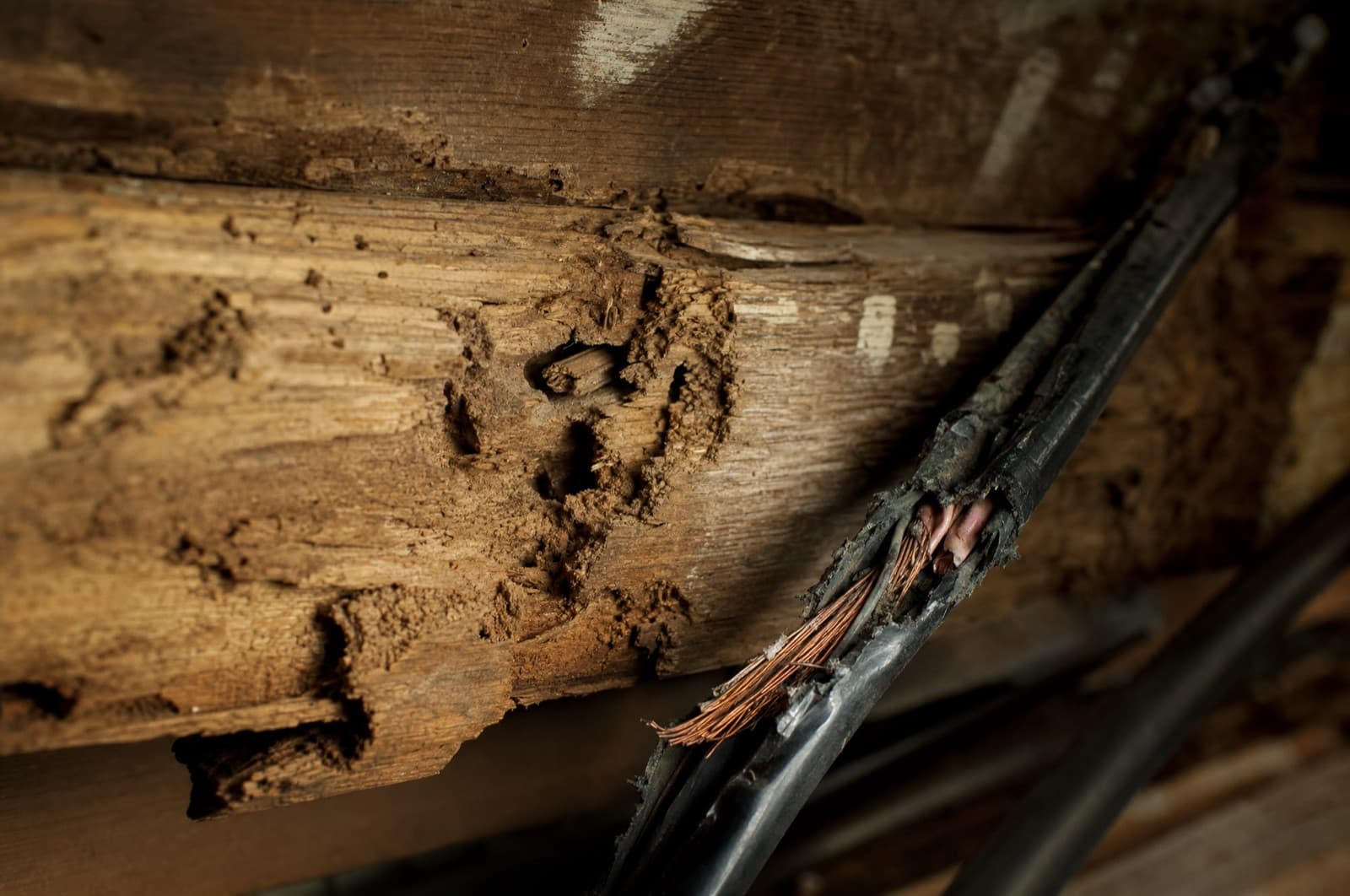
Pest damage evidence — a gnawed structural beam and a chewed electrical wire
Daniel Brady · NH-Licensed Pesticide Applicator · License #782664
Reviewed by Daniel Brady

Can pests weaken a home's structure over time?

Compounds slowly — real, but on a years-to-decades timescale
Yes, for a specific, named group of pests, and this is one of the hub's genuinely earned fears rather than a debunk. Subterranean termites, carpenter ants in wood that's already moisture-damaged, powderpost beetles in hardwood, and old-house borers in softwood framing can all cause real structural weakening if left undetected. But the honest timescale is years, not weeks — NC State Extension puts serious eastern subterranean termite structural damage at three to eight years of continuous, undetected feeding — and nearly every stage remains fully repairable if the problem is caught and the pest is professionally treated. The 'your home could collapse' framing is the invented part, not the underlying risk.

At a glance

  • Hype: Overstated
  • Evidence: Plausible, under-documented
  • Who fixes it: Pest pro first
  • three to eight years

    Ongoing, undetected feeding it takes for subterranean termites to cause serious structural damage

    NC State Extension — Eastern Subterranean Termites

  • about 60,000 workers

    Size of a mature eastern subterranean termite colony that consumes ~1/5 oz of wood a day

    NC State Extension — Eastern Subterranean Termites

The honest answer

The short of it

The verdict
Compounds slowly — real, but on a years-to-decades timescale

Yes, a short list of pests genuinely weaken structure over time — subterranean termites, moisture-fed carpenter ants, powderpost beetles, and old-house borers — but the honest clock runs in years, not weeks, and 'your home could collapse' compresses a slow, interruptible process into false urgency.

The correction

What they claim vs. what the evidence supports

One shared severity track, two markers. The span between them is the hype delta — named out loud.

The claim — the claim that pests are slowly weakening your home's structure until it fails

That pests are a ticking structural time bomb — that an infestation left alone leads to your home 'collapsing' or becoming unsafe, often implied to happen within a matter of weeks or a single season.

Where the claim comes from: Pest-company urgency marketing and viral home-horror posts that compress a multi-year process into a single dramatic headline.

Severity, 0–100
Hype says90
55Evidence says
Hype delta35point gapPlausible, under-documented
The evidence

A short, specific list of pests can genuinely reach structural significance: subterranean termites, carpenter ants in wood that's already moisture-damaged, powderpost beetles in hardwood, and old-house borers in softwood framing. All four are real and well documented — but all four are also slow and largely moisture-gated. NC State Extension puts eastern subterranean termite structural damage at three to eight years of ongoing, undetected feeding, and the process remains reversible at nearly every stage if it's caught.

The gap

The mechanisms here are genuinely earned — this isn't a debunk. The invented part is the speed: a house does not go from fine to collapsing while pests work in the dark for a few weeks. It takes years of an undetected, usually moisture-fed problem, and it's interruptible at nearly every point along the way.

The compounding clock

Does it get worse if you ignore it?

Over time
Compounds slowly

Compounds slowly — years of undetected feeding, not weeks of hidden ruin.

The timeline
4 stages
  1. WeeksReversible

    No meaningful structural change from any of these pests. Termite scouts, an early carpenter-ant satellite colony, or a fresh powderpost beetle infestation are all still at a stage with zero measurable structural consequence.

  2. MonthsReversible

    Early, hidden feeding or excavation begins — termite galleries inside a sill, ant tunnels in already-wet wood, beetle larvae tunneling hardwood sapwood. Still invisible from outside, and still fully reversible with treatment.

  3. YearsReversible

    This is where genuine structural consequence appears if the problem stays undetected and any moisture source is never fixed — NC State Extension's termite figure is three to eight years of continuous feeding for serious damage. Framing may be measurably weakened, but a licensed contractor can still repair it.

  4. DecadesReversible

    The worst realistic, essentially avoidable endpoint: years of compounding, undetected damage across multiple seasons reaches serious structural compromise — sagging floors, a weakened beam. Still addressable, but now a genuine contractor-scale rebuild rather than a patch.

What stops the clock
Fixing the moisture source — the master switch behind nearly every genuinely structural pest on this list — plus professional treatment of the specific pest. Termites and carpenter ants stop compounding once the colony is eliminated; powderpost beetles and old-house borers stop once the wood is dried, sealed, or treated.
Repair scope

Who actually fixes this

Scope, not dollars — the honest answer to “how expensive is it,” routed to the right trade.

Who fixes it
Pest pro first
Effort
A project

Every genuinely structural pest on this list has to be treated before any structural repair is worth doing — patching over an active termite or carpenter-ant colony just buries the problem under new material.

The right order
  1. 1
    Get the specific pest professionally identified — termites, carpenter ants, powderpost beetles, and old-house borers all need different treatments
  2. 2
    Resolve the pest: soil treatment or bait for termites, colony elimination for carpenter ants, borate or fumigation for beetles
  3. 3
    Fix the moisture source, if one exists — it's usually the reason the wood was vulnerable in the first place
  4. 4
    Bring in a licensed contractor only after the pest is resolved, to assess and repair any weakened framing
Route by symptom
  • Licensed contractorYears of undetected termite, ant, or beetle activity has measurably weakened a structural member
Do not
  • Don't wait for visible sagging before acting — by the time framing visibly sags, the problem has usually been running for years
  • Don't patch or panel over suspected termite or ant damage without professional treatment first
Where we help — and where we don't

Anchor treats the termites, carpenter ants, and wood-boring beetles that drive this list — that's the genuine, structural-consequence part of our work. We do not do the framing rebuild itself; that's a licensed contractor's job once the pest is gone.

In depth

The full picture

01

The short, honest list of pests that actually weaken structure

Only four pests in this hub genuinely reach structural significance over time: subterranean termites, carpenter ants (specifically in wood already moisture-damaged), powderpost beetles in hardwood, and old-house borers in softwood framing. All four are well documented and all four are legitimately worth acting on. That's a deliberately short list — most of the pests people worry about behind a wall, on a deck, or in a pantry never reach this category at all, and lumping them all together is exactly how a genuine risk gets diluted into generic fear.

02

Auditing 'your home could collapse'

This is the claim worth taking apart directly, because the underlying risk is real and shouldn't be softened. Subterranean termites do consume structural wood, and NC State Extension's own figure — three to eight years of ongoing, undetected feeding for serious structural damage — confirms it's a genuine threat. What's invented is the timeline compression: no marketing claim of a home 'collapsing' from pest activity reflects a process that actually takes years to reach that stage, assisted by New Hampshire winters that slow feeding sharply. The honest version of this fear keeps the structural risk and drops the speed.

03

Moisture is the master switch

Every pest on this list needs moisture to become a structural threat. Carpenter ants overwhelmingly colonize wood that's already water-damaged rather than sound, dry lumber. Powderpost beetles and old-house borers both need elevated wood moisture to develop, and termites require sustained soil-moisture contact to establish and keep feeding. Fix a chronic leak or poor drainage condition and you remove the shared driver behind nearly every genuinely structural pest this hub covers — which is why naming the moisture problem, not just the pest, is the single most useful thing a homeowner can hear.

04

What stays reversible, and for how long

The reassuring, equally honest half of this answer is that essentially every stage of this process remains fixable. Early termite or beetle activity, caught within months, is a straightforward treatment. Even years of undetected feeding, once discovered, is a contractor-scale repair rather than a lost cause — sills, joists, and beams can be sistered, reinforced, or replaced. The genuinely bad outcome — serious, decades-deep structural compromise — is rare specifically because it requires years of a problem going both undetected and untreated, which is the scenario regular inspection and prompt treatment exist to prevent.

Key takeaways
5 points
  • Four pests genuinely weaken structure over time: subterranean termites, moisture-fed carpenter ants, powderpost beetles, and old-house borers.
  • The honest timescale is years — NC State Extension puts serious termite structural damage at three to eight years of continuous feeding.
  • 'Your home could collapse' compresses a genuinely earned, multi-year risk into false, invented urgency.
  • Moisture is the shared driver behind nearly every pest on this list — fixing it removes the root cause.
  • The process stays reversible at nearly every stage if it's caught and professionally treated.
New Hampshire context

What this looks like in New Hampshire homes

Southern New Hampshire sits in a moderate termite-pressure zone, and central New Hampshire's older housing stock combines wood-to-soil contact with the seasonal moisture that both termites and carpenter ants need. New Hampshire's cold winters slow termite feeding sharply for several months each year, which stretches the already multi-year structural timeline out further than in warmer climates. Anchor's typical structural finding in this region is a years-old carpenter-ant colony tied to one specific, fixable leak — not a fast-moving collapse scenario.

  • NH-licensed #782664

    Southern New Hampshire

  • Family-owned

    Since 2017

  • Honest routing

    Even when it isn’t us

We serve these communities

ManchesterNashuaConcordDerryBedfordSalemHudsonAmherstAuburnGoffstownHooksettLitchfieldLoudonMilfordBristol

Service Area Map

Southern New Hampshire

BristolPop. 3,200LoudonPop. 5,500ConcordPop. 43,900HooksettPop. 14,800GoffstownPop. 18,000AuburnPop. 5,700ManchesterPop. 115,600BedfordPop. 23,300LitchfieldPop. 8,500AmherstPop. 11,300DerryPop. 34,500MilfordPop. 15,700HudsonPop. 25,600NashuaPop. 91,100SalemPop. 30,000HQCityHover for info

Real risk, honest timeline — catch it in the years it's still cheap to fix.

Anchor treats the termites, carpenter ants, and wood-boring beetles that genuinely weaken structure — before years of undetected activity turn into a contractor-scale project.

Follow-up questions

Frequently asked

Sources & citations(4)
  1. NC State Extension — Eastern Subterranean Termites

    Serious structural termite damage takes three to eight years of ongoing, undetected feeding

    extensionverified 2026-07-16
  2. University of Minnesota Extension — Carpenter Ants

    Carpenter ant structural damage occurs slowly, often taking years

    extensionverified 2026-07-16
  3. Mississippi State Extension — Old House Borer

    Old-house borer moisture dependence and multi-year generational development

    extensionverified 2026-07-16
  4. USDA Forest Products Laboratory — Wood Handbook, Chapter 14: Biodeterioration of Wood

    Moisture as the shared requirement behind fungal decay and wood-destroying insect activity

    govverified 2026-07-16

Written & reviewed by

Verified

Daniel Brady

NH-Licensed Pesticide Applicator · License #782664 (NHDAMF, RSA 430)

Daniel Brady is the New Hampshire–licensed applicator behind Anchor Pest Services, a family-owned pest control company serving the Manchester area since 2017.

Verify license

Last updated Jul 2026

Honest pest help for New Hampshire homes

The Threat Is Real. The Timeline Isn't What You've Read.

Termites, carpenter ants, and wood-boring beetles genuinely can weaken a home's structure — over years, not weeks, and almost always tied to a moisture problem. Anchor Pest Services treats the pest side of that equation; the structural rebuild, when one is needed, goes to a licensed contractor. Family-owned since 2017, NH license #782664, serving Manchester, Nashua, Concord and nearby towns.

  • Honest advice — we name the years-long timeline instead of manufacturing urgency
  • NH-licensed applicators (#782664) — free inspection, same-day service
  • Termite, carpenter ant, and wood-boring beetle treatment across southern and central New Hampshire

NH License #782664 · No obligation · We answer in person