
Skip to content
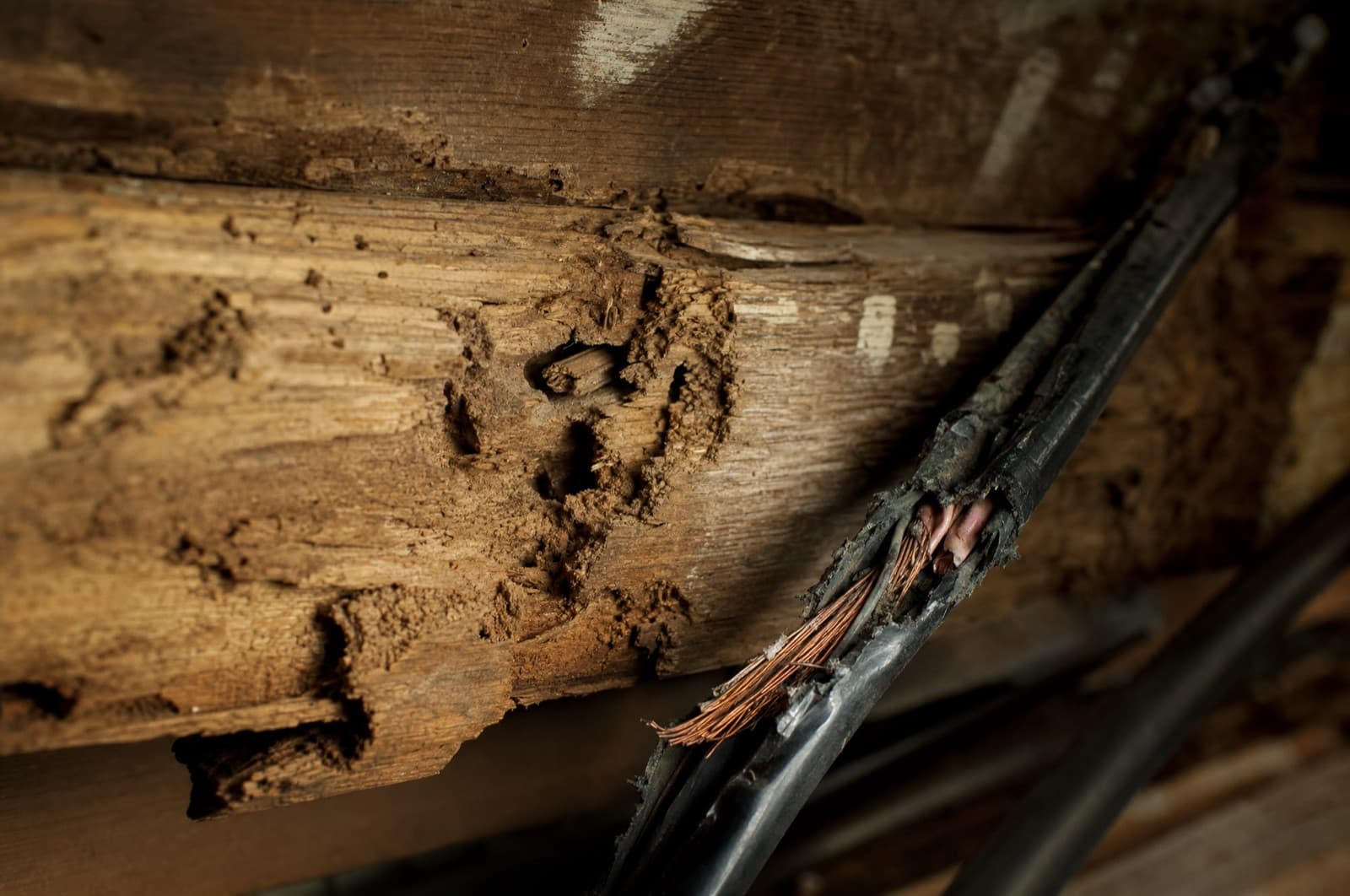
Pest damage evidence — a gnawed structural beam and a chewed electrical wire
Daniel Brady · NH-Licensed Pesticide Applicator · License #782664
Reviewed by Daniel Brady

Do carpenter bees weaken decks or fences?

Functional damage — real, but cumulative and preventable
Rarely from one season's activity, but yes over time. A single carpenter-bee tunnel in a deck rail or fence post is cosmetically visible but structurally trivial. The real risk is cumulative: on unpainted, unsealed wood, bees reopen and extend the same gallery year after year rather than always starting fresh, and woodpeckers hunting the larvae inside an active tunnel often enlarge it further. That combination — multi-year reuse of one gallery, plus woodpecker follow-on — is the specific pathway that can genuinely weaken a board. Painted or sealed wood is rarely attacked in the first place.

At a glance

  • Can it?: Yes, but
  • How common: Routine
  • Hype: Overstated
  • Evidence: Plausible, under-documented
The honest answer

The short of it

The verdict
Functional damage — real, but cumulative and preventable

A single carpenter-bee gallery does not weaken a deck or fence — the genuine risk is the same unsealed tunnel reused and extended across years, plus woodpeckers hunting the larvae inside it.

The correction

What they claim vs. what the evidence supports

One shared severity track, two markers. The span between them is the hype delta — named out loud.

The claim — carpenter bees weakening deck rails, fence posts, and fascia

That carpenter bees will 'destroy your deck' or compromise a fence within a season, treating every drilled hole as an active structural emergency requiring immediate professional intervention.

Where the claim comes from: Pest-control marketing copy and DIY-blog posts that treat a single entry hole as equivalent to a spreading infestation.

Severity, 0–100
Hype says72
34Evidence says
Hype delta38point gapPlausible, under-documented
The evidence

Per University of Maryland Extension, a single bee's nest will not cause structural damage — a new gallery runs only about four to six inches. The genuine concern is multiple tunnels, reused and expanded over several years, which can weaken wood; UMD and University of Georgia Extension document reused galleries reaching as long as ten feet in long-neglected, unpainted lumber. Woodpeckers hunting the larvae inside an active tunnel frequently enlarge it further while foraging.

The gap

One season's tunnel is not a deck-destroying event — that part of the marketing is invented urgency. What's real and worth acting on is the pattern: unpainted, unsealed wood that gets reused season after season is where a handful of holes can become a genuinely weakened board, especially once woodpeckers start working the same spot.

Damage assessment

What is actually harmed

Damage verdict
Functional damage — real, but cumulative and preventable
FunctionalCan it?Yes, but
The specimen
Pest
Carpenter bees (Xylocopa species)
What is in question
Unpainted or unsealed softwood deck rails, fence posts, and fascia
How common
Routine
Evidence
Plausible, under-documented
Mechanism

A female bee bores a near-perfect, roughly half-inch entry hole straight into the grain, then turns and tunnels along it to build brood cells for her young — she gains no food value from the wood and eats only nectar and pollen. A new tunnel runs about four to six inches, which is cosmetically visible but structurally negligible on its own. The functional risk comes from two compounding pathways specifically: bees frequently reopen and extend the very same gallery in subsequent seasons rather than boring a fresh one, on wood that's never painted or sealed; and woodpeckers hunting the larvae developing inside an active tunnel peck into the surrounding wood to reach them, enlarging a gallery well beyond what the bee alone created.

Actually at risk4
  • Unpainted or unsealed softwood deck rails, fence posts, and fascia boards — the near-universal target
  • The same board, reused and extended season after season if it's never sealed after bees vacate
  • Wood already weakened by a multi-year gallery, once woodpeckers enlarge the tunnel hunting larvae
  • Cosmetic staining beneath entry holes from bee frass
Not at risk — despite the myth4
  • Painted, stained, or otherwise sealed wood — carpenter bees strongly prefer bare, weathered surfaces and rarely attack finished wood
  • Metal, composite, or vinyl rail and fence materials — bees cannot bore into any of these
  • Overall deck or fence framing from a single bee or a single season's activity — that scale of damage requires years of unaddressed reuse
  • The wood's food value — bees consume nothing; nothing about the tunnel represents lost nutrients
Worst realistic case
A deck rail, fence post, or fascia board that's gone unpainted and unpatched for several years develops a network of reused, expanded galleries — occasionally the documented extreme of several feet of tunnel in one board — weakened further by woodpecker excavation seeking the larvae inside. That's a genuine functional repair. It is not a single season's outcome, and it doesn't happen to painted wood.

Assessed from: University of Maryland Extension — Carpenter Bees; University of Georgia Extension — Carpenter Bees; NestWatch (Cornell Lab of Ornithology) — woodpecker foraging behavior

The compounding clock

Does it get worse if you ignore it?

Over time
Compounds slowly

Compounds slowly and only on unsealed wood — a single season's tunnel is nearly inert, but reuse plus woodpecker follow-on across years is the real clock.

The timeline
3 stages
  1. WeeksReversible

    A female bores a new entry and a four-to-six-inch tunnel with brood cells for one season's young. Cosmetic frass staining may appear below the hole.

  2. One seasonReversible

    The bees emerge and the tunnel sits vacant. On unpainted, unsealed wood, next year's females frequently reopen and extend this same tunnel rather than starting a new one elsewhere.

  3. YearsReversible

    Repeated reuse and branching produce a longer gallery network — documented up to roughly ten feet in badly neglected boards — and woodpeckers hunting the larvae inside widen the same tunnels further. This is where a rail or post genuinely weakens.

What stops the clock
Fill and paint (or otherwise finish) the wood once the bees are gone for the season. Sealed, finished wood is rarely reattacked, and a filled tunnel can't be reopened or extended — cutting off the reuse pathway responsible for essentially all of the cumulative damage.
Repair scope

Who actually fixes this

Scope, not dollars — the honest answer to “how expensive is it,” routed to the right trade.

Who fixes it
Pest pro first
Effort
An afternoon

Filling or painting over an actively used tunnel just traps a bee inside or gets chewed back open — the bees need to be resolved for the season before any hole is filled, which is what keeps next year's females from reopening the same gallery.

The right order
  1. 1
    Treat or resolve active carpenter-bee activity for the current season
  2. 2
    Once activity has stopped, fill each tunnel (dowel and wood filler, or a purpose-made plug)
  3. 3
    Paint or seal the wood — this is the step that actually prevents next year's reuse
Route by symptom
  • You — a DIY patchActivity has already ended for the season and you're simply filling and painting old holes before next spring
Do not
  • Don't fill or paint over a hole while bees are still actively provisioning it — you'll trap a bee inside, or she'll simply chew a new entry nearby
  • Don't ignore a heavily reused gallery on a structural rail or fence post hoping it stops on its own — unsealed wood invites the same tunnel back every spring, and woodpeckers make it worse, not better
Where we help — and where we don't

Anchor treats the active bees — the carpentry (filling tunnels, painting or sealing the wood) is a homeowner task once they're gone, and it's the step that actually stops the multi-year cycle.

In depth

The full picture

01

One hole is a nursery, not a structural event

A female carpenter bee drills her nearly perfect half-inch entry hole and tunnels with the grain to build a handful of brood cells, each stocked with pollen for a single egg. That's the entire purpose of the tunnel, and per University of Maryland Extension, 'the nest of a single bee will not cause structural damage.' A new gallery runs about four to six inches — cosmetically noticeable on a deck rail or fence post, structurally irrelevant. If every carpenter-bee season produced one fresh, isolated hole, this would be a purely cosmetic page.

02

The two pathways that actually compound

It isn't the whole story, because carpenter bees have a habit that matters: on wood that stays unpainted and unsealed, they frequently reopen and extend an existing tunnel rather than boring an entirely new one each season. University of Maryland and University of Georgia Extension both document reused galleries reaching extreme lengths — up to roughly ten feet — in wood that's gone untreated for years.

The second, secondary pathway is woodpeckers. They hunt carpenter-bee larvae developing inside an occupied tunnel, and to reach them they peck and enlarge the wood around the gallery. A tunnel that a bee alone would leave at four to six inches can end up considerably wider once a woodpecker has worked it over hunting grubs. These two pathways — years of reuse of the same unsealed gallery, and woodpecker excavation into an active one — are the specific, honest mechanism behind any deck rail or fence post that's genuinely been weakened. Neither happens from a single season's activity on its own.

03

Why painted wood mostly avoids this

Carpenter bees strongly prefer bare, weathered, unfinished wood because it's easier to grip and bore into. Painted, stained, or otherwise sealed deck rails and fence boards are rarely targeted in the first place, and even where an old hole exists, filling it and painting over it removes the option for next year's females to reopen and extend that same tunnel — which is the pathway responsible for essentially all of the cumulative damage this page is grading.

04

Functional, not structural — and preventable

The honest verdict here is functional damage: real, worth addressing, and capable of genuinely weakening a board over years of neglect — but not structural in the sense of threatening a building's frame, and not a fast-moving threat the way marketing copy implies. A deck rail or fence post with a multi-year, woodpecker-enlarged gallery network is a legitimate repair. A single half-inch hole discovered this spring is not an emergency, and painting it once the bees are gone is usually the entire fix.

Key takeaways
5 points
  • A single carpenter-bee tunnel in one season is cosmetic, not structural — University of Maryland Extension is explicit on this point.
  • The genuine risk is cumulative: the same gallery reused and extended across years on unpainted, unsealed wood.
  • Woodpeckers hunting the larvae inside an active tunnel are a real secondary damage source that can enlarge a gallery well beyond what the bee alone created.
  • Painted or sealed wood is rarely attacked in the first place, which is why finishing wood is the single most effective prevention step.
  • Filling and painting a vacated tunnel is what actually stops the multi-year reuse cycle — not urgent same-week treatment of a single hole.
New Hampshire context

What this looks like on New Hampshire decks and fences

Southern and central New Hampshire's unpainted cedar decking, weathered rail caps, and unfinished fence posts are classic carpenter-bee targets, with activity typically running from spring through early summer as females establish new or reused galleries. The telltale local sign is a perfectly round half-inch hole on the underside of a deck rail or the top of a fence post, often with a yellow-brown frass stain trailing below it, and sometimes with woodpecker damage nearby if the board has hosted bees for more than one season. Painting or sealing exposed wood before spring is the most effective single step a New Hampshire homeowner can take, particularly given how long the wood stays exposed to weather across the state's full outdoor season.

  • NH-licensed #782664

    Southern New Hampshire

  • Family-owned

    Since 2017

  • Honest routing

    Even when it isn’t us

We serve these communities

ManchesterNashuaConcordDerryBedfordSalemHudsonAmherstAuburnGoffstownHooksettLitchfieldLoudonMilfordBristol

Service Area Map

Southern New Hampshire

BristolPop. 3,200LoudonPop. 5,500ConcordPop. 43,900HooksettPop. 14,800GoffstownPop. 18,000AuburnPop. 5,700ManchesterPop. 115,600BedfordPop. 23,300LitchfieldPop. 8,500AmherstPop. 11,300DerryPop. 34,500MilfordPop. 15,700HudsonPop. 25,600NashuaPop. 91,100SalemPop. 30,000HQCityHover for info

A few holes in the deck rail? Stop the bees before they reuse the tunnel next spring.

Anchor treats active carpenter-bee activity so you can safely fill and paint the tunnels — the step that actually ends the multi-year cycle.

Follow-up questions

Frequently asked

Sources & citations(3)
  1. University of Maryland Extension — Carpenter Bees

    A single bee's nest will not cause structural damage; reused galleries can reach up to roughly ten feet in neglected wood

    extensionverified 2026-07-16
  2. University of Georgia Extension — Carpenter Bees

    New gallery lengths and reuse/extension of existing tunnels across seasons

    extensionverified 2026-07-16
  3. NestWatch (Cornell Lab of Ornithology) — Woodpecker Foraging Behavior

    Woodpeckers excavate wood to reach wood-boring insect larvae, enlarging existing galleries

    academicverified 2026-07-16

Written & reviewed by

Verified

Daniel Brady

NH-Licensed Pesticide Applicator · License #782664 (NHDAMF, RSA 430)

Daniel Brady is the New Hampshire–licensed applicator behind Anchor Pest Services, a family-owned pest control company serving the Manchester area since 2017.

Verify license

Last updated Jul 2026

Honest pest help for New Hampshire homes

We Treat the Bees. You (or a Handyman) Handle the Fill and Paint.

A single carpenter-bee hole in a deck rail or fence post isn't a structural emergency, but an unpainted board reused year after year genuinely weakens. Anchor Pest Services treats active carpenter-bee activity so the tunnels can be safely filled and the wood sealed — the repair itself is a straightforward homeowner task once the bees are gone. Family-owned since 2017, NH license #782664, serving Manchester, Nashua, Concord and nearby towns.

  • Honest advice — we'll tell you when a single hole doesn't need treatment at all
  • NH-licensed applicators (#782664) — free inspection, same-day service
  • Carpenter bee treatment across southern and central New Hampshire

NH License #782664 · No obligation · We answer in person