
Carpenter Bee in New Hampshire — ID, Signs & Control
Also called Carpenter bee
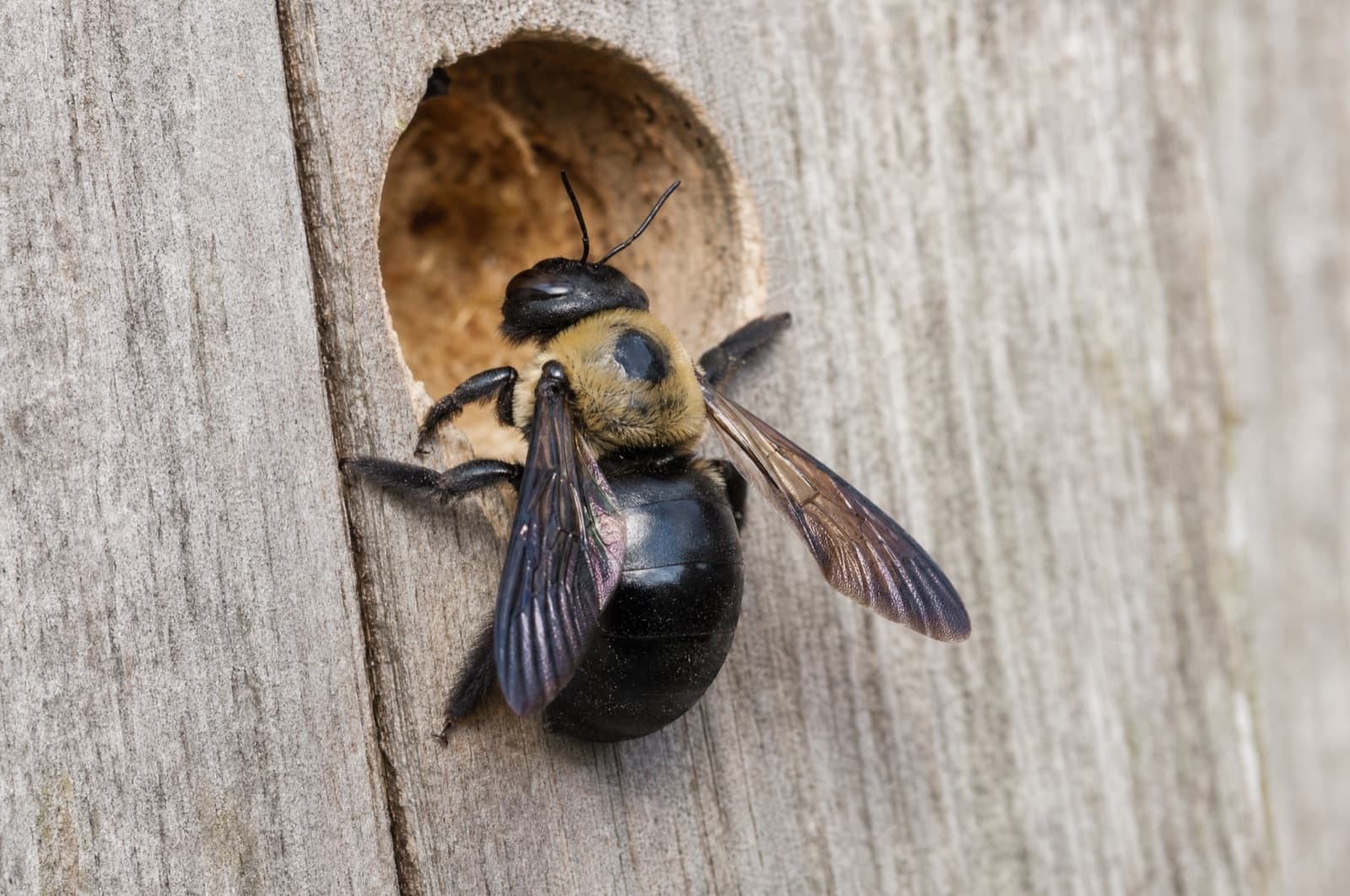
The Eastern carpenter bee is a large (~¾–1 in) native NH pollinator with a shiny black abdomen — it looks like a bumble bee but bores round holes in softwood. The hovering males that seem aggressive cannot sting at all. The real concern is wood damage: round entry holes plus repeated annual reuse can cause cosmetic and eventually structural damage, compounded by woodpecker attack. Prevention (paint/seal exposed wood) beats extermination every time.
- Adult size
- ~¾–1 in — robust, bumble-bee-sized
- Ohio State University Extension (HYG-2074)
- Best visual tell
- Shiny, hairless, black 'patent-leather' abdomen — vs the fuzzy bumble bee
- Ohio State University Extension; University of Maryland Extension
- Male sting risk
- None — males cannot sting
- Penn State Extension; Ohio State Extension
- Entry hole
- Nearly perfectly round, ~½ in diameter
- Penn State Extension
- Gallery depth
- Up to ~10 ft when reused over years
- Ohio State University Extension
- Ecological role
- Native beneficial pollinator — does not eat wood; excavates for brood
- UMD Extension; NH Fish & Game
- DIY verdict
- Partially — prevention (paint/seal) beats extermination; pro for heavy damage
- Penn State Extension; OSU
The big hovering bee is bluffing — and there are real holes to fix
Every spring, New Hampshire homeowners notice a large, loud, hovering bee near their deck, porch, or eaves that seems to dive-bomb anyone who approaches. The fear response is understandable — but the anti-fearmonger fact is the most important thing on this page: the aggressive hovering bee is almost always the male Eastern carpenter bee, and males cannot sting. They have no stinger. The intimidating aerial display is pure territorial bluff.
Female carpenter bees do have a stinger but are docile and almost never sting unless physically handled. The bees themselves are not the problem.
The real concern is wood. Female carpenter bees bore nearly perfectly round ~½-inch holes into unfinished, unpainted, or weathered softwood — decks, fascia boards, cedar railings, eaves, siding, and fence posts. Each spring a female returns to an existing gallery (or bores a new one), extends it, and provisions it with pollen for her larvae. A gallery reused over multiple years can extend up to ~10 feet. Multiple females working the same wood over seasons causes compounding cosmetic and structural damage. Secondary woodpecker damage — birds hammering the wood open to extract larvae — often causes as much or more harm as the bees themselves.
Carpenter bees are native, beneficial pollinators. New Hampshire has multiple carpenter bee species among its 350+ native wild bee species (NH Fish & Game). Extension services and Anchor favor prevention — painting and sealing exposed wood — over extermination. Control is warranted only to protect structural wood from further damage, never as a first response to seeing a large bee hover.
How to identify a carpenter bee — and tell it from a bumble bee
One feature separates the Eastern carpenter bee from every other large bee you'll see in New Hampshire: the shiny, hairless, black abdomen. Bumble bees have fuzzy yellow and black abdomens. Honey bees are much smaller. The round, cleanly bored hole in wood confirms the identification regardless of which bee you've seen.
Eastern carpenter bee
- Scientific name
- Xylocopa virginica
- Family
- Apidae
- Size
- ~¾–1 in — robust, nearly as large as a bumble bee
- Coloration
- Shiny black hairless abdomen; thorax with yellow, orange, or white hairs; males have a white or yellow face patch; females have an all-black face
- Habitat
- Nests bored into unpainted or weathered softwood — decks, railings, fascia, eaves, siding, fence posts, outdoor furniture, barn wood
- Active season
- Emerges late April–May; active through summer; adults overwinter in galleries
- Diet
- Nectar and pollen — do NOT eat wood; wood is excavated only to construct brood chambers
- Reproduction
- Solitary; female excavates gallery with brood cells provisioned with pollen; 1–2 generations per year
- Lifespan
- A single carpenter bee can live up to ~3 years
Xylocopa virginica is the widely distributed eastern North American species; a native pollinator present throughout New Hampshire
The tells — key ID features
- Shiny, hairless, black 'patent-leather' abdomen — the fastest and most reliable separation from any fuzzy bumble bee. Best visual tell.
- Large and robust (~¾–1 in), with a head nearly as wide as the thorax.
- Males have a distinctive white or yellow face patch; females have an all-black face.
- Hovering, territorial males near eaves, decks, and fascia in spring — intimidating display, no stinger.
- Nearly perfectly round ~½-inch entry holes in softwood, often with a coarse sawdust pile and yellowish staining directly below.
Size, to scale
~¾–1 in body length
About the size of a bumble bee or the top joint of your thumb; the entry hole is approximately the diameter of a finger or pencil (~½ in)
Bumble bee (Bombus spp.)
How to tell — Fuzzy yellow-and-black abdomen — not shiny or hairless. Bumble bees nest in the ground (abandoned rodent burrows) or dense grass, not in wood. They do not bore holes. The fuzzy abdomen is the one reliable separator from carpenter bees.
Honey bee (Apis mellifera)
How to tell — Much smaller (~½ in), slimmer, amber to golden-brown with darker bands. Lives in managed hives. Cannot be confused with a carpenter bee at close range; the size difference is dramatic.
Carpenter ant galleries (damage lookalike)
How to tell — Carpenter ants leave rough, irregular galleries with sawdust-like frass (coarse, pale shavings) but NO round entry hole. Carpenter bee holes are nearly perfectly round ~½ in; carpenter ant damage is torn and irregular. No mud tubes (termite).
Signs of a problem
Carpenter bee presence is usually obvious from the combination of large hovering bees and distinctive round holes in softwood. Here is what each sign tells you about activity level and damage stage.
A nearly perfectly round ~½-inch hole in bare, unpainted, or weathered softwood — often on the underside of a horizontal board
What it means — Carpenter bee nest entrance; perfectly round and smooth-edged, unlike the torn irregular opening left by carpenter ants.
A small pile or trail of coarse sawdust (frass) on the surface below a hole
What it means — Active excavation — a female is currently boring or extending a gallery.
Fan-shaped yellowish or brownish-yellow staining on the wood below a hole
What it means — Defecation staining from bees exiting and re-entering the nest; the staining itself is cosmetic but indicates active use.
Large bees hovering and darting aggressively near eaves, deck fascia, or railings in spring
What it means — Territorial male carpenter bees — cannot sting; behavior is pure display. Their patrol area usually circles the active nest holes.
Irregular torn holes or woodpecker damage (chiseled wood, bark removed) around bee holes
What it means — Secondary woodpecker damage — birds are excavating the galleries to reach bee larvae; this damage is often more structurally destructive than the bee holes themselves.
Audible buzzing or vibration from inside a wood member
What it means — Bees moving within galleries — confirms active infestation and indicates gallery length may extend well inside the board.
The real risks, calibrated
The sting risk from carpenter bees is very low. The real risks are to wood: cosmetic damage from holes and staining, structural weakening from deep galleries reused over many years, and secondary woodpecker attack that opens the wood to weather infiltration.
Sting risk
Low riskOnset: Only if female is physically handled
Males cannot sting — period. Females can sting but are docile and rarely do unless captured or squeezed. Outdoor encounters with hovering males, which is what most homeowners experience, carry no sting risk.
Cosmetic wood damage
Low riskOnset: Each active season
Bore holes, sawdust frass, and yellowish staining accumulate on exposed deck and fascia surfaces over seasons. The cosmetic damage alone may be significant on finished wood structures.
Structural damage from reused galleries
ModerateOnset: Years of seasonal reuse
A gallery extended over multiple years by the same or successive bees can reach up to ~10 feet into a wood member. Multiple galleries in the same board can weaken it significantly, especially in fascia, deck joists, or support posts.
Secondary woodpecker damage
ModerateOnset: When bee larvae are present — spring through summer
Woodpeckers (downy, hairy, and red-bellied woodpeckers are the most common offenders in NH) detect bee larvae acoustically and chisel open the wood to extract them. The woodpecker holes are large and irregular, admit moisture, and accelerate wood decay far faster than the bee holes alone.
DIY — what works, what backfires
Honest verdict: partially YES, and prevention is more effective than trying to eliminate existing bees. Extension guidance from Penn State and Ohio State — and Anchor's posture as responsible operators — favors protecting pollinators over broad extermination. The most effective steps are structural: paint and seal exposed wood before bees can drill it.
What actually works
- Paint or apply an oil-based or polyurethane finish to all exposed softwood surfaces — carpenter bees strongly prefer unpainted, weathered, or rough wood and will almost entirely avoid well-finished surfaces. This is the single most effective prevention step.
- Fill nail holes, knots, and surface cracks before painting — imperfections attract females as starting points for galleries.
- Use non-wood materials (vinyl, aluminum, composite, or hardwood) for replacement fascia, railings, or eaves in high-risk areas where appearance of soft pine/cedar has repeated damage.
- Once galleries are confirmed inactive (late summer after brood has emerged, or before new nesting begins in early spring), plug each hole with a wood dowel, caulk, or wooden filler — then paint over it immediately.
- Inspect and re-coat weathered wood surfaces every 2–3 years in NH's climate; sun-bleached or peeling paint is an invitation.
What backfires
- Don't kill carpenter bees indiscriminately — they are native, beneficial pollinators and an important part of New Hampshire's ecosystem. Extension services universally advise against broad extermination; control only to prevent structural damage.
- Don't plug an active hole prematurely and seal larvae or adult bees inside — wait until late summer after brood emergence, or use a plugging approach that allows occupants to exit before sealing.
- Don't rely on surface sprays alone to stop boring. Insecticide sprays applied at entry holes can reduce bee traffic temporarily, but without sealing and painting the wood they will not prevent re-nesting the following spring.
Carpenter bees in New Hampshire
The Eastern carpenter bee (Xylocopa virginica) is a native, beneficial pollinator active in New Hampshire from spring through summer. Bees typically emerge in late April or May as temperatures reliably warm. They target unfinished, unpainted, or sun-bleached softwood on NH's numerous wood-framed decks, cedar/pine railings, fascia boards, and weathered barn boards — the building material NH homes use extensively. Well-maintained painted surfaces are the simplest and most effective defense. Carpenter bees overwinter as adults in their galleries, so the same holes you see this spring were used last year. Control is generally warranted only to prevent structural damage or to stop secondary woodpecker attack.
Peak season
Late April–May emergence; active through summer; overwinter as adults in galleries; peak boring and territorial behavior in spring
You might actually have
- Bumble bees — fuzzy all over, nest in ground, don't bore holes; often confused on first look
- Honey bees — much smaller, slimmer, amber-colored; live in managed hives
We serve these communities
- NH-licensed applicator · #782664
- Same-day service
- Family-owned since 2017
Service Area Map
Southern New Hampshire
When to call Anchor Pest Services for carpenter bees
For minor or early-stage carpenter bee activity, prevention and plugging of inactive galleries are the right approach. Call Anchor when damage is extensive, when galleries are in locations you can't safely reach (high eaves, second-story fascia, structural supports), when secondary woodpecker damage is actively expanding, or when you're uncertain whether the wood damage is from carpenter bees, carpenter ants, or termites — each requires a different response.
When to call a pro
- Heavy or repeated nesting across multiple boards or structural members — more than a few isolated holes.
- Active galleries in eaves, fascia, or structural members that are too high or inaccessible for safe DIY plugging.
- Woodpecker damage expanding around bee holes — birds are actively opening the wood and the damage is escalating.
- Uncertainty about whether you have carpenter bee damage, carpenter ant galleries, or termite damage — the treatment is completely different for each.
Paint and seal all exposed softwood — including the undersides
The most effective prevention is finish paint or a penetrating sealer on every exposed softwood surface, including the undersides of deck boards, the underside of fascia, and railings. Carpenter bees strongly prefer the rough, weathered wood of the undersides that homeowners often miss when painting.
Replace high-risk soft wood with hardwood or non-wood alternatives
If a particular fascia board or railing section is attacked repeatedly, consider replacing it with composite, PVC, or a hardwood like cedar heartwood or ipe — carpenter bees rarely bore into dense hardwoods or non-wood materials.
Seal old galleries before spring
Each fall or early spring before bees emerge, inspect for and plug old holes with a wood dowel and construction adhesive or wood filler, then paint over the repair. Plugged galleries are not re-used; unplugged ones are returned to each spring by the same or new bees.
Not sure it's a eastern carpenter bee?
A licensed NH technician can confirm the species and tell you honestly whether it's a DIY fix or a job for a pro — free inspection, same-day service across Southern New Hampshire.
Frequently asked questions
Sources(6)
- [1]Penn State Extension — Carpenter Bees
male cannot sting; entry hole ~½ in; prevention via painting; control guidance
extensionverified 2026-06-30 - [2]Ohio State University Extension — Carpenter Bees (HYG-2074)
adult size, shiny hairless abdomen vs bumble bee, gallery depth up to 10 ft, lifespan ~3 years
extensionverified 2026-06-30 - [3]University of Maryland Extension — Carpenter Bees
hairless abdomen vs bumble bee; prevention; control
extensionverified 2026-06-30 - [4]University of Maryland Extension — Meet a Pollinator: Carpenter Bee
ecological role as native pollinator; pollinator protection framing
extensionverified 2026-06-30 - [5]Mississippi State Extension — Carpenter Bees vs Bumble Bees
visual comparison; abdomen hair pattern distinction
extensionverified 2026-06-30 - [6]NestWatch (Cornell Lab of Ornithology) — Woodpecker and Nest Box Damage
woodpecker secondary damage: excavating larvae from carpenter bee galleries
industryverified 2026-06-30
Written & reviewed by
VerifiedDaniel Brady
NH-Licensed Pesticide Applicator · License #782664 (NHDAMF, RSA 430)
Daniel Brady is the New Hampshire–licensed applicator behind Anchor Pest Services, a family-owned pest control company serving the Manchester area since 2017.
Last updated 2026-06-30

New Hampshire pest control
Dealing with eastern carpenter bees in your home?
Anchor Pest Services identifies and handles eastern carpenter bee problems across southern and central New Hampshire. Family-owned since 2017, NH license #782664.
- NH-licensed applicators (#782664)
- Same-day service · free inspection
- Family-owned since 2017
Your next step
- What to do next
How to Get Rid of Carpenter Bees
Read the answer - What to do next
What Attracts Carpenter Bees to Your House?
Read the answer - Also relevant
Why do carpenter bees drill holes in wood?
Read the answer - Related guide
Carpenter Ant — Quick ID for New Hampshire Homeowners
Read the answer - Also relevant
Carpenter Ant Damage: Year-by-Year Timeline and What It Actually Looks Like
Read the answer