
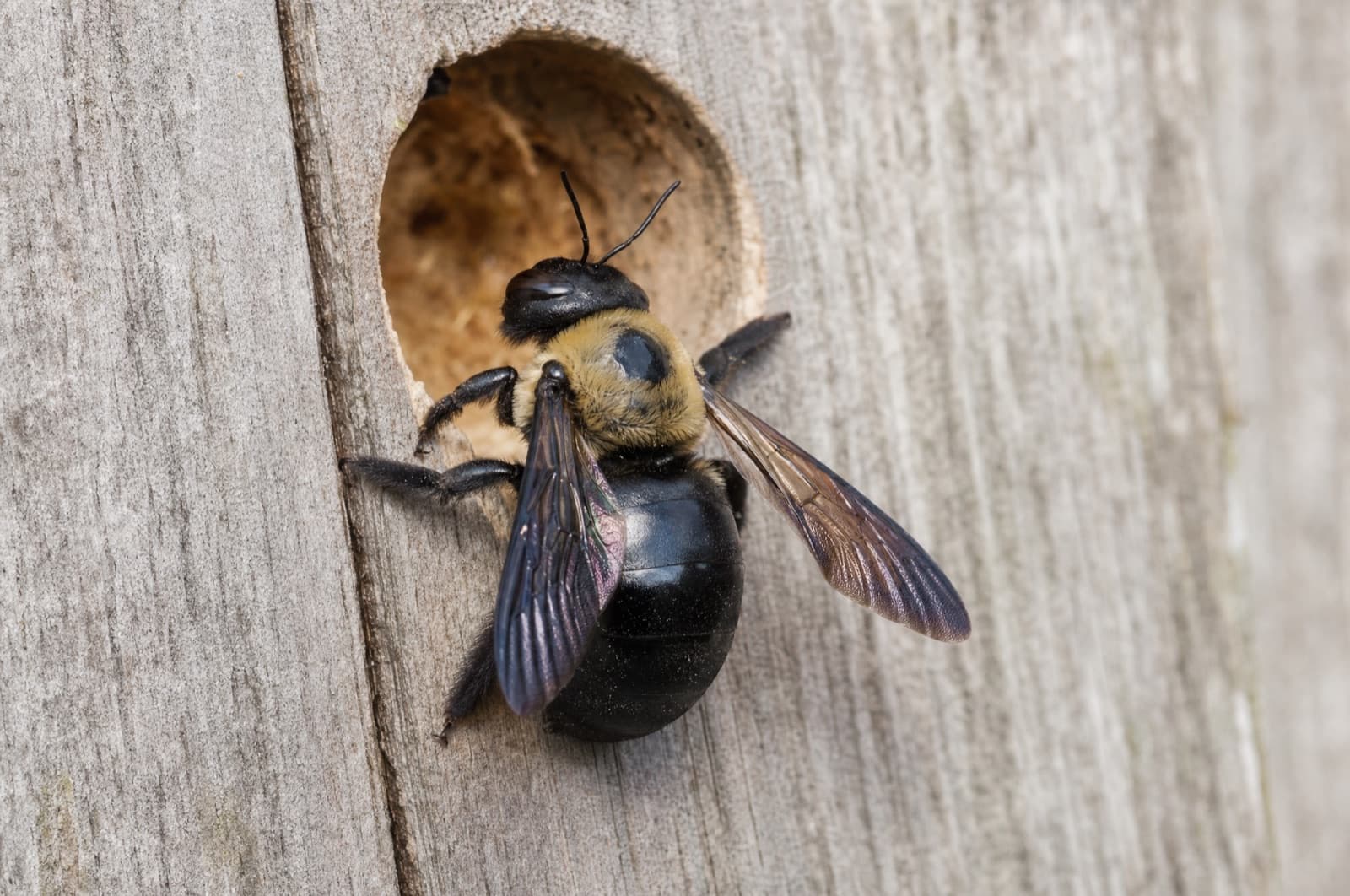
What Attracts Carpenter Bees to Your House?
At a glance
- Short answer: Carpenter bees choose bare, weathered softwood they can tunnel — a painted board is a far less inviting nest site.
- The verdict: Something specific
The attractant verdict
Four possible answers to why this species turned up. Three stay unlit — and that's the argument: the honest answer could have been any of them, and for this species it wasn't.
Carpenter bees choose bare, weathered softwood they can tunnel — a painted board is a far less inviting nest site.
Most advice, including our own previous page, says carpenter bees are "primarily attracted to specific factors that meet their needs for nesting and foraging," without naming what those factors actually are. The specific, useful answer is about the surface of the wood, not the wood as a category.
Female carpenter bees excavate nesting galleries in wood, and they strongly prefer bare, unfinished, or weathered softwoods — cedar, redwood, cypress, pine, and fir — over wood that's painted or pressure-treated. A finished surface removes both the visual cue and the physically easier substrate that makes excavation worthwhile. Existing nail holes, cracks, and old bee holes, along with the sun-exposed undersides of eaves, fascia boards, deck railings, and window trim, are the classic starting points. Carpenter bees do not eat wood at all — adults feed on nectar and pollen outdoors — so the wood is purely a nest site, not a food source.
“Carpenter bees choose bare, weathered softwood they can tunnel — a painted board is a far less inviting nest site.”
Bare, unpainted, or weathered softwood — cedar, redwood, cypress, pine, or fir — on sun-exposed eaves, fascia, deck railings, or trim, often with an existing nail hole or crack to start from.
It turns a vague 'they're attracted to my house' into a specific, checkable condition: which exterior wood surfaces are unfinished or weathered enough to be excavated. Two houses built from the same lumber can have very different exposure depending only on whether that wood is painted.
Calibrated from: University of Maryland Extension, Ohio State University Extension, and Purdue Extension: carpenter bees strongly prefer bare, unfinished, or weathered softwood over painted or pressure-treated wood for nest excavation.
Why it's here, in full
It's the finish, not the species of wood
Carpenter bees don't eat wood — adults feed entirely on nectar and pollen outdoors — so any wood they excavate is purely a nesting site, and the deciding factor is how easy that wood is to tunnel into. University of Maryland Extension, Ohio State University Extension, and Purdue Extension all describe the same strong preference: bare, unfinished, or weathered softwoods such as cedar, redwood, cypress, pine, and fir are excavated readily, while painted or pressure-treated wood is rarely attacked at all.
That single distinction explains most of the pattern people notice around a house. Sun-exposed, unpainted surfaces — the underside of eaves and fascia boards, deck railings, unfinished trim, old fence posts — are the classic starting points, often beginning at an existing nail hole, crack, or old bee hole from a previous season. A neighboring house with the same style of construction but a well-maintained paint job on its trim can see far less activity, simply because the surface itself is a much weaker nesting cue.
How to tell it's actually this species
Real signs only — a species with four honest tells gets four, and stops. Where a sign is weak on its own, we say so.
Perfectly round, roughly half-inch entry holes bored into the underside of a fascia board, eave, deck railing, or other unpainted softwood
A pile of fine sawdust directly below an entry hole
Large, robust bees hovering territorially near eaves or a deck, particularly noticeable in spring
Yellowish staining on wood or siding below a nest entrance, from bee waste
Want carpenter bee gone?
This page only answers why it's here. Every removal step for this exact species — what to seal, what to set, what actually works — lives on its own dedicated guide.
Two questions, two pages
Here: why it turned up at all — the honest answer, blame removed.
There: the step-by-step removal guide for this exact species.
Key takeaways
- Carpenter bees don't eat wood — they excavate it purely as a nest site.
- The specific driver is bare, unfinished, or weathered softwood, not wood construction generally.
- Painted or pressure-treated wood is rarely attacked.
- Repair and prevention steps are covered at /top-diy-methods/carpenter-bee.
Found round holes in unpainted trim?
This page is about why carpenter bees chose that wood. Repair and prevention are covered at /top-diy-methods/carpenter-bee.
Frequently asked
Sources(3)
- [1]University of Maryland Extension — Carpenter Bees
Carpenter bees prefer bare, unfinished, or weathered softwood for nest excavation
extensionverified 2026-07-17 - [2]Ohio State University Extension — Carpenter Bees (HYG-2074)
Preferred softwood species and the low rate of attack on painted or treated wood
extensionverified 2026-07-17 - [3]Purdue Extension — Carpenter Bees (E-252)
Nest-site selection behavior and the reduced attractiveness of finished wood
extensionverified 2026-07-17
Written & reviewed by
VerifiedDaniel Brady
NH-Licensed Pesticide Applicator · License #782664 (NHDAMF, RSA 430)
Daniel Brady is the New Hampshire–licensed applicator behind Anchor Pest Services, a family-owned pest control company serving the Manchester area since 2017.
Last updated Jul 2026
It's the finish, not the frame
We check the exposed wood, not just the holes
Inspections across southern and central New Hampshire for carpenter bee activity on eaves, fascia, and trim.
- Family-owned in Manchester since 2017
- NH commercial applicator #782664, category F1
- We will tell you when the answer is do nothing
NH License #782664 · No obligation · We answer in person
Your next step
- What to do next
Carpenter Bee in New Hampshire — ID, Signs & Control
Read the answer - What to do next
Do Carpenter Ants Eat Wood? (No — Here's What They Actually Do)
Read the answer - Also relevant
How to Get Rid of Carpenter Bees
Read the answer - Also relevant
Why do carpenter bees drill holes in wood?
Read the answer - Also relevant
Do carpenter bees weaken decks or fences?
Read the answer