
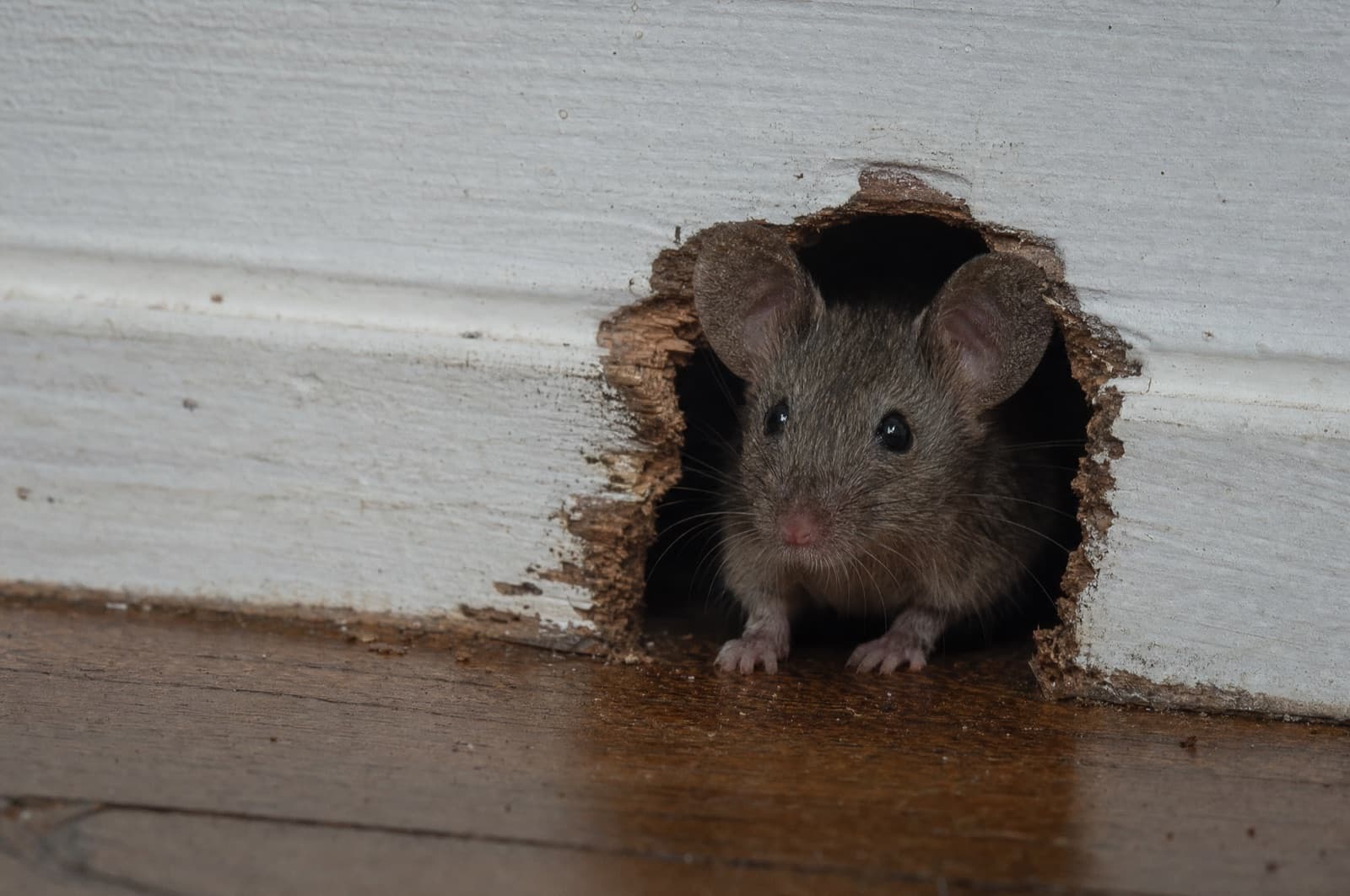
What Materials Can Rats Not Chew Through?
At a Glance
- Short answer: Hard barriers (concrete, steel, sealed steel wool) stop rats; soft materials (wood, drywall, foam, vinyl) don't.
- Key fact: Rat incisors rate ~5.5 on the Mohs hardness scale — harder than copper or iron.
- NH relevance: NH homes' common soft points — sill plates, foundation vents, wood trim — are exactly the materials rats defeat easily.
- Action needed: Seal gaps with a chew-proof material, not just caulk or foam alone.
The short of it
A rat's incisors rank about 5.5 on the Mohs hardness scale — harder than copper or iron, slightly harder than human tooth enamel — and they grow continuously, so rats must gnaw to wear them down. The practical rule: a rat can chew anything softer than its teeth. Solid cured concrete, steel, galvanized hardware cloth, sheet metal, and steel wool packed with sealant are effectively rat-proof. Wood, drywall, vinyl, rubber, thin aluminum, and foam sealant used alone are not — a rat with an edge to bite will get through them.
What Materials Can Rats Not Chew Through — By the Numbers
5.5
Mohs hardness of rat incisors (vs. ~5 for human enamel)
19-gauge
Recommended hardware-cloth gauge for rat exclusion
24-gauge+
Minimum sheet-metal thickness that resists gnawing
2 in
Reinforced concrete thickness that resists rat gnawing
Materials rodents can — and can't — chew through
Rat incisors rate about 5.5 on the Mohs hardness scale — the dividing line between materials that stop them and materials that don't.
Solid, cured concrete or stone
Rodent-proofImpervious unless already cracked or poorly cured; rats exploit weak spots rather than gnawing intact concrete.
Galvanized hardware cloth (19-gauge, ½-inch mesh)
Rodent-proofThe standard rat-exclusion mesh; must be installed with no bitable edge.
Heavy sheet metal (24-gauge or heavier)
Rodent-proofDurable barrier for pipe and wall penetrations.
Steel wool, packed tight + sealed with caulk/foam
Rodent-proofMetal fibers deter gnawing, but ONLY works anchored — loose steel wool can be pulled out.
Wood
Can chewCommon at sill plates and trim; rats gnaw through it easily.
Drywall / gypsum board
Can chewNo resistance once a rat reaches an interior wall cavity.
Vinyl, rubber, thin aluminum flashing
Can chewSoft enough for a rat's incisors; used in siding and weatherstripping.
Expanding foam or caulk, used alone
Can chewFine as a sealant to anchor a hard material, but no barrier on its own.
Bottom line — Rats defeat anything softer than their teeth. Use hard barriers — steel, hardware cloth, concrete, or sealed steel wool — with no bitable edge, and never rely on foam, caulk, wood, or vinyl alone.
The full picture
Materials rats CANNOT chew through
Solid, cured concrete and stone are effectively impervious unless already cracked or poorly cured. Steel and galvanized hardware cloth resist gnawing — for rats specifically, use 19-gauge mesh with openings no larger than ½ inch. Heavy sheet metal (24-gauge or heavier) makes a durable barrier around pipes and wall penetrations. Steel wool is also effective, but only when packed tightly into a gap and held in place with caulk or expanding foam — the metal fibers injure a rat's mouth and the sealant keeps it from being pulled loose. These materials share two things: they're harder than the rat's teeth, and correctly installed, they leave no edge to start gnawing on.
Materials rats CAN chew through
Extension research lists wood, rubber, vinyl, plastic, aluminum sheeting, and even standard concrete block among materials rats readily gnaw through. Add drywall and gypsum board, lead sheeting, thin aluminum flashing, and expanding foam or caulk used alone — all common at NH home entry points like sill plates, utility penetrations, and trim. These fail for the same reason the hard materials succeed: they give a rat's teeth something softer to bite into, and foam or caulk on its own offers no resistance at all once a rat starts working at an edge.
Why installation matters as much as material
Extension guidance stresses that rats "often gnaw into walls at corners or where joints provide an edge." A chew-proof material installed with a gap or a loose seam is only as good as its weakest edge. That's why professionals pack hardware cloth or steel wool into an opening and cap it, rather than relying on a single soft material to bridge a gap. Combining a hard barrier with proper sealing — not one or the other — is what actually holds.
Bottom line — Rats defeat anything softer than their teeth: wood, drywall, vinyl, rubber, thin aluminum, and foam or caulk alone all fail. Solid cured concrete, steel, galvanized hardware cloth, heavy sheet metal, and tightly packed, sealant-anchored steel wool hold. Use the hard materials at entry points, install them with no bitable edge, and pair them with the full exclusion protocol for lasting results.
Not sure what's letting rats in?
Anchor's licensed NH technicians inspect for every gap that matters and seal it with materials rats can't defeat.
Why this matters in New Hampshire
Older NH housing stock — especially homes with wood sill plates, unlined foundation vents, and softwood trim — offers rats exactly the chewable materials they need at ground level. Completing hard-material exclusion before Manchester's first hard frost (~Oct 19 at 50% probability, ~Oct 29 at 80%, NOAA 1991–2020) closes the door before the fall push indoors, when rats are actively searching for winter harborage.
Key local data
Older southern-NH homes with unlined foundation vents, stone cellars, and softwood trim offer rodents ready entry and chewable material (UNH Cooperative Extension).
- NH-licensed applicator · #782664
- Same-day service
- Family-owned since 2017
Service Area Map
Southern New Hampshire
Frequently asked
Sources (5)
- [1]
- [2]
- [3]
- [4]
- [5]
Written & reviewed by
VerifiedDaniel Brady
NH-Licensed Pesticide Applicator · License #782664 (NHDAMF, RSA 430)
Daniel Brady is the New Hampshire–licensed applicator behind Anchor Pest Services, a family-owned pest control company serving the Manchester area since 2017.
Professional Rodent Control
Foam and Caulk Alone Won't Hold — We Seal It Right
Anchor Pest Services identifies every ½-inch-plus gap on your property and closes it with the hard materials rats can't chew through, then backs it with monitored trapping. Family-owned since 2017, NH license #782664.
- Same-day service across southern NH
- NH-licensed applicators (#782664)
- Free inspection — no flat-price guesswork
NH License #782664 · No obligation · We answer in person
Your next step
- Book a NH pro
Rodent Control in New Hampshire
Mice and rats move indoors every fall. We trap, seal entry points and keep them out.
Book now - Next step
Rodent Mites After Mice or Rats Are Removed
Read the answer - Related guide
How Big of a Hole Can a Rat Squeeze Through?
Read the answer - Related guide
Can Rats Chew Through Walls or Floors?
Read the answer - Related guide
Does Steel Wool Stop Mice From Entering?
Read the answer - Related guide
What Steps Prevent Rats From Coming Back?
Read the answer