
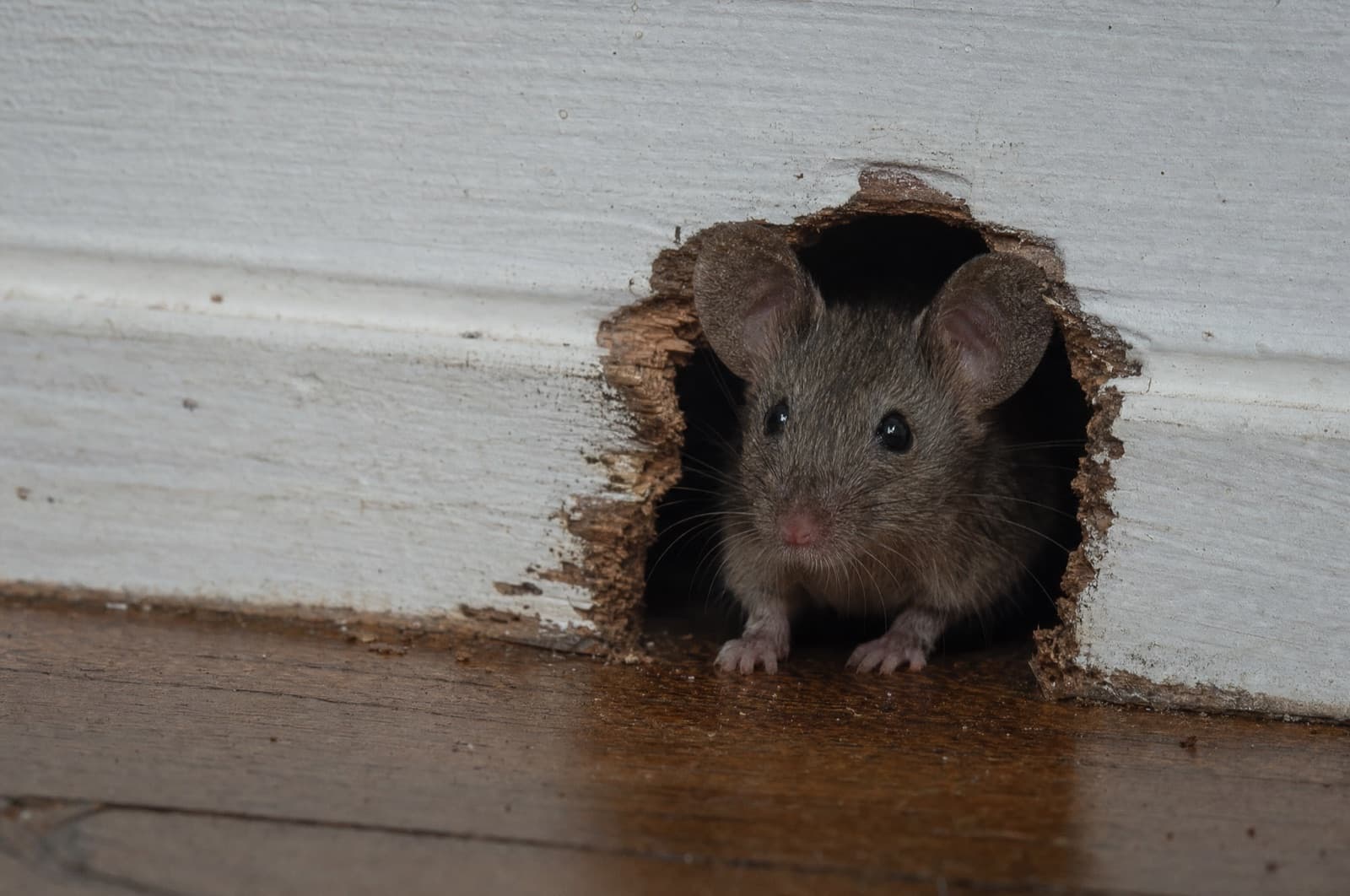
Can Rats Chew Through Walls or Floors?
At a Glance
- Short answer: Yes, for wood, drywall, and most soft materials; solid cured concrete generally resists them.
- Key fact: Rats are linked to an estimated 20–25% of fires of undetermined origin, largely from gnawed wiring.
- NH relevance: Wood-framed NH homes with wall-cavity access from attics or foundation gaps are classic rat nesting sites.
- Action needed: Treat gnaw marks and wall-cavity activity as a prompt-action signal, not a wait-and-see situation.
The short of it
Rats readily chew through wood, drywall, plastic, vinyl, rubber, and aluminum sheeting found in most residential walls and floors, and they can enlarge existing cracks or weep holes in concrete. Solid, properly cured concrete genuinely resists them. The damage is real but rarely dramatic on its own — the bigger structural risk is rats chewing electrical wiring inside wall cavities, which the National Pest Management Association links to a meaningful share of fires of undetermined origin.
Can Rats Chew Through Walls or Floors — By the Numbers
20–25%
Estimated share of undetermined-origin fires linked to rodent wire-gnawing (NPMA)
5.5
Mohs hardness of rat incisors — harder than most wall materials
2 in
Reinforced concrete thickness that resists rat gnawing
0
Fearmongering intended — most rat damage is contamination, not fire
The full picture
What rats can and can't chew through
Rats gnaw through wood framing, drywall, plastic, vinyl, rubber, and aluminum sheeting with little difficulty — their incisors are harder than all of these materials and grow continuously, forcing regular use. Concrete is the honest exception: solid, properly cured concrete resists gnawing, which is why intact slab foundations are effective barriers. But rats exploit weakness rather than raw strength — they enlarge existing cracks, use brick weep holes and pipe penetrations, and can work through crumbling or low-quality concrete block. An Orkin Canada entomologist has noted that rats generally prefer to gnaw softer material over concrete, but cautioned that substandard cinder block may not stop a motivated rat.
The real structural risk: wiring, not holes
The most serious risk from rats in walls isn't the chewed hole itself — it's electrical wiring. Rodents gnaw wire insulation to wear down their teeth, exposing conductors that can arc and ignite surrounding framing or insulation. The National Pest Management Association's own trade research puts rodents at 20–25% of fires with an undetermined cause, tied directly to their habit of chewing wiring and gas lines. We present this without fearmongering: most rat activity in a wall causes contamination, noise, and nuisance damage rather than a fire — but the pathway is real, and it's a legitimate reason to act on early signs rather than wait.
What to do about it
Because rats gnaw at edges, the fix is removing the bitable edge, not just patching the hole they made. Cap penetrations with mortar or metal rather than wood or foam, back gaps with hardware cloth, and repair cracked concrete instead of caulking over it. Scratching in walls, gnaw marks at baseboards, or grease rub marks along a wall cavity are signs worth acting on promptly.
Bottom line — Rats readily chew through wood, drywall, and most soft wall and floor materials; solid cured concrete resists them barring existing cracks or poor quality. The structural damage itself is usually manageable, but chewed wiring is a documented fire-risk pathway worth taking seriously — remove the bitable edges and seal with materials that actually stop them.
Hearing scratching in the walls?
Anchor's licensed NH technicians inspect wall cavities, wiring risk, and entry points, then seal with materials rats can't chew.
Why this matters in New Hampshire
Wood-framed construction and older foundations are common across southern and central NH, giving rats plenty of chewable wall and floor material once they're inside. Rats that gain wall-cavity access ahead of Manchester's first hard frost (~Oct 19 at 50% probability, ~Oct 29 at 80%, NOAA 1991–2020) can nest and gnaw undisturbed through the coldest months, which is why acting on early signs — before winter sets in — matters more than the size of the damage seen so far.
Key local data
Older southern-NH homes with unlined foundation vents, stone cellars, and softwood trim offer rodents ready entry and chewable material (UNH Cooperative Extension).
- NH-licensed applicator · #782664
- Same-day service
- Family-owned since 2017
Service Area Map
Southern New Hampshire
Frequently asked
Sources (4)
- [1]
- [2]
- [3]
- [4]
Written & reviewed by
VerifiedDaniel Brady
NH-Licensed Pesticide Applicator · License #782664 (NHDAMF, RSA 430)
Daniel Brady is the New Hampshire–licensed applicator behind Anchor Pest Services, a family-owned pest control company serving the Manchester area since 2017.
Professional Rodent Control
Don't Wait for the Damage to Show
Anchor Pest Services inspects wall and floor cavities for rat activity, addresses the population, and seals entry points with chew-proof materials. Family-owned since 2017, NH license #782664.
- Same-day service across southern NH
- NH-licensed applicators (#782664)
- Free inspection — no flat-price guesswork
NH License #782664 · No obligation · We answer in person
Your next step
- Book a NH pro
Rodent Control
Book now - Next step
Are rodents more likely to breed indoors during winter?
Read the answer - Related guide
What Materials Can Rats Not Chew Through?
Read the answer - Related guide
How Big of a Hole Can a Rat Squeeze Through?
Read the answer - Related guide
What Steps Prevent Rats From Coming Back?
Read the answer - Related guide
What Materials Can Rats Not Chew Through?
Read the answer