
Skip to content
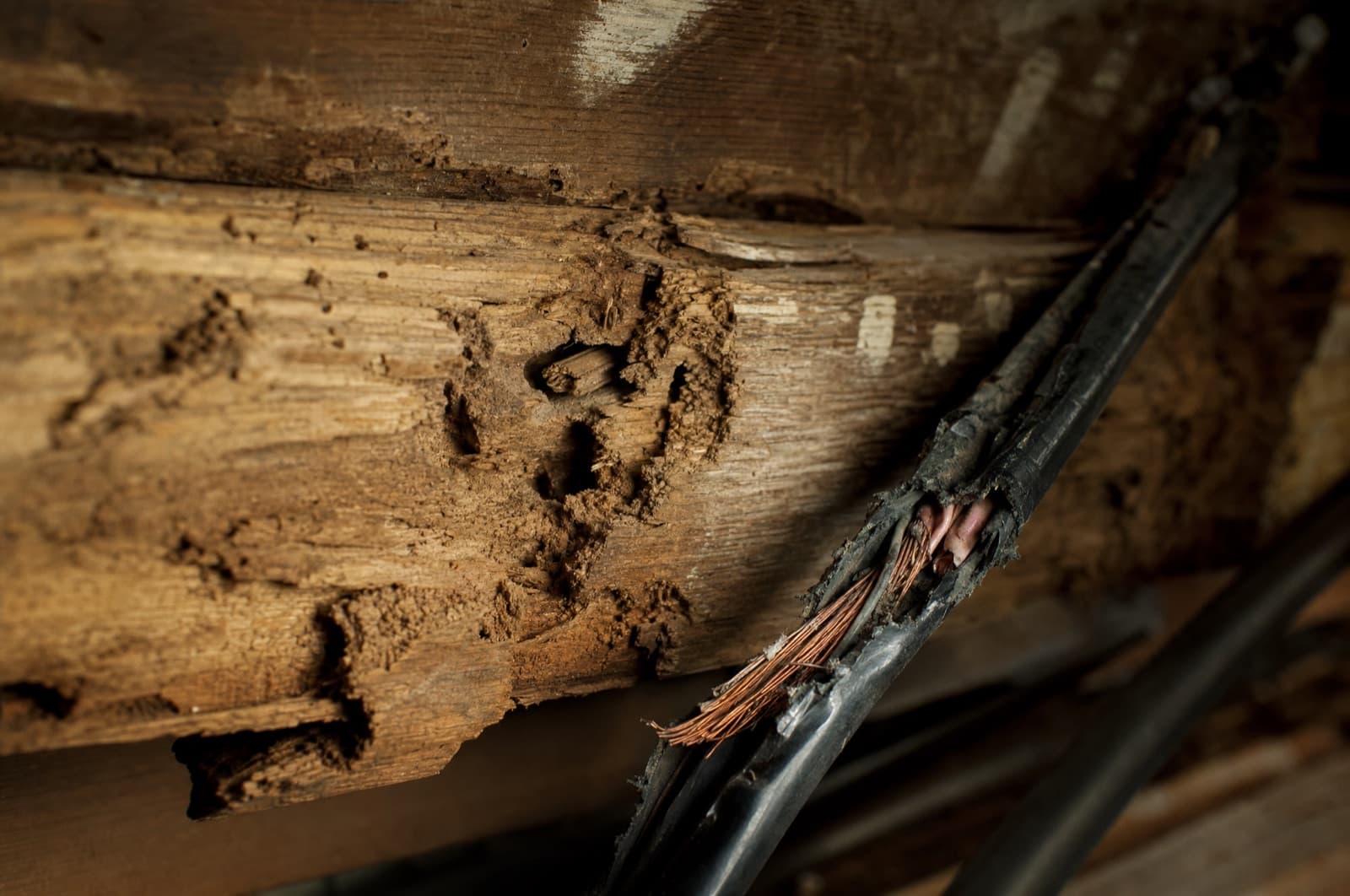
Pest damage evidence — a gnawed structural beam and a chewed electrical wire
Daniel Brady · NH-Licensed Pesticide Applicator · License #782664
Reviewed by Daniel Brady

Do pests ruin landscaping or decorative plants?

Cosmetic damage, mostly — "ruin" fits a short, specific list
Rarely, if "ruin" means a plant dying or being permanently destroyed. Per University of Minnesota Extension, adult Japanese beetle damage usually affects only the appearance of plants, and healthy, mature trees and shrubs tolerate a lot of feeding without significant, long-term injury — and that pattern holds for most ornamental pests: aphid honeydew and sooty mold, lace-bug stippling, and most caterpillar tents are cosmetic and self-limiting. A defined minority — active wood borers, heavy sustained scale infestations, repeated invasive caterpillar defoliation, and voles girdling young tree trunks — can genuinely kill the specific plant affected. Either way, this is horticulture, and the right help is UNH Cooperative Extension, a garden center, or an ISA-certified arborist, not a pest-control contract.

At a glance

  • Can it?: Yes, but
  • How common: Occasional
  • Hype: Overstated
  • Evidence: Well documented
The honest answer

The short of it

The verdict
Cosmetic damage, mostly — "ruin" fits a short, specific list

Rarely, in the full sense of the word. Most landscape-pest damage — aphid honeydew, beetle skeletonizing, lace-bug stippling, caterpillar tents — is cosmetic, and healthy established plants recover on their own. A short list of genuine exceptions (borers, heavy scale, repeated invasive defoliation, vole girdling) can actually kill a plant, but that's the exception, not the rule.

The correction

What they claim vs. what the evidence supports

One shared severity track, two markers. The span between them is the hype delta — named out loud.

The claim — pests ruining landscaping and decorative or ornamental plants

That insects and other pests are laying waste to ornamental plantings and that routine spraying is needed to protect them — a framing that treats every leaf hole, stippled leaf, or skeletonized shrub as an emergency requiring intervention.

Where the claim comes from: Lawn-and-tree-service and pest-marketing content, which benefits from treating ordinary cosmetic feeding as damage serious enough to justify a paid spray program.

Severity, 0–100
Hype says65
30Evidence says
Hype delta35point gapWell documented
The evidence

Per University of Minnesota Extension, adult Japanese beetle damage usually affects only the appearance of plants, and healthy, mature trees and shrubs tolerate a lot of feeding without significant, long-term injury. The same pattern holds for aphid honeydew and sooty mold, lace-bug stippling, and most caterpillar tents — cosmetic and self-limiting. A genuinely lethal minority exists and is well documented: active borers, heavy sustained scale infestations, repeated invasive defoliation (spongy moth, winter moth), and vole girdling of young trees.

The gap

"Ruin" is the wrong word for the vast majority of ornamental-pest damage people notice and worry about — it's cosmetic, and an established, healthy plant shrugs it off. The word genuinely applies to a short, specific list: active borers, heavy scale, repeated invasive defoliators, and voles girdling a trunk. Even then, the fix is plant-health care and correct identification, not blanket spraying of everything in the yard.

Damage assessment

What is actually harmed

Damage verdict
Cosmetic damage, mostly — "ruin" fits a short, specific list
CosmeticCan it?Yes, but
The specimen
Pest
A broad range of ornamental pests — aphids, Japanese beetles and other chafers, lace bugs, caterpillars (both cosmetic web-makers and invasive repeat defoliators), scale insects, wood borers, and voles
What is in question
Ornamental trees, shrubs, and decorative plantings in the home landscape
How common
Occasional
Evidence
Well documented
Mechanism

Damage mechanisms vary by pest. Sap-sucking insects (aphids, scale, lace bugs) cause leaf stippling, honeydew fouling, and sooty mold that blocks light but doesn't invade plant tissue. Chewing insects (beetles, caterpillars) skeletonize leaves or leave ragged holes, reducing a plant's photosynthetic surface for a season. Wood-boring insects tunnel into stems and trunks, cutting into the plant's actual vascular tissue and causing dieback. Voles girdle bark and roots at the trunk base, most often hidden under snow cover in winter. Most of this is surface-level damage the plant's vascular system recovers from; borers, heavy scale, and girdling cut into the tissue that actually moves water and nutrients, and that's what can kill the plant.

Actually at risk4
  • The appearance of most ornamental plantings under typical insect feeding — leaf holes, honeydew fouling, stippled foliage
  • Survival of plants attacked by active wood borers or heavy, sustained scale infestations
  • Survival of plants under repeated (two or more consecutive years) invasive defoliation from spongy moth or winter moth
  • Young or newly planted trees girdled by voles at the trunk base, especially under winter snow cover
Not at risk — despite the myth3
  • Survival of most established, healthy ornamentals under typical, single-season insect feeding
  • Your home's structure, wiring, or any building system
  • Human health — this is a plant-health matter, not a property or health hazard
Worst realistic case
Loss of a specific ornamental to active borers, heavy scale, repeated invasive defoliation, or vole girdling. For the great majority of ornamental-pest encounters, the realistic ceiling is a temporarily unsightly plant that fully recovers within the same growing season or the next.

Assessed from: UNH Cooperative Extension Beetles on Ornamental Plants; UNH Cooperative Extension Aphids fact sheet; Penn State Extension Flowers & Ornamentals; University of Minnesota Extension Japanese beetles

The compounding clock

Does it get worse if you ignore it?

Over time
Self-limiting — it ends

Self-limiting for most ornamental-pest feeding — cosmetic damage tracks the season and plants recover; a specific minority genuinely compounds.

The timeline
3 stages
  1. WeeksReversible

    Cosmetic feeding — aphid honeydew, beetle skeletonizing, lace-bug stippling — becomes visible on foliage. Correct identification at this point is what separates the cosmetic majority from the lethal minority.

  2. One seasonReversible

    For the great majority of pests, feeding peaks and then declines with the season, natural predators, and weather. The plant recovers fully by the following year without intervention.

  3. YearsPermanent

    For the lethal exceptions specifically — active borers, sustained heavy scale, repeated invasive defoliation, or unaddressed vole girdling — damage compounds year over year and can kill the specific plant affected.

What stops the clock
Correct pest identification before treating anything. Most ornamental feeding needs nothing beyond routine plant-health care — proper watering, mulching, and the right plant for the site — plus conserving the natural predators that check pest populations for free. For the lethal minority, an ISA-certified arborist's targeted intervention (treating an active borer, guarding a young trunk against voles with hardware cloth) stops the specific threat before it kills the plant.
Repair scope

Who actually fixes this

Scope, not dollars — the honest answer to “how expensive is it,” routed to the right trade.

Who fixes it
You — a DIY patch
Effort
An afternoon

This is a horticulture and plant-health task, not a pest-control service or a repair — diagnosing the actual pest and giving the plant basic care handles the great majority of cases; only the lethal minority needs a trade-level intervention.

The right order
  1. 1
    Identify the actual pest and whether it's a cosmetic feeder or one of the genuinely lethal exceptions (active borers, heavy scale, repeat invasive defoliators, or voles)
  2. 2
    For cosmetic damage, address plant-health basics — watering, mulching, and the right plant for the site — and let the season run its course
  3. 3
    For a confirmed lethal pest on a valued plant, bring in an ISA-certified arborist or garden center for targeted treatment and correct timing
Route by symptom
  • ISA-certified arboristAn active borer, heavy scale infestation, repeated invasive defoliation, or vole girdling is confirmed on a valued tree or shrub
  • Nobody — nothing to repairDamage is cosmetic and the plant is established and healthy — most ornamental-pest encounters need nothing beyond routine plant care
Do not
  • Don't sign up for a blanket spray program based on cosmetic damage alone — extension sources are consistent that healthy plants tolerate ordinary feeding without long-term harm
  • Don't skip correct pest identification — treating a cosmetic feeder as if it were a borer wastes effort and can harm the beneficial insects that keep real pests in check
Where we help — and where we don't

This is genuinely not an Anchor job. Ornamental and landscape plant health is a horticulture matter — route it to UNH Cooperative Extension, a garden center, or an ISA-certified arborist, not a pest-control treatment plan. See /leaves-pest-faq for the fuller plant-diagnostic triage.

In depth

The full picture

01

Why "ruin" is almost always the wrong word

The great majority of what homeowners notice on ornamental plants — stippled leaves from lace bugs, honeydew and sooty mold from aphids, skeletonized foliage from Japanese beetles, a season of caterpillar tents — is cosmetic. Per University of Minnesota Extension, adult Japanese beetle damage usually affects only the appearance of plants, and healthy, mature trees and shrubs tolerate a lot of feeding without significant, long-term injury. That's the honest baseline for this entire category: an unsightly plant in July is very often a completely normal plant again by the following spring.

02

The short, specific list where it isn't

A defined minority of landscape pests genuinely can kill a plant, and it's worth naming them precisely rather than treating the whole category as equally risky. Active wood borers tunnel into stems and trunks and cut into the tissue that actually moves water and nutrients. Heavy, sustained scale infestations can do the same over time. Repeated (two or more consecutive year) defoliation by the invasive spongy moth or winter moth depletes a tree's energy reserves faster than it can rebuild them. And voles girdling the bark at a young tree's trunk base, often hidden under winter snow, can cut off the tree's circulation entirely. These four are the genuine exceptions — everything else on this page is the cosmetic rule.

03

What actually helps — and why it isn't Anchor

Correct identification is the single highest-value step: it tells you immediately whether you're looking at the cosmetic majority (do nothing, or give the plant basic care) or the lethal minority (call in help before the plant is lost). Either way, the actual fix lives in horticulture and arboriculture — UNH Cooperative Extension, a local garden center, or an ISA-certified arborist for a valued tree or shrub. None of this touches a home's structure or systems, and treating it as a pest-control matter to justify a service call would be exactly the overreach this hub exists to call out.

Key takeaways
5 points
  • Most landscape-pest damage — aphid honeydew, beetle skeletonizing, lace-bug stippling, caterpillar tents — is cosmetic, and healthy established plants recover fully.
  • A short, specific list — active borers, heavy scale, repeated invasive defoliation, and vole girdling — can genuinely kill the specific plant affected.
  • Correct pest identification is the single highest-value step: it tells you whether you're facing the cosmetic majority or the lethal minority.
  • None of this touches a home's structure, wiring, or systems — it's a plant-health question from start to finish.
  • The right resource is UNH Cooperative Extension, a garden center, or an ISA-certified arborist, not a pest-control treatment plan.

This one's a garden question, not a pest control one.

Landscape and ornamental plant damage is horticulture — UNH Cooperative Extension, a garden center, or an ISA-certified arborist are the right call.

Follow-up questions

Frequently asked

Sources & citations(4)
  1. University of Minnesota Extension — Japanese beetles

    Adult Japanese beetle damage usually only affects appearance; healthy trees/shrubs tolerate heavy feeding without long-term injury

    extensionverified 2026-07-16
  2. UNH Cooperative Extension — Beetles on Ornamental Plants

    New Hampshire ornamental beetle/chafer damage patterns

    extensionverified 2026-07-16
  3. UNH Cooperative Extension — Aphids fact sheet

    Sap-sucking feeding, honeydew, and sooty mold on ornamental plants

    extensionverified 2026-07-16
  4. Penn State Extension — Flowers and Ornamentals: Pests and Diseases

    Common ornamental-plant pest survey and cosmetic-versus-lethal distinction

    extensionverified 2026-07-16

Written & reviewed by

Verified

Daniel Brady

NH-Licensed Pesticide Applicator · License #782664 (NHDAMF, RSA 430)

Daniel Brady is the New Hampshire–licensed applicator behind Anchor Pest Services, a family-owned pest control company serving the Manchester area since 2017.

Verify license

Last updated Jul 2026

Honest pest help for New Hampshire homes

We'll Tell You When It's Not Our Job.

Damage to landscaping and decorative plants is a horticulture issue, not a structural or household pest problem — we won't sell you a treatment plan for it. If pests are also a problem inside your home, Anchor Pest Services genuinely helps with that. Family-owned since 2017, NH license #782664, serving Manchester, Nashua, Concord and nearby towns.

  • Honest advice — we route landscape and plant-health questions to UNH Extension, garden centers, and arborists
  • NH-licensed applicators (#782664) — free inspection, same-day service
  • Household and structural pest control across southern and central New Hampshire

NH License #782664 · No obligation · We answer in person