
Skip to content
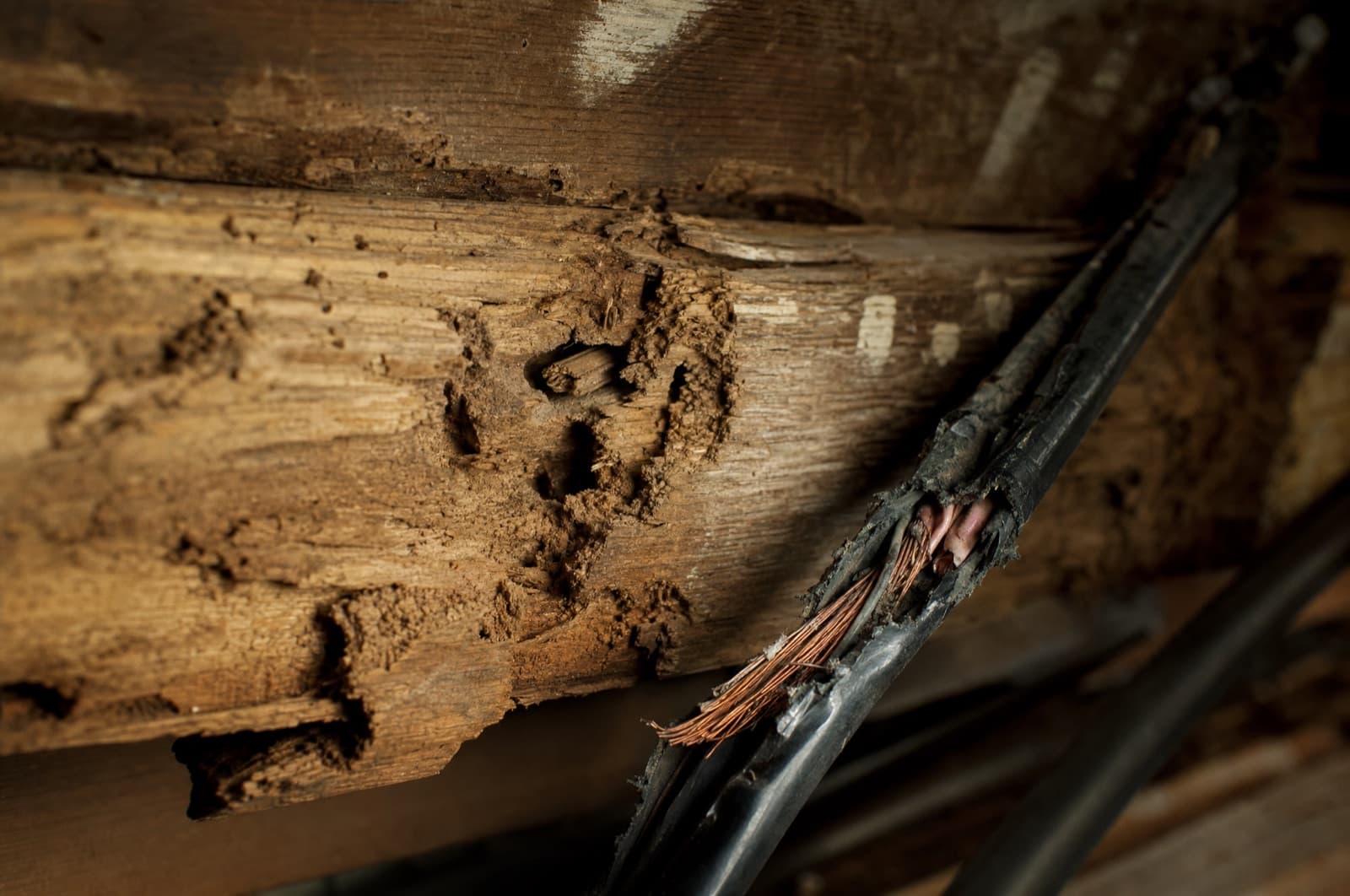
Pest damage evidence — a gnawed structural beam and a chewed electrical wire
Daniel Brady · NH-Licensed Pesticide Applicator · License #782664
Reviewed by Daniel Brady

What are early signs of pest-related damage?

Partial — real signs exist, but each has a look-alike, and the worst damage is hidden
Yes, there are real early signs — frass or sawdust near wood, mud tubes on a foundation, discarded swarmer wings, and rodent droppings or gnaw marks. But the honest complication is that every one of these signs has an ordinary, non-pest explanation, and the earliest, most consequential damage from wood-destroying pests happens inside wall cavities, under slabs, and behind finished surfaces where nobody — including a professional inspector — can actually look. A pest inspection is a genuinely useful tool, not an X-ray machine.

At a glance

  • Hype: About right
  • Evidence: Plausible, under-documented
  • Who fixes it: Pest pro first
The honest answer

The short of it

The verdict
Partial — real signs exist, but each has a look-alike, and the worst damage is hidden

There are genuine early signs of pest damage — but every one of them can be mistaken for something else, and the most consequential damage happens where nobody can see it.

The correction

What they claim vs. what the evidence supports

One shared severity track, two markers. The span between them is the hype delta — named out loud.

The claim — the idea that early signs let you catch every pest problem before it does damage

That a homeowner who knows the checklist of warning signs will reliably catch pest damage 'before it's too late,' implying a diligent inspection can rule out hidden problems entirely.

Where the claim comes from: Pest-company blog checklists and home-maintenance listicles that present early-sign lists as a complete detection system rather than a partial one.

Severity, 0–100
Hype says65
53Evidence says
The hype is fairPlausible, under-documented
The evidence

The listed signs are genuinely useful and often do appear early — frass, mud tubes, and droppings are standard, evidence-based indicators (University of Missouri Extension; UNH Cooperative Extension). But termite-damaged timber 'can look perfectly normal on the outside, even when riddled with termite galleries on the inside' (MU Extension), and the same is true for damage inside a wall cavity or under a slab. Visible signs catch a meaningful share of problems, not all of them.

The gap

The signs are real and worth learning — this isn't a debunk. The correction is narrower: 'watch for these signs' is not the same as 'you'll catch everything,' because a hidden wall cavity doesn't show you anything at all until the damage is already established.

Repair scope

Who actually fixes this

Scope, not dollars — the honest answer to “how expensive is it,” routed to the right trade.

Who fixes it
Pest pro first
Effort
A trade visit

Whatever the sign turns out to be, identifying the pest correctly comes before any repair — patching over an active termite or carpenter-ant problem just hides it again.

The right order
  1. 1
    Identify the sign correctly — ideally with a professional, since several look-alikes exist
  2. 2
    Resolve any active pest before repairing or covering the affected area
  3. 3
    Route the repair itself to the trade that owns it: a contractor for structural wood, an electrician for wiring, a roofer or plumber for a leak that turns out to be the real cause of a stain
Route by symptom
  • You — a DIY patchThe sign turns out to be a minor, resolved cosmetic issue — old droppings, a dried mud splash, a finished carpenter-bee hole
  • Licensed contractorA confirmed termite or carpenter-ant finding shows active galleries in structural wood
Do not
  • Don't assume a stain or a small hole is 'just cosmetic' without ruling out the pest explanation first
  • Don't wait for a sign to become obvious before checking — several genuine early signs are easy to miss on a casual glance
Where we help — and where we don't

Anchor identifies and resolves the pest side of any of these signs — termites, carpenter ants, rodents, wasps. We do not repair a roof leak, a plumbing issue, or structural framing ourselves, and we'll say so plainly rather than quote you for work outside our lane.

Prevention

Early signals — and the honest limits

How much warning you get
Partial warning
SignWhat it meansHow earlyConfusable with
Sawdust-like frass near wood surfacesFine, granular material pushed out of small holes — a sign of carpenter ants, wood-boring beetles, or carpenter bees excavating or tunneling nearby wood.First weeksOrdinary drywall dust from a recent repair, or sawdust from DIY woodworking done nearby.
Mud tubes on a foundation wallPencil-width tunnels of soil and saliva that subterranean termites build to travel between soil and wood while staying hidden from open air.Already establishedDried mud splashed up by rain, old paint drips, or a mud-dauber wasp's nest marks.
Discarded wings or swarmers indoorsTermite or carpenter ant reproductives shed their wings after a swarm — finding a small pile of wings near a window or sill means a mature colony nearby has already reproduced.Already establishedCluster flies or ordinary winged ant swarmers, which are seasonal nuisances with no property-damage implication.
Droppings and gnaw marks along baseboards or in cabinetsFresh rodent droppings and chewed corners on boxes or wood trim indicate active mouse or rat travel routes, usually appearing within the first weeks of an incursion.First weeksOld droppings left by a prior owner's rodent problem, or settling and HVAC-duct noises mistaken for active gnawing.
Ceiling or wall stainingA brown or dark stain can indicate a raccoon urine/latrine spot in an attic, but far more often it is simply a roof leak or plumbing issue with no pest involved at all.LateAn ordinary roof or plumbing leak, or pre-existing water damage from a prior owner — the single most commonly misread 'pest sign' in this list.
An inspection can see5
  • Surface frass and exit holes on exposed wood
  • Mud tubes on an accessible foundation exterior
  • Droppings and gnaw marks in open basements, attics, and cabinets
  • Active swarmers or discarded wings near windows and sills
  • Moisture at accessible framing, sills, and crawlspace wood
It cannot see5
  • Damage inside a closed wall cavity
  • Anything beneath a poured concrete slab
  • Activity behind finished drywall, paneling, or built-in cabinetry
  • Conditions inside a sealed soffit or fully insulated, inaccessible attic pocket
  • The interior condition of a timber that looks sound from the outside — termite-riddled wood 'can look perfectly normal on the outside' (MU Extension)
Honest cadence
Walk the foundation and exterior sills each spring, during New Hampshire's termite swarm season, and check the attic and basement again in fall before rodents move indoors ahead of Manchester's first hard frost, historically around October 19 to 29 (NOAA). A twice-yearly self-check, plus a professional inspection the moment you find a confirmed sign, catches meaningfully more than checking only when something already looks wrong.
In depth

The full picture

01

The real early signs, honestly listed

There is a genuine, evidence-based list of early pest-damage signs, and it's worth knowing it precisely rather than vaguely. Frass — fine, sawdust-like material pushed out of small holes — signals carpenter ants, wood-boring beetles, or carpenter bees at work nearby. Mud tubes on a foundation are the classic subterranean termite sign, built so the insects can travel between soil and wood without exposure to open air. Discarded wings near a window mean a colony has already matured enough to swarm. Rodent droppings and gnaw marks along baseboards or in cabinets usually show up within the first few weeks of an incursion. All four are real, useful, and worth a homeowner learning to recognize.

02

Why every sign on that list has a look-alike

The complication pest-marketing checklists rarely mention is that every one of these signs can be produced by something with nothing to do with pests at all. Frass looks like drywall dust from a repair. A mud tube can be mistaken for a dried splash of rain-driven mud or an old mud-dauber mark. Swarmer wings get confused with cluster flies. Rodent droppings found in a newly purchased home might be leftovers from a previous owner's already-resolved problem, and duct or settling noises get misread as active gnawing. Taking any single sign at face value, without ruling out its non-pest twin, is how homeowners either panic unnecessarily or, worse, dismiss a real sign because it 'looked like' something harmless.

03

The honest limit: what an inspection cannot see

This is the part worth stating plainly, because it's the credibility test of any inspection claim. A pest professional can examine accessible framing, sills, foundations, attics, and crawlspaces, and can find surface frass, mud tubes, droppings, and moisture wherever those surfaces are exposed. What no inspection — professional or DIY — can do is see inside a closed wall cavity, beneath a poured concrete slab, behind finished drywall, or inside a sealed soffit. University of Missouri Extension states it directly about termites: infested wood 'can look perfectly normal on the outside, even when riddled with termite galleries on the inside.' Moisture meters and careful probing narrow that blind spot but don't eliminate it. A pest professional is not an X-ray machine, and any service that implies otherwise is overselling what an inspection actually is.

04

A realistic checking rhythm for New Hampshire homes

The useful cadence is seasonal, not constant vigilance. Walk the foundation and exterior sills each spring, when subterranean termites swarm and are most likely to leave visible tubes or discarded wings. Check the attic and basement again in fall, before rodents move indoors ahead of Manchester's first hard frost, which historically lands around October 19 to 29 (NOAA). A twice-a-year self-check, paired with a professional look the moment any of the signs above actually shows up, is a realistic and genuinely useful rhythm — not a guarantee against every hidden problem, but a meaningful reduction in how long a real one goes unnoticed.

Key takeaways
5 points
  • Frass, mud tubes, discarded wings, droppings, and gnaw marks are real, evidence-based early signs — not manufactured checklist filler.
  • Every one of those signs has a non-pest look-alike: drywall dust, rain-splashed mud, cluster flies, a prior owner's old droppings, or an ordinary leak.
  • The honest limit is what's hidden — inside wall cavities, under slabs, behind finished surfaces — where no inspection, professional or DIY, can see.
  • A spring foundation check and a fall attic/basement check, timed to NH's termite swarm season and pre-frost rodent migration, is a realistic checking rhythm.
  • A confirmed sign should go to a professional for correct identification before anything gets patched or repaired.
New Hampshire context

Timing early checks to New Hampshire's seasons

Southern New Hampshire's subterranean termite pressure is real, and spring swarms are the most visible seasonal cue — check foundations and sills then. Rodent pressure follows the opposite calendar: as overnight temperatures fall toward Manchester's first hard frost, historically around October 19 to 29 (NOAA), mice and rats move indoors and droppings or gnaw marks tend to appear within weeks. A homeowner who checks at both ends of that seasonal swing catches meaningfully more than one who only looks when something already seems wrong.

  • NH-licensed #782664

    Southern New Hampshire

  • Family-owned

    Since 2017

  • Honest routing

    Even when it isn’t us

We serve these communities

ManchesterNashuaConcordDerryBedfordSalemHudsonAmherstAuburnGoffstownHooksettLitchfieldLoudonMilfordBristol

Service Area Map

Southern New Hampshire

BristolPop. 3,200LoudonPop. 5,500ConcordPop. 43,900HooksettPop. 14,800GoffstownPop. 18,000AuburnPop. 5,700ManchesterPop. 115,600BedfordPop. 23,300LitchfieldPop. 8,500AmherstPop. 11,300DerryPop. 34,500MilfordPop. 15,700HudsonPop. 25,600NashuaPop. 91,100SalemPop. 30,000HQCityHover for info

Spotted one of these signs? Get it identified correctly.

Anchor tells you plainly whether it's a pest problem or a look-alike — before anything gets patched over.

Follow-up questions

Frequently asked

Sources & citations(3)
  1. University of Missouri Extension — Subterranean Termites (G7420)

    Termite-infested wood can look normal on the outside while riddled with galleries inside; mud tube behavior

    extensionverified 2026-07-16
  2. UNH Cooperative Extension — Carpenter Ants Fact Sheet

    Frass and gallery signs as indicators of carpenter ant activity, tied to a moisture source

    extensionverified 2026-07-16
  3. Purdue Extension Entomology — Powderpost Beetles (E-73)

    Frass and exit-hole signs from wood-boring beetle activity

    extensionverified 2026-07-16

Written & reviewed by

Verified

Daniel Brady

NH-Licensed Pesticide Applicator · License #782664 (NHDAMF, RSA 430)

Daniel Brady is the New Hampshire–licensed applicator behind Anchor Pest Services, a family-owned pest control company serving the Manchester area since 2017.

Verify license

Last updated Jul 2026

Honest pest help for New Hampshire homes

We'll Tell You What's Actually Behind the Sign.

Anchor identifies frass, mud tubes, droppings, and gnaw marks correctly — and just as importantly, tells you when what you're looking at isn't a pest problem at all. Family-owned since 2017, NH license #782664, serving Manchester, Nashua, Concord and nearby towns.

  • Honest identification — we'll say when it's not a pest issue
  • NH-licensed applicators (#782664) — free inspection, same-day service
  • Seasonal termite and rodent inspection across southern and central New Hampshire

NH License #782664 · No obligation · We answer in person