
What Are the Signs of a Mouse Infestation?
At a Glance
- Short answer: Droppings, gnaw marks, rub marks, nests, night noise, and odor — in that order of reliability.
- Key fact: Mouse droppings run about 1⁄8–¼ inch with pointed ends; that size alone confirms mice over rats.
- NH relevance: Sign reports climb in NH each fall as mice push indoors ahead of Manchester's first hard frost.
- Action needed: One or two signs: investigate. Several together, or a musky odor: start active control.
The short of it
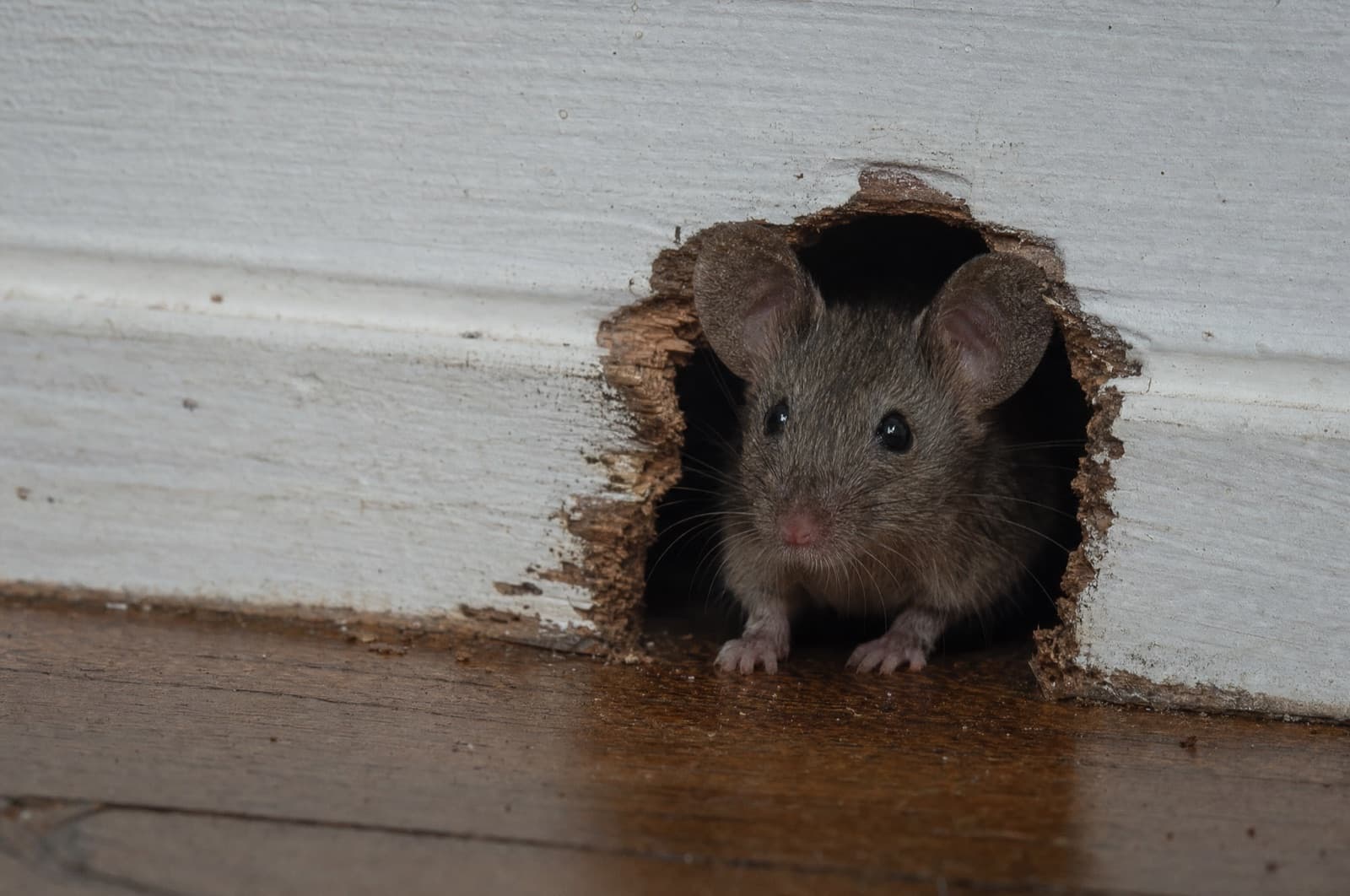
No single sign is proof on its own, but droppings, gnaw marks, greasy rub marks, nesting material, night noise, and a musky odor together build a confident diagnosis. Droppings are the fastest confirmation — Cornell IPM describes mouse droppings as roughly 1⁄8–¼ inch long with pointed ends, resembling dark grains of rice. One or two isolated signs warrant a closer look; several together mean an established population that needs active control, not just cleanup.
What Are the Signs of a Mouse Infestation — By the Numbers
1⁄8–¼ in
Typical mouse dropping length, pointed ends
1–2 mm
Width of a mouse's paired-tooth gnaw marks
~200
Small nightly "nibble" meals a mouse takes, driving near-constant movement
24 hrs
Time to re-check cleared droppings and confirm ongoing activity
What you're seeing — and what it means
Match at least two or three of these independently before concluding it's a full infestation rather than a single stray mouse.
Small, pointed droppings (about 1⁄8–¼ inch) near baseboards, cabinets, or drawers
The fastest confirmation of mice; re-check after 24 hours to see if fresh droppings appear
Gnaw marks about 1–2 mm wide on food packaging, wood, or wiring
Mice gnaw constantly to wear down their teeth and widen entry gaps
Greasy, dark rub marks along baseboards and edges
Body oils leave smudges on a repeatedly used travel route, pointing to an established runway
Shredded paper, fabric, or insulation gathered in a hidden cavity
Nesting material means mice have settled in, not just passed through
Scratching, scurrying, or faint squeaking after dark
Mice are active mostly at night; recurring noise from the same spot signals a nearby nest
A persistent musky odor in the room or wall void
UC IPM identifies this as common in large or long-term infestations
Bottom line — One or two of these signs warrants a closer look; droppings plus rub marks plus night noise, or a musky odor, mean an established infestation that needs active trapping and exclusion, not just cleanup.
The full picture
Droppings and gnaw marks: the fastest confirmation
Droppings are the most common and fastest sign: mouse droppings are small, about 1⁄8 to ¼ inch long, with pointed ends, resembling dark grains of rice, scattered along baseboards, in cabinets, pantries, and drawers, per Cornell IPM. Gnaw marks corroborate it — Cornell notes an adult mouse's paired-tooth grooves measure only about 1–2 mm wide, distinctly finer than a rat's. Because dropping color is an unreliable age indicator, the most useful test is to clear an area of droppings and re-check after 24 hours: new droppings confirm the population is still active, not a leftover from months ago.
Rub marks, nests, and sound
Greasy rub marks are dark smudges from a mouse's body oils along baseboards and edges where it repeatedly brushes the same route — their presence points to an established runway, not a single passer-through. Nesting material shows up as finely shredded paper, fabric, or insulation gathered into a concealed cavity, per UC IPM. Sound is the sign most homeowners notice first: light scratching, scurrying, and occasional thin squeaks after dark, since mice are active mostly at night and feed in roughly 200 tiny meals each night, keeping them almost constantly moving.
Odor: the sign of a large or long-standing problem
UC IPM notes house mice "have a characteristic musky odor that is common in large or long-term infestations." A persistent smell — as opposed to a faint one-time whiff — suggests the population has been established for a while rather than a single recent arrival. Combined with droppings and rub marks, odor is usually the sign that pushes a problem from "investigate" to "act now."
Bottom line — Droppings and gnaw marks confirm mice fastest; rub marks, nests, and night sound corroborate an established population; a musky odor signals a large or long-term infestation. One sign deserves a look — several together mean active control is warranted, not just cleanup.
Spotted more than one sign?
Anchor's licensed NH technicians confirm the infestation, find the nest, and handle elimination and exclusion together.
Why this matters in New Hampshire
Sign reports rise across NH each fall as outdoor mice push indoors ahead of Manchester's first hard frost (~Oct 19 at 50% probability, ~Oct 29 at 80%, NOAA 1991–2020). One regional safety note: deer mice and white-footed mice, both common in NH, are the local hantavirus reservoir, so handle any droppings per CDC guidance — don't sweep or vacuum; air out the space and wet-clean instead.
Key local data
Deer mice (Peromyscus) are the hantavirus-relevant species in NH; NH DHHS reports no confirmed case acquired in-state to date.
- NH-licensed applicator · #782664
- Same-day service
- Family-owned since 2017
Service Area Map
Southern New Hampshire
Frequently asked
Sources (3)
- [1]
- [2]
- [3]
Written & reviewed by
VerifiedDaniel Brady
NH-Licensed Pesticide Applicator · License #782664 (NHDAMF, RSA 430)
Daniel Brady is the New Hampshire–licensed applicator behind Anchor Pest Services, a family-owned pest control company serving the Manchester area since 2017.
Professional Rodent Control
Droppings, Rub Marks, and Noise Add Up to a Call
Anchor Pest Services inspects for every sign that matters, confirms what's active, and builds a plan around elimination and exclusion. Family-owned since 2017, NH license #782664.
- Same-day service across southern NH
- NH-licensed applicators (#782664)
- Free inspection — no flat-price guesswork
NH License #782664 · No obligation · We answer in person
Your next step
- Next step
Will Rats Go Away Without Food?
Read the answer - Related guide
How Can I Tell If I Have Mice or Rats in My House?
Read the answer - Related guide
What Is the Difference Between a Mouse and a Rat?
Read the answer - Related guide
Can I Handle a Large Mouse Infestation on My Own?
Read the answer - Related guide
Where Do Mice Usually Hide Indoors?
Read the answer - Related guide
What Are the Signs of a Rat Infestation?
Read the answer