
Skip to content
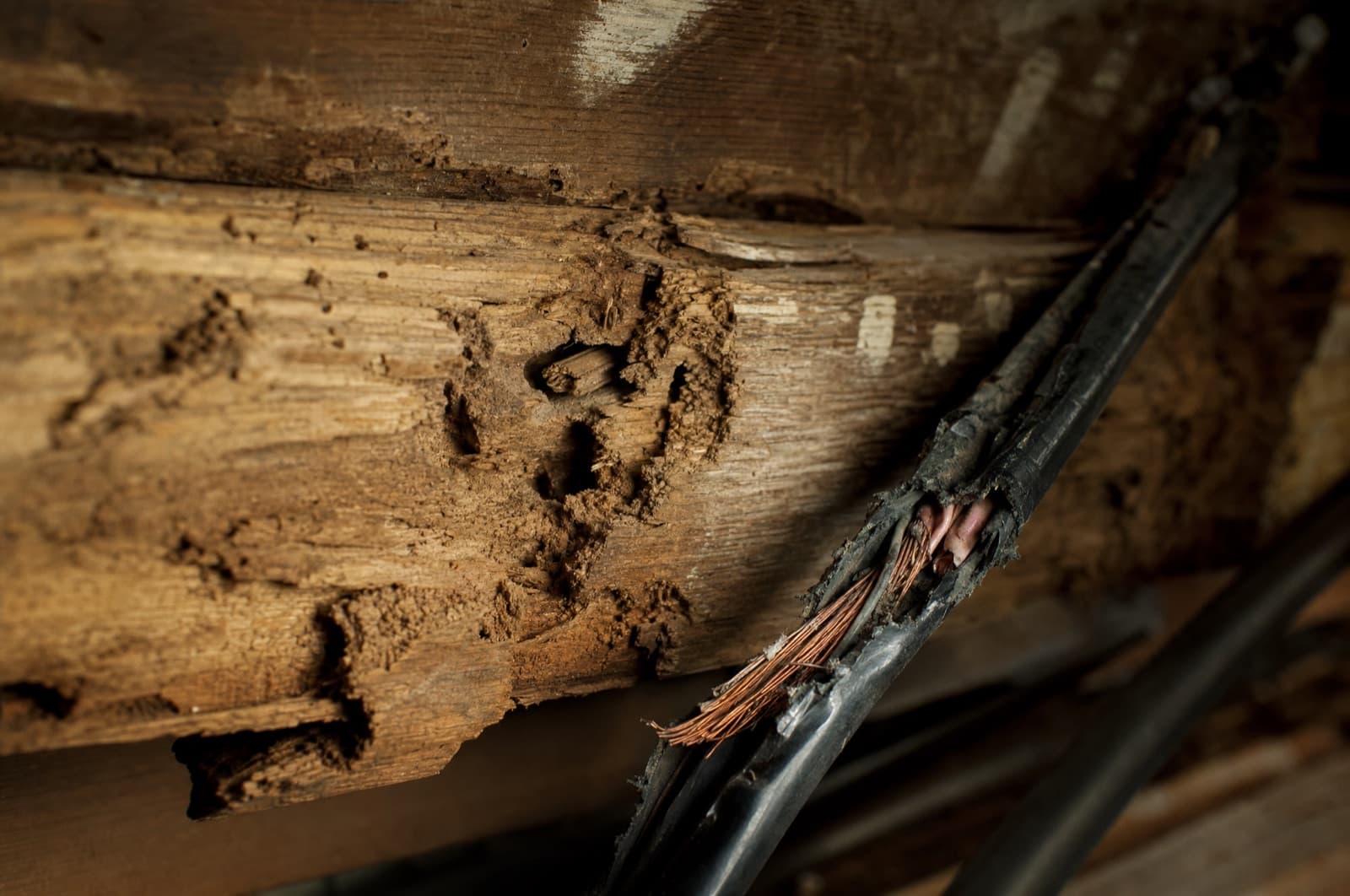
Pest damage evidence — a gnawed structural beam and a chewed electrical wire
Daniel Brady · NH-Licensed Pesticide Applicator · License #782664
Reviewed by Daniel Brady

What are the most common types of pest damage?

Ranked by how often it actually happens
Ranked by real-world frequency rather than severity, the most common pest damage in New Hampshire homes is rodent gnawing on wiring, insulation, and stored goods, especially in the colder months. Close behind is cosmetic staining and soiling from bird, bat, and mouse droppings, followed by moisture-linked carpenter ant galleries, which are more a sign of a water problem than a wood-eating one. Cockroach and rodent allergen contamination is a genuine but under-discussed functional harm to indoor air. Structural termite galleries exist and matter, but are encountered far less often than everyday gnawing and staining. A large share of what people report — cluster flies, boxelder bugs, ladybugs — causes no property damage at all.

At a glance

  • Who fixes it: Pest pro first
The honest answer

The short of it

The verdict
Ranked by how often it actually happens

The pest damage NH homeowners actually run into most is functional and cosmetic — gnawed wiring, stained ceilings, moisture-linked ant galleries — not structural collapse.

Repair scope

Who actually fixes this

Scope, not dollars — the honest answer to “how expensive is it,” routed to the right trade.

Who fixes it
Pest pro first
Effort
An afternoon

Whatever is most common in your home, the same first step applies: confirm the pest, because gnawed insulation and a stained ceiling point to entirely different fixes depending on what's actually up there.

The right order
  1. 1
    Identify the pest behind the sign you're seeing — gnaw marks, staining, frass, or a live nuisance insect
  2. 2
    Resolve it first if it's still active (Anchor's lane for rodents and carpenter ants)
  3. 3
    Clean or repair the surface damage once nothing is coming back for it
Route by symptom
  • Qualified remediationDroppings have accumulated heavily or you suspect bat or bird guano
  • Licensed contractorFrass or galleries suggest active termite or deep carpenter-ant damage
Do not
  • Don't dry-sweep or vacuum rodent or bird droppings — wet-clean per CDC guidance, or call a remediation service for a heavy accumulation, since dry disturbance can aerosolize hantavirus or histoplasmosis spores.
Where we help — and where we don't

Anchor handles the two most common causes on this list directly — rodent exclusion and carpenter ant colonies. We don't do insulation replacement, large-scale guano cleanup, or the structural rebuild, and we'll tell you plainly when you need one of those instead.

The ledger

The ranked damage ledger

The damage New Hampshire homeowners actually report, ranked by how often it shows up — not by how severe it could theoretically become.

Ranked by
Real-world frequency — how often NH homeowners actually encounter each damage type — not severity or repair cost. For the severity and repair-scope ranking, see 'Which pests cause the most expensive repairs?'
RankPestClassWhat it wrecksWho fixes itEvidence
01

Rodent gnawing (wiring, insulation, ductwork)

The single most common pest-damage complaint in NH homes, especially as temperatures drop toward the first hard frost. Gnawing on energized wire is a genuine fire pathway — but the specific percentage attached to it in most articles is invented, not sourced to any fire authority.

FunctionalWire insulation, PEX/PVC lines, ductwork, and stored goods along travel routesLicensed electricianWell documented
02

Droppings and soiling (birds, bats, mice)

Usually cosmetic staining and odor for a light case — but bat or bird guano carries a real histoplasmosis risk, and deer-mouse droppings carry a hantavirus risk, so 'just cosmetic' still deserves careful, non-DIY cleanup once accumulation is heavy.

CosmeticAttic insulation, ceiling and wall surfaces, and stored itemsYou — wipe it upWell documented
03

Carpenter ant galleries

Real, localized structural damage — but UNH Extension frames it chiefly as a moisture indicator. Carpenter ants rarely nest in sound, dry wood, so the ants are usually the messenger, not the root problem.

StructuralDamp, decay-softened framing near a persistent moisture sourcePest pro firstWell documented
04

Cockroach and rodent allergen contamination

Not damage to the building itself, but a genuine functional harm to the people living in it — a documented asthma trigger, especially in children. It gets far less attention than gnawing despite showing up in most infested homes.

FunctionalIndoor air quality and food-contact surfacesQualified remediationWell documented
05

Termite galleries

Less common in day-to-day complaints than rodent gnawing, but more consequential when present — the classic case of lower frequency paired with higher severity.

StructuralFraming, sills, and subfloor near soil contactLicensed contractorWell documented
06

Overwintering nuisance invaders (cluster flies, boxelder bugs, ladybugs)

Extremely common every fall and causes zero property damage. Included specifically because it gets mistaken for a damage claim more often than almost anything else on this list.

NoneNothing — a seasonal indoor nuisance onlyYou — wipe it upWell documented
What people get wrong
People assume the pest they see most often must also be doing the most damage, and they catalog every sighting as a structural threat. The honest picture: the everyday damage in NH homes is functional and cosmetic — gnawing, staining, allergen load — while genuinely structural damage is rarer but more consequential when it happens. The most under-rated line item here is allergen contamination from roaches and rodents, a real, documented health harm that gets a fraction of the attention gnawing does. The most over-rated is treating a fall cluster-fly swarm as 'damage' at all.
Health risk

The health angle

Hantavirus from deer-mouse droppings, histoplasmosis from bat or bird guano, and cockroach/rodent allergen as an asthma trigger

Caution
Who is at risk
  • Anyone cleaning up rodent droppings without wet-cleaning precautions
  • Children and asthmatic household members in homes with a roach or rodent allergen load
Precautions
  • Ventilate the area, then wet-clean droppings with a disinfectant rather than dry-sweeping or vacuuming
  • Address a roach or heavy rodent presence promptly if a household member has asthma
  • Leave heavy guano accumulations to qualified remediation
Do not
  • Don't dry-sweep or vacuum droppings
  • Don't ignore new or worsening asthma symptoms in a home with a known infestation
When to seek care

See a doctor for flu-like or respiratory symptoms after disturbing droppings, or call the Northern New England Poison Center at 1-800-222-1222 with exposure questions.

Health guidance from: CDC

In depth

The full picture

01

How we ranked this list — frequency, not fear

This page answers a different question than 'which pest costs the most to fix.' Here, the criterion is simple: what does an NH pest professional and an NH homeowner actually encounter most often, regardless of how severe it could theoretically become? That produces a very different order than a severity ranking — rodent gnawing and cosmetic staining, both common and rarely catastrophic, outrank termite galleries, which are rarer but more consequential when found. Neither ranking is wrong; they're answering different questions, and conflating them is exactly how a nuisance turns into a headline about collapse.

02

The everyday tier: gnawing, staining, and moisture-linked ants

Rodent gnawing tops this list because it's tied to a universal biological need, not an occasional behavior: a mouse or rat's incisors grow continuously and must be worn down, so wire insulation, plastic supply lines, and stored goods get chewed on a routine basis wherever rodents get indoors, which in New Hampshire is strongly seasonal as temperatures fall toward the first hard frost. That gnawing is also where the hub's most repeated fire statistic lives, and it deserves the correction every time it comes up: rodent gnawing on energized wiring is a genuine, documented ignition pathway, but the specific claim that rodents cause roughly a quarter of house fires has no primary source in NFPA or federal fire data — it traces to an uncited 2012 pest-trade magazine article. The mechanism is real; the number is not.

Droppings and soiling are the next most common complaint, and for most cases that's genuinely cosmetic — a stain, an odor, a surface to wipe down. Carpenter ant galleries round out the everyday tier, and UNH Cooperative Extension is clear that they're chiefly a signal of a moisture problem rather than a wood-eating one on their own; the ants excavate, they don't consume, and they gravitate to wood that's already wet.

03

The health story hiding behind the damage story

The most under-rated entry on this list isn't a structural one at all. Cockroach and rodent allergen contamination doesn't show up as a hole, a stain, or a gnaw mark — it accumulates in household dust and is a well-documented trigger for asthma, particularly in children in homes with a heavier infestation history. It rarely gets discussed alongside 'pest damage' because there's nothing visible to photograph, but by frequency and genuine harm to occupants, it belongs on this list more than several pests people worry about far more.

04

The rare but real tier: termite galleries

Termite damage is the honest exception to this list's overall message. It's less common in day-to-day complaints than gnawing or staining, but when it's present it's the one entry that can require a licensed contractor to rebuild framing rather than a repair job measured in an afternoon. That combination — lower frequency, higher consequence — is exactly why the hub keeps termites, rodent gnawing, and carpenter ants graded as genuinely earned concerns even while it corrects the statistics wrapped around them.

Key takeaways
5 points
  • Ranked by frequency, the most common NH pest damage is rodent gnawing, followed by dropping-related staining and moisture-linked carpenter ant activity.
  • Rodent gnawing on energized wiring is a real fire pathway, but the widely repeated 'quarter of house fires' figure attached to it has no primary source in fire-authority data.
  • Carpenter ant galleries are mostly a signal of an existing moisture problem, not an independent wood-eating threat.
  • Cockroach and rodent allergen contamination is a genuine, common, and under-discussed functional harm — to occupants' health, not the building.
  • Termite galleries are rarer in everyday reports than gnawing or staining, but more consequential when they occur — low frequency, high severity.
New Hampshire context

The New Hampshire seasonal pattern behind this list

New Hampshire's pest-damage calendar drives this ranking more than any other single factor. As overnight temperatures fall toward Manchester's first hard frost, historically around October 19 to 29, rodents move indoors and gnawing complaints spike within weeks — which is why gnawing sits at the top of a frequency-based list even though it's rarely the most severe damage type in the hub. Carpenter ant activity and termite swarming, by contrast, cluster in spring and summer around moisture and warmth. The season you're reading this in is a reasonable clue to which row on this ledger is most relevant to your home right now.

  • NH-licensed #782664

    Southern New Hampshire

  • Family-owned

    Since 2017

  • Honest routing

    Even when it isn’t us

We serve these communities

ManchesterNashuaConcordDerryBedfordSalemHudsonAmherstAuburnGoffstownHooksettLitchfieldLoudonMilfordBristol

Service Area Map

Southern New Hampshire

BristolPop. 3,200LoudonPop. 5,500ConcordPop. 43,900HooksettPop. 14,800GoffstownPop. 18,000AuburnPop. 5,700ManchesterPop. 115,600BedfordPop. 23,300LitchfieldPop. 8,500AmherstPop. 11,300DerryPop. 34,500MilfordPop. 15,700HudsonPop. 25,600NashuaPop. 91,100SalemPop. 30,000HQCityHover for info

Seeing gnaw marks, stains, or ant trails?

Anchor identifies what's actually causing it before recommending anything — free inspection, same-day service across southern and central New Hampshire.

Follow-up questions

Frequently asked

Sources & citations(6)
  1. NFPA Research — Home Fires Caused by Electrical Failure or Malfunction (R. Campbell, 2019)

    Arcing as the leading ignition factor in home electrical fires; no rodent factor identified — basis for correcting the circulating rodent-fire percentage

    fireverified 2026-07-16
  2. CDC — Histoplasmosis

    Histoplasmosis risk from disturbed bat and bird guano

    govverified 2026-07-16
  3. CDC — Hantavirus (HPS) Clinician Brief

    Deer-mouse hantavirus transmission and the do-not-dry-sweep precaution

    govverified 2026-07-16
  4. CDC/ATSDR — Environmental Triggers of Asthma

    Cockroach and rodent allergen as a documented asthma trigger, especially in children

    govverified 2026-07-16
  5. UNH Cooperative Extension — Carpenter Ants Fact Sheet

    Carpenter ants as a moisture-problem indicator; NH's top structural pests alongside termites

    extensionverified 2026-07-16
  6. Penn State Extension — Eastern Subterranean Termites

    Termite structural damage as a slow, multi-year process

    extensionverified 2026-07-16

Written & reviewed by

Verified

Daniel Brady

NH-Licensed Pesticide Applicator · License #782664 (NHDAMF, RSA 430)

Daniel Brady is the New Hampshire–licensed applicator behind Anchor Pest Services, a family-owned pest control company serving the Manchester area since 2017.

Verify license

Last updated Jul 2026

Honest pest help for New Hampshire homes

The Common Stuff Is Our Lane. We'll Tell You When It Isn't.

Rodent exclusion and carpenter ant treatment are genuinely Anchor's work. Insulation replacement, large-scale guano cleanup, and structural rebuilds are somebody else's job, and we'll say so plainly. Family-owned since 2017, NH license #782664, serving Manchester, Nashua, Concord and nearby towns.

  • Honest routing — we name the right trade even when it isn't us
  • NH-licensed applicators (#782664) — free inspection, same-day service
  • Rodent exclusion and structural pest control across southern and central New Hampshire

NH License #782664 · No obligation · We answer in person