
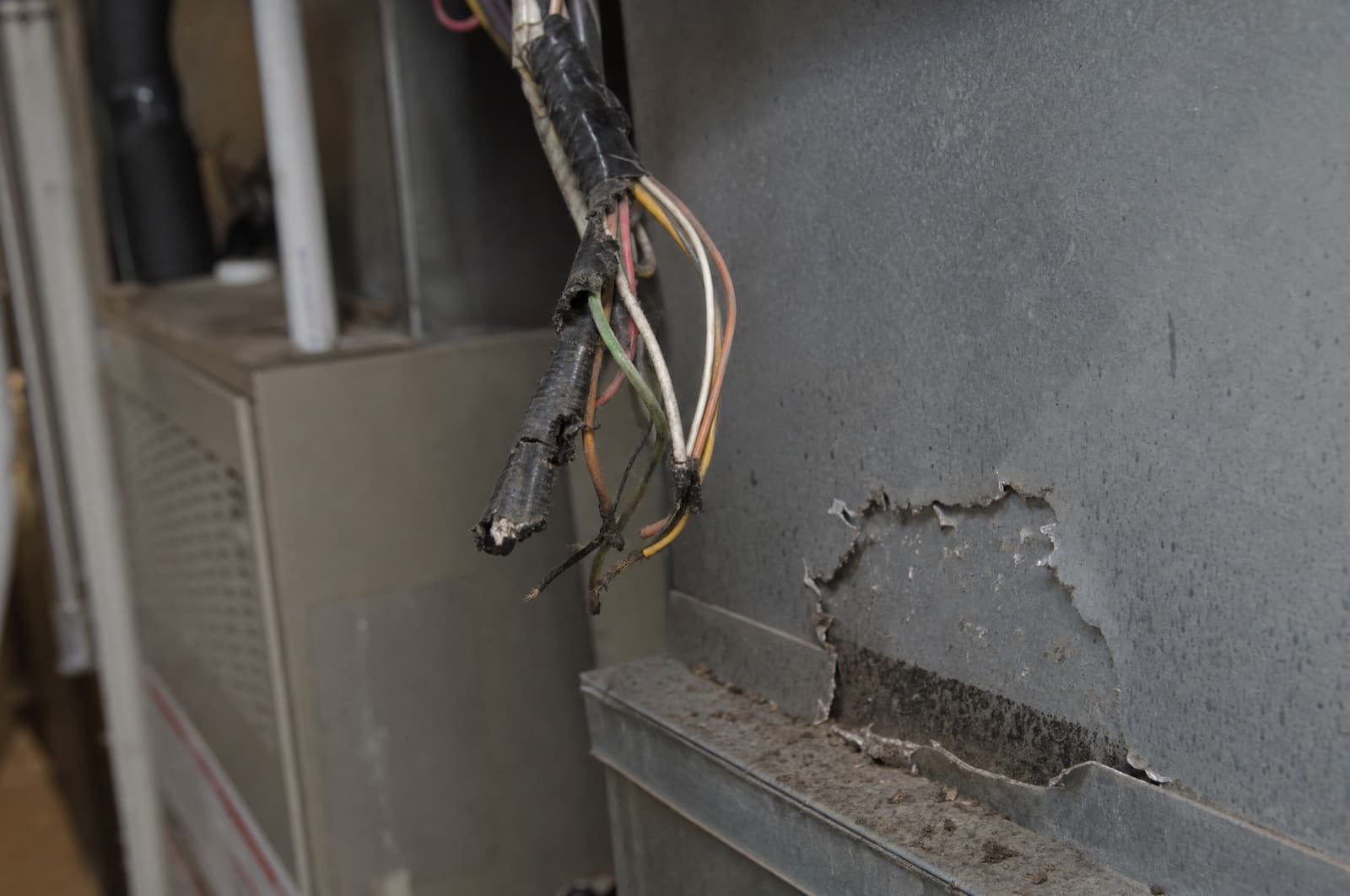
Can Pests Chew Heating Wires and Insulation?
Yes — rodents genuinely chew wire insulation and pipe/duct insulation, a real and well-documented behavior with a real, if rare, ignition pathway if the wire is energized.
This is worth fixing and worth inspecting, not a house that's statistically likely to burn down. The commonly repeated '20-25% of house fires' figure has no basis in NFPA or USFA data — see below — but the arc-fault mechanism it distorts is genuinely documented.
At a glance
- The mechanism: Damages the system
- Who fixes it: A licensed pest pro
- The rest lives at: Can rats cause electrical fires? Mechanism vs. the myth
Yes — rodents genuinely chew wire insulation and pipe/duct insulation, a real and well-documented behavior with a real, if rare, ignition pathway if the wire is energized.
This is worth fixing and worth inspecting, not a house that's statistically likely to burn down. The commonly repeated '20-25% of house fires' figure has no basis in NFPA or USFA data — see below — but the arc-fault mechanism it distorts is genuinely documented.
Heat doesn't spawn pests — it changes what you notice
The season and the building set the stage before the thermostat ever comes on. Here's the honest chain of events, spelled out.
What's really happening
A rodent's incisors grow continuously and must be worn down by gnawing. Wire insulation — plastic or rubber, sometimes plant-based — offers ideal resistance for that purpose, so gnawing strips it away. If the exposed conductor underneath is energized, it can arc, and NFPA documents that an arc fault "can produce enough heat to ignite a fire." That mechanism is real; the widely-quoted prevalence statistic built on top of it is not.
Source:NFPA— Non-Home Electrical Fires report (Campbell, 2019) — arc-fault definition and ignition mechanism
Is this an HVAC problem or a pest problem?
Who actually fixes it
A licensed pest pro
Eliminating and excluding the rodents stops new gnawing; a licensed electrician then repairs any wiring damage already done, since inspecting and re-terminating energized conductors is licensed electrical work, not pest control.
Visible chew marks on energized wiring, flickering lights, or repeated breaker trips — call an electrician immediately rather than waiting for a routine inspection.
This hub owns the heating-system angle
General winter behavior, rodent control, and equipment-damage severity live in siblings that already earn them. Here's exactly where.
This hub owns the heating-wiring/insulation angle and the fire-statistic correction as it relates to the heating system. The full damage-and-risk severity ledger, including the complete myth-vs-mechanism breakdown, lives on our pest damage & risks FAQ; rodent control is owned by our mice & rats FAQ.
How this calibrates for NH
New Hampshire's months-long heating season keeps furnace and boiler wiring energized and warm for most of the year, and field mice are documented to shift undercover in winter and favor spots near warm electrical components — so gnawing damage near heating equipment is a cold-season pattern here, not a random year-round event.
NH-licensed applicator #782664 (NHDAMF, RSA 430) · NEPMA member · family-owned since 2017.
Frequently asked
Sources(4)
- [1]NFPA
Non-Home Electrical Fires report (Campbell, 2019) — arc-fault mechanism and ignition quote
- [2]NFPA
Home Fires Caused by Electrical Distribution and Lighting Equipment — arcing as heat source in 73% of such fires
- [3]USFA/FEMA
NFIRS Complete Reference Guide (2015) — confirms only a generic 'Animal' ignition-factor code, no rodent-specific code or percentage
- [4]Peer-reviewed cable-damage literature
Cogelia, LaVoie & Glahn — rodent incisor growth and cable-sheath damage thresholds, 25th International Wire and Cable Symposium
Written & reviewed by
VerifiedDaniel Brady
NH-Licensed Pesticide Applicator · License #782664 (NHDAMF, RSA 430)
Daniel Brady is the New Hampshire–licensed applicator behind Anchor Pest Services, a family-owned pest control company serving the Manchester area since 2017.
Anchor Pest Services
Worth a professional pest inspection?
We've protected Southern New Hampshire homes since 2017. Free inspection, same-day service — we tell you what's actually there before we treat anything.
- NH-licensed applicator
- Same-day service
- Pet & family-conscious
NH License #782664 · No obligation · We answer in person