
How to Use Bug Stop Home Barrier by Spectracide
At a glance
- Efficacy: Workhorse
- Best job: Laying a continuous foundation and entry-point band that reduces exterior and entry-point pest pressure
- Format: Ready-to-use (RTU) liquid — trigger-spray gallon or AccuShot refill, no mixing required. The current EPA registration (Reg. No. 9688-298-8845) lists gamma-cyhalothrin; older Bug Stop stock used lambda-cyhalothrin, so verify the active-ingredient panel on your specific bottle.
- Technique: Easy technique
Does this product actually work?
A genuine workhorse for a foundation and entry-point band — situational to weak everywhere past the perimeter.
Applied as a continuous, coarse band along the foundation and entry points, Bug Stop Home Barrier reliably knocks down exposed insects and cuts entry pressure for weeks. But it's a perimeter/contact product, not a colony treatment — UC IPM's caveat that perimeter sprays 'kill only foraging ants without killing the colony and the queens' applies here too, and the 12-month claim is qualified to non-porous indoor surfaces, not the outdoor foundation band. Treat it as seasonal prevention, reapply outdoors on schedule, and escalate to a pro when indoor activity, carpenter ants, or termite signs show up.
Best for
Contact-killing exposed ants, roaches, spiders, fleas, and ticks, plus a residual band at the foundation and entry points that reduces how many get inside.
Skip it for
An indoor infestation, a carpenter-ant or termite problem already in the structure, or as your only termite protection.
What it is — and what it's really for
The label is the law. Here's the honest read on the format, the one job it does well, and the job people wrongly buy it for.
The technique walkthrough
Where DIY succeeds or fails is in the placement, patience, and the small pro moves the label never mentions. Follow the label; these are the technique details on top of it.
This is an easy product to apply and an easy one to apply poorly — the whole barrier depends on a coarse, continuous band at the surface, not on how much product you use.
Shake/prime and set a coarse pattern
Shake or prime the trigger or AccuShot unit, then set the nozzle to a coarse stream/band setting rather than a fine mist.
Pro moveUse the coarse setting outdoors so the band lands where crawling insects actually walk, instead of drifting as an airborne mist.Common mistakeUsing the fine-mist setting outdoors — it disperses the product instead of laying a durable band on the surface.Clear the band first
Sweep away leaf litter, cobwebs, and mulch contact along the line you're about to treat so the spray lands on the surface itself.
Common mistakeSpraying over debris — the product binds to litter instead of forming a real barrier on the surface.Lay the indoor band
Indoors, apply a continuous band along baseboards, under and behind appliances, and around entry points until slightly wet — never soaked.
CautionKeep off food, dishes, and food-prep surfaces.Lay the outdoor foundation band
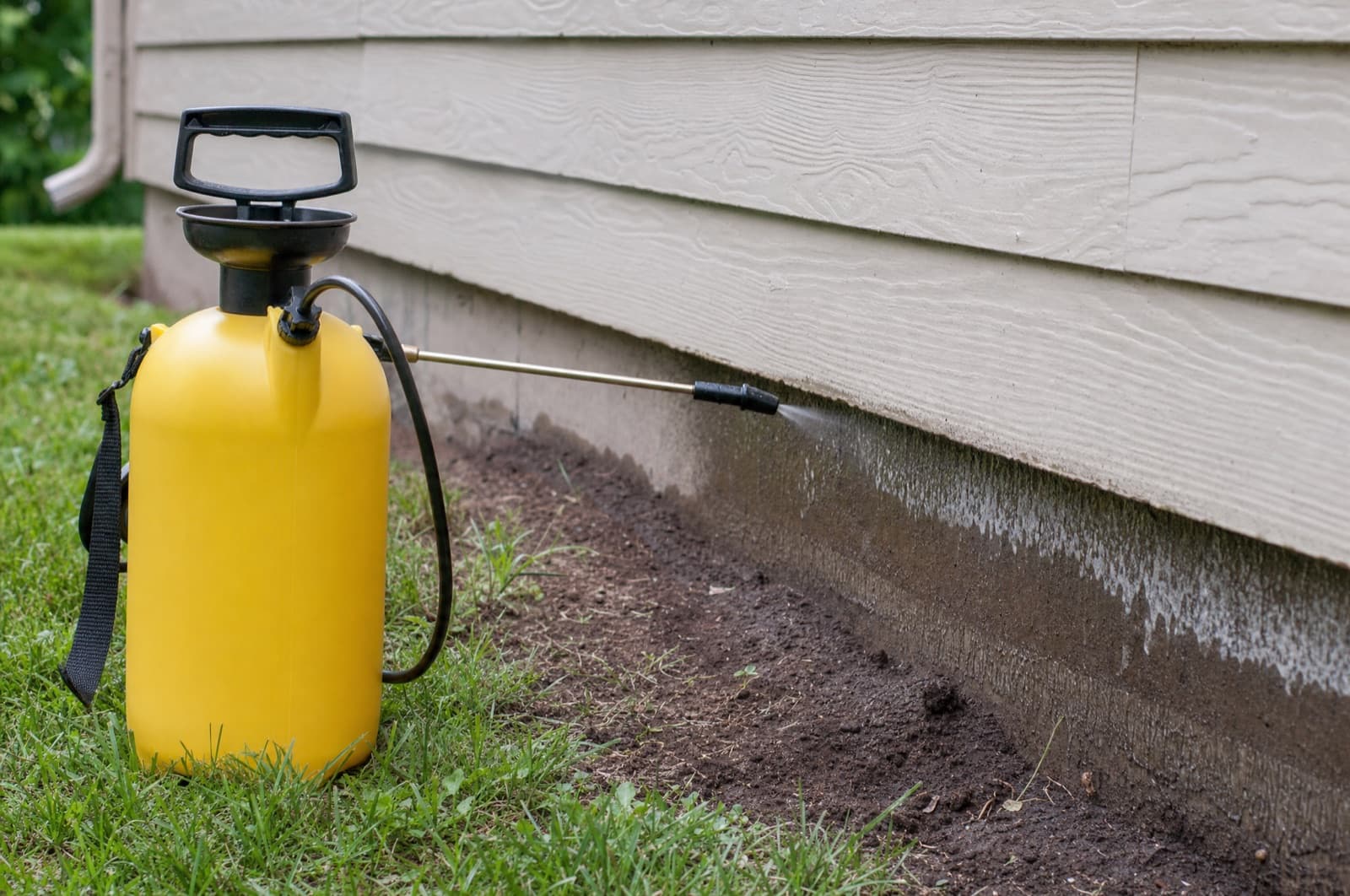
Outdoors, apply the band the label specifies up the foundation and around windows, doors, and roof overhangs as a coarse, uniform wet band.
Pro moveHit weep holes, thresholds, and utility penetrations deliberately — those are the actual entry routes, not just the open foundation wall.Common mistakeTreating it like a broadcast lawn spray over open turf — the label restricts it to bands and spot/foundation treatment, not broadcast application.Keep the band unbroken
Maintain one continuous line at label width around the whole perimeter. Any gap is simply an entry point insects will reroute to.
Let it dry, then reapply on schedule
Keep people and pets off the treated area until it's fully dry. Reapply the outdoor band on the label's interval, and refresh after heavy rain or storms.
CautionKeep spray out of storm drains and water — pyrethroids are toxic to aquatic life.
Do & don't
- Use the coarse setting outdoors so the band lands where insects walk, not a fine mist.
- Keep the band continuous and at label width.
- Target weep holes, thresholds, and utility penetrations specifically.
- Test an inconspicuous spot on siding first.
- Reapply outdoors as the residue decays.
- Don't broadcast it over lawns or large open areas — that's off-label.
- Don't rely on it as your sole defense against termites or an active nest.
- Don't spray it where it can wash into drains or water.
- Don't spray over an ant bait placement you want ants to carry back.
- Don't expect it to clear an established indoor infestation.
Where it works vs. where it fails
No product fixes everything. This is the honest boundary — the situations it genuinely handles, and the ones it simply won't.
Where it works
- Treating an exterior foundation band and entry points as seasonal prevention
- Knocking down exposed ants, roaches, spiders, fleas, and ticks on contact
- Sealing thresholds, weep holes, and utility penetrations against entry
- Pre-season treatment before pest pressure builds
Where it fails
- You need to eliminate a colony or nest — it only reaches foragers and exposed insects
- Carpenter ants or termites are already active in structural wood — the label itself says it isn't sole termite protection
- German cockroaches are the target (widespread pyrethroid resistance)
- There's an untreated indoor source or harborage the band never touches
Mistakes that waste the product
Using the fine-mist setting outdoors
A misted application disperses in the air instead of depositing where crawling insects travel, so no durable band forms.
Skipping weep holes and thresholds
Those are the actual entry routes — leaving them untreated defeats the barrier even if the rest of the band looks complete.
Assuming the 12-month claim applies outdoors
That claim is qualified to non-porous indoor surfaces; the outdoor foundation band fades much sooner under UV, rain, and soil contact.
Spraying over an ant bait placement
The repellent pyrethroid drives ants away from the bait you wanted them to carry back to the colony.
Broadcasting it over open lawn like a lawn spray
The label restricts this product to bands and spot/foundation treatment — broadcasting over turf is off-label and wastes product.
What to expect — and when
This is a prevention tool with a fast visible edge and a slow-fading residual — judge it on entry reduction, not on 'no more bugs, ever.'
First few hours to a day
Contact knockdown of insects that touch the fresh band — dead ants, roaches, and spiders along the line.
Days 1-7
Noticeably reduced entry as the residual band intercepts insects at the foundation and entry points.
Weeks-to-months (outdoors)
Protection tapers as UV, rain, and soil contact degrade the outdoor band — declining control is the cue to reapply.
When to stop DIY & call a pro
A ready-to-use foundation band intercepts insects at the wall but can't follow them back to whatever is producing them inside. These are the signals the job is no longer a spray-can job:
Insects keep coming despite a clean, continuous, correctly-timed band
Persistent activity after correct application usually points to an established colony or indoor harborage the barrier can't reach.
You see carpenter ants, frass, or moisture-damaged wood
Those point to a wood-destroying pest nesting in structure — UNH Extension calls carpenter ants, alongside termites, New Hampshire's most troublesome structural pest, requiring licensed inspection.
Termite swarmers appear indoors
The manufacturer's own label says this product isn't sole protection against termites — swarmers mean it's time for a licensed termite inspection, not more barrier spray.
Cockroaches persist after treatment
German cockroaches carry widespread pyrethroid resistance and live in harborage a surface band never contacts — an established roach problem is a call-a-pro.
When a clean perimeter band still isn't holding the line, Anchor's licensed NH technicians identify and treat the actual source — colony, nest, or entry pathway — with targeted, professional methods. Free inspection, same-day service across southern and central New Hampshire.
Band still not holding the line?
Is it safe for pets & kids?
The short version lives here; the full per-species verdict lives on this product's pet-safety page.
Gamma-cyhalothrin is a pyrethroid and is toxic to fish and aquatic invertebrates, so keep it out of storm drains, gutters, and standing water. Around pets and kids, the main precaution is simple: keep them off the treated band until it's fully dry.
Re-entry: Keep children and pets off treated surfaces until the band is fully dry.
Perimeter timing in New Hampshire
In southern and central New Hampshire, ants, spiders, and occasional invaders push toward the house in the warm months and again as fall cooling sets in — so a foundation band pays off most when it's laid down before that pressure builds and refreshed through the season. German cockroaches can't survive away from heated structures, which is exactly why an indoor baseboard band matters as much as the outdoor foundation line. If you'd rather not manage the coarse-band application and reapplication yourself, Anchor Pest Services treats the perimeter — and the source behind it — across Manchester, Nashua, Concord, and the surrounding towns.
Service area
Southern New Hampshire
Anchor Pest Services · NH license #782664 · NEPMA member · family-owned since 2017.
Frequently asked
Sources & further reading(4)
- [1]EPA Pesticide Product Label System (PPLS) — Spectracide Bug Stop Home Barrier, Reg. No. 9688-298-8845
Verified active (gamma-cyhalothrin 0.025%), band/foundation application directions, up to 12-month non-porous indoor claim
epa_labelverified 2026-07-14 - [2]DoMyOwn — Spectracide Bug Stop Home Barrier product/label page
RTU trigger/AccuShot format, labeled pest list, band-only (not broadcast) application restriction
manufacturerverified 2026-07-14 - [3]UC IPM — Ants (Home & Landscape)
Perimeter treatments kill only foraging ants, not the colony or queens
extensionverified 2026-07-14 - [4]UNH Cooperative Extension — Carpenter Ants Fact Sheet
Carpenter ants, alongside termites, are New Hampshire's most troublesome structural pest — a call-a-pro escalation
extensionverified 2026-07-14
Written & reviewed by
VerifiedDaniel Brady
NH-Licensed Pesticide Applicator · License #782664 (NHDAMF, RSA 430)
Daniel Brady is the New Hampshire–licensed applicator behind Anchor Pest Services, a family-owned pest control company serving the Manchester area since 2017.
Last updated July 2026
Related products in this category
Same shelf, different jobs — the dot shows each product's honest efficacy verdict at a glance.
Professional Pest Control
When the Perimeter Isn't Enough
A barrier spray reduces entry, but it can't eliminate a colony, a carpenter-ant nest, or a termite problem. Anchor Pest Services treats the actual source with targeted, licensed methods across southern and central New Hampshire. Family-owned since 2017, NH license #782664.
- Targeted source treatment, not just perimeter spray
- NH-licensed applicators (#782664)
- Free inspection — same-day service across southern NH
NH License #782664 · No obligation · We answer in person
Your next step
- Book a NH pro
Pest Control Services
Licensed, family-owned pest control across southern NH.
Book now - What to do next
Is Bug Stop Home Barrier by Spectracide Safe for Pets?
Read the answer - What to do next
Is Max Bug Barrier Spray by Raid Safe for Pets?
Read the answer - Also relevant
Is Bug Stop Home Barrier by Spectracide Safe for Pets?
Read the answer - Also relevant
Chemical Ant Control: Why Bait Beats Spray
Read the answer - Related guide
How to Use Max Bug Barrier Spray by Raid
Read the answer