
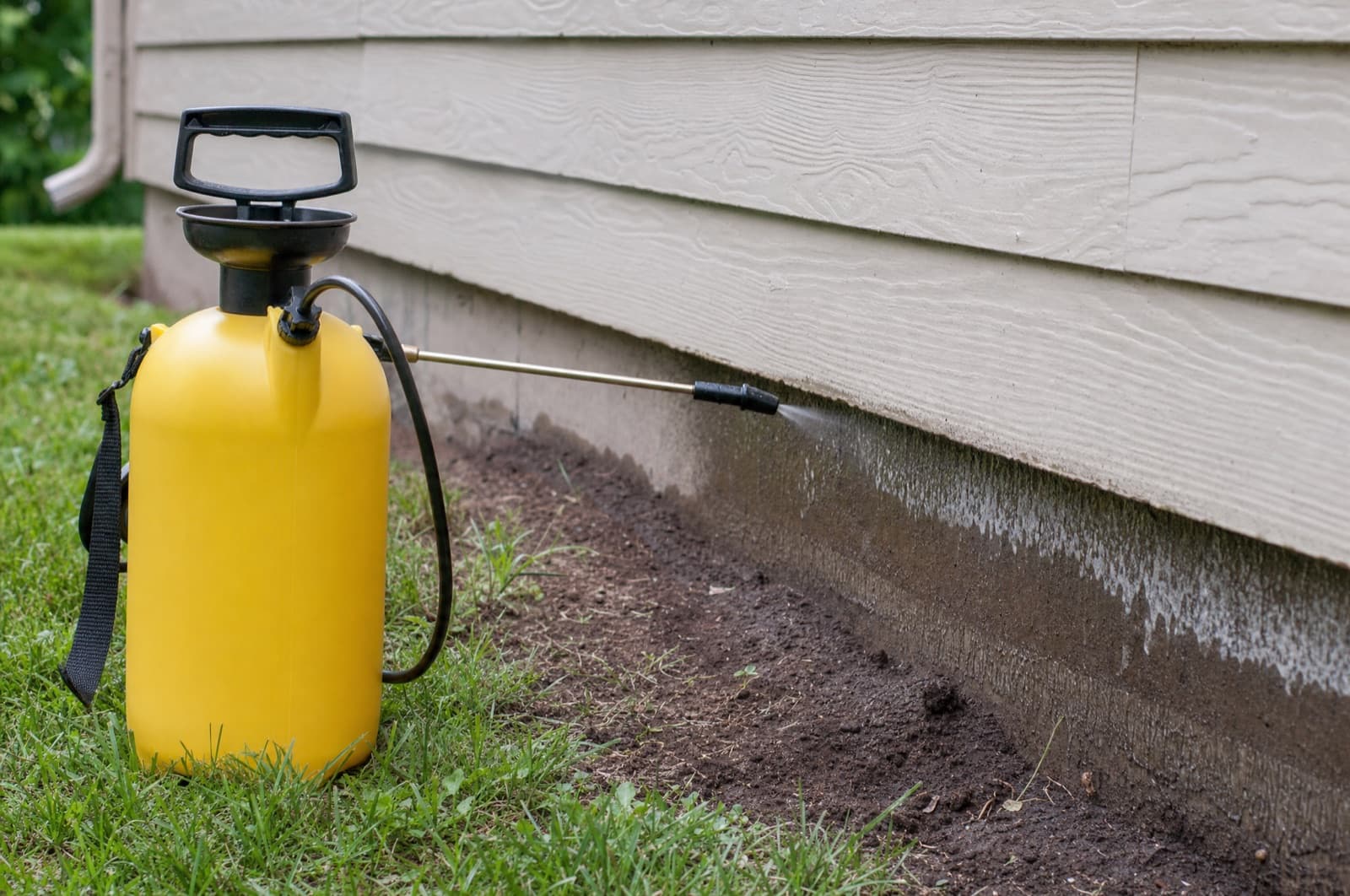
How to Use Suspend SC Insecticide Concentrate by Bayer
At a glance
- Efficacy: Workhorse
- Best job: Laying durable, even residual bands indoors and around structures when mixed accurately
- Format: Professional dilutable suspension concentrate (SC) — mix-your-own, shake well and keep agitated; also marketed as K-Othrine SC; for indoor and outdoor residual control on a broad structural pest list
- Technique: Moderate technique
Does this product actually work?
A pro-grade workhorse for durable, even residual bands — mixed right, not a colony cure.
Deltamethrin is one of the most potent pyrethroids available, and Suspend SC's suspension-concentrate formulation gives it long residual life with a genuinely non-staining, water-based finish — a real professional-grade advantage over many retail sprays. But it kills foragers and exposed insects on contact, not colonies, and the same resistance and interior-source limits that apply across this whole product category apply here too. Mixed accurately and applied as an even band, it's a real workhorse; guessed at or left unagitated in the tank, it underperforms.
Best for
Durable, even residual bands indoors and around structures on a broad pest list, when measured and mixed to the exact label rate.
Skip it for
Instant knockdown expectations, nests that need dusting or baiting instead of a surface band, and resistant German cockroaches.
What it is — and what it's really for
The label is the law. Here's the honest read on the format, the one job it does well, and the job people wrongly buy it for.
The technique walkthrough
Where DIY succeeds or fails is in the placement, patience, and the small pro moves the label never mentions. Follow the label; these are the technique details on top of it.
This is a moderate-difficulty product because the whole professional-grade advantage lives in shaking, measuring, and agitating correctly — skip any of those and it performs like a cheaper spray.
Shake before measuring
Shake the concentrate well before measuring — the active must be fully suspended, not settled at the bottom of the container.
Common mistakeMeasuring straight from an unshaken bottle — the first measured dose comes out weaker than the label rate.Measure precisely
Measure to the exact label rate. Too weak leaves no real barrier; too strong wastes product, risks runoff, and violates the label.
Mix and agitate
Mix in water and agitate or invert the sprayer to keep the concentrate suspended; re-agitate if you pause.
Pro moveInvert or agitate the sprayer periodically through the job so the last gallon deposits as strongly as the first.Apply an even, continuous band
Apply to targeted surfaces, harborage, cracks, and the exterior perimeter/entry points as an even, continuous band — not a broadcast over driveways or patios.
CautionBroadcast application over impervious horizontal surfaces like sidewalks and driveways is prohibited by label.Reapply on schedule
Reapply per label, and refresh exterior bands sooner as weather degrades them.
CautionKeep it out of storm drains and water — extremely toxic to fish — and away from blooming plants, as deltamethrin is also highly toxic to bees.
Do & don't
- Shake before measuring and agitate the tank throughout
- Measure to the exact label rate
- Band entry points and harborage evenly
- Respect outdoor spot/crack-and-crevice restrictions
- Don't broadcast over sidewalks, driveways, or patios
- Don't over-concentrate the mix
- Don't let it reach water or drains
- Don't expect it to eliminate a colony
- Don't skip re-agitating mid-job
Where it works vs. where it fails
No product fixes everything. This is the honest boundary — the situations it genuinely handles, and the ones it simply won't.
Where it works
- Laying even, durable residual bands indoors and around structures
- Mixed and agitated accurately to the label rate
- Treating a broad structural pest list — ants, spiders, roaches, fleas, ticks, mosquitoes
- Non-staining application on surfaces where appearance matters
Where it fails
- You need instant, same-day knockdown
- There's a colony or nest the surface band can't reach
- German cockroaches carry documented pyrethroid resistance
- The concentrate wasn't shaken or the tank wasn't kept agitated, leaving uneven coverage
Mistakes that waste the product
Not shaking or re-agitating
The active settles in the container and tank, so unshaken or unagitated application delivers uneven, progressively weaker coverage.
Wrong dilution
Too weak leaves no real barrier; too strong wastes product, risks runoff, and can violate the label.
Broadcasting over horizontal surfaces
That's off-label for this product and increases runoff risk toward drains and water.
Ignoring the interior source
A residual band reduces exposed-insect activity but doesn't touch a colony or nest already established indoors.
Expecting instant knockdown
Insects die from contact over hours to a couple of days, not seconds — judging it too soon leads to unnecessary reapplication.
What to expect — and when
This is a residual tool with a delayed kill and a genuinely durable hold — judge it on sustained suppression, not instant results.
Hours to 1-2 days
Insects contacting the treated residue die — not instantly, but reliably.
Days 3-14
New activity on treated surfaces drops noticeably as the residual band takes effect.
Weeks (surface- and weather-dependent)
Residual control continues, with outdoor bands fading faster under UV and rain than indoor, non-porous applications.
When to stop DIY & call a pro
Suspend SC is genuinely professional-grade, and its accuracy requirements are exactly where DIY often falls short. These are the signals to bring in a licensed technician:
You're unsure of the correct dilution, agitation routine, or use site
Mixing and coverage errors waste a professional concentrate's entire advantage, and getting it right takes training and practice.
Cockroaches persist despite correctly mixed, evenly applied treatment
Documented pyrethroid-resistant German cockroach populations can survive residual treatment alone and need baiting or dusting alongside it.
You find carpenter ants, frass, or a suspected nest in structural wood
A surface residual band doesn't reach an in-wall colony — that needs inspection and often void treatment.
You need broader structural pest coverage than a single residual application provides
A licensed technician can combine Suspend SC with baiting, dusting, and IGRs into a coordinated program a single product can't replicate.
Anchor's NH-licensed technicians mix and apply pro-grade concentrates like Suspend SC at the correct rate, with the agitation and coverage accuracy that make the difference, and pair it with baiting or dusting where a residual band alone won't finish the job. Free inspection, same-day service across southern and central New Hampshire.
Mixing and agitation accuracy is the whole game
Is it safe for pets & kids?
The short version lives here; the full per-species verdict lives on this product's pet-safety page.
Deltamethrin is a pyrethroid, extremely toxic to fish and aquatic invertebrates, and highly toxic to bees, so keep it well away from water, drains, and blooming plants during mixing and application. Around pets and kids, the practical precaution is staying off the treated area until it's fully dry.
Re-entry: Keep children and pets off treated surfaces until the application is fully dry.
Pro-grade residual across NH's seasons
A durable, non-staining residual band matters most across southern and central New Hampshire's warm-season pest pressure and fall ingress, when ants, spiders, and occasional invaders push toward structures repeatedly. Because Suspend SC's advantage depends on mixing and agitation accuracy most homeowners don't practice regularly, Anchor Pest Services applies it at the correct rate and site across Manchester, Nashua, Concord, and the surrounding towns rather than leaving that precision to a one-time DIY job.
Service area
Southern New Hampshire
Anchor Pest Services · NH license #782664 · NEPMA member · family-owned since 2017.
Frequently asked
Sources & further reading(3)
- [1]EPA/Bayer K-Othrine (Suspend SC) label, Reg. No. 432-763
Verified active (deltamethrin 4.75%), suspension-concentrate format, outdoor spot/crack-and-crevice restrictions, prohibited broadcast on impervious surfaces
epa_labelverified 2026-07-14 - [2]Bayer Environmental Science — Suspend SC SDS
Formulation facts, non-staining water-based finish, use-site list — facts only
manufacturerverified 2026-07-14 - [3]NPIC — Deltamethrin General Fact Sheet
Deltamethrin class, aquatic and bee toxicity
npicverified 2026-07-14
Written & reviewed by
VerifiedDaniel Brady
NH-Licensed Pesticide Applicator · License #782664 (NHDAMF, RSA 430)
Daniel Brady is the New Hampshire–licensed applicator behind Anchor Pest Services, a family-owned pest control company serving the Manchester area since 2017.
Last updated July 2026
Related products in this category
Same shelf, different jobs — the dot shows each product's honest efficacy verdict at a glance.
Professional Pest Control
Pro-Grade Products Deserve Pro-Grade Application
Suspend SC rewards precision and punishes guesswork. Anchor Pest Services mixes, agitates, and applies it at the correct rate and site across southern and central New Hampshire. Family-owned since 2017, NH license #782664.
- Accurate, licensed mixing and application
- NH-licensed applicators (#782664)
- Free inspection — same-day service across southern NH
NH License #782664 · No obligation · We answer in person
Your next step
- Book a NH pro
Pest Control Services
Licensed, family-owned pest control across southern NH.
Book now - What to do next
Is Suspend SC Insecticide Concentrate by Bayer Safe for Pets?
Read the answer - What to do next
Is Demand CS Insecticide Concentrate by Syngenta Safe for Pets?
Read the answer - Also relevant
Is Suspend SC Insecticide Concentrate by Bayer Safe for Pets?
Read the answer - Also relevant
Chemical Ant Control: Why Bait Beats Spray
Read the answer - Related guide
How to Use Demand CS Insecticide Concentrate by Syngenta
Read the answer