
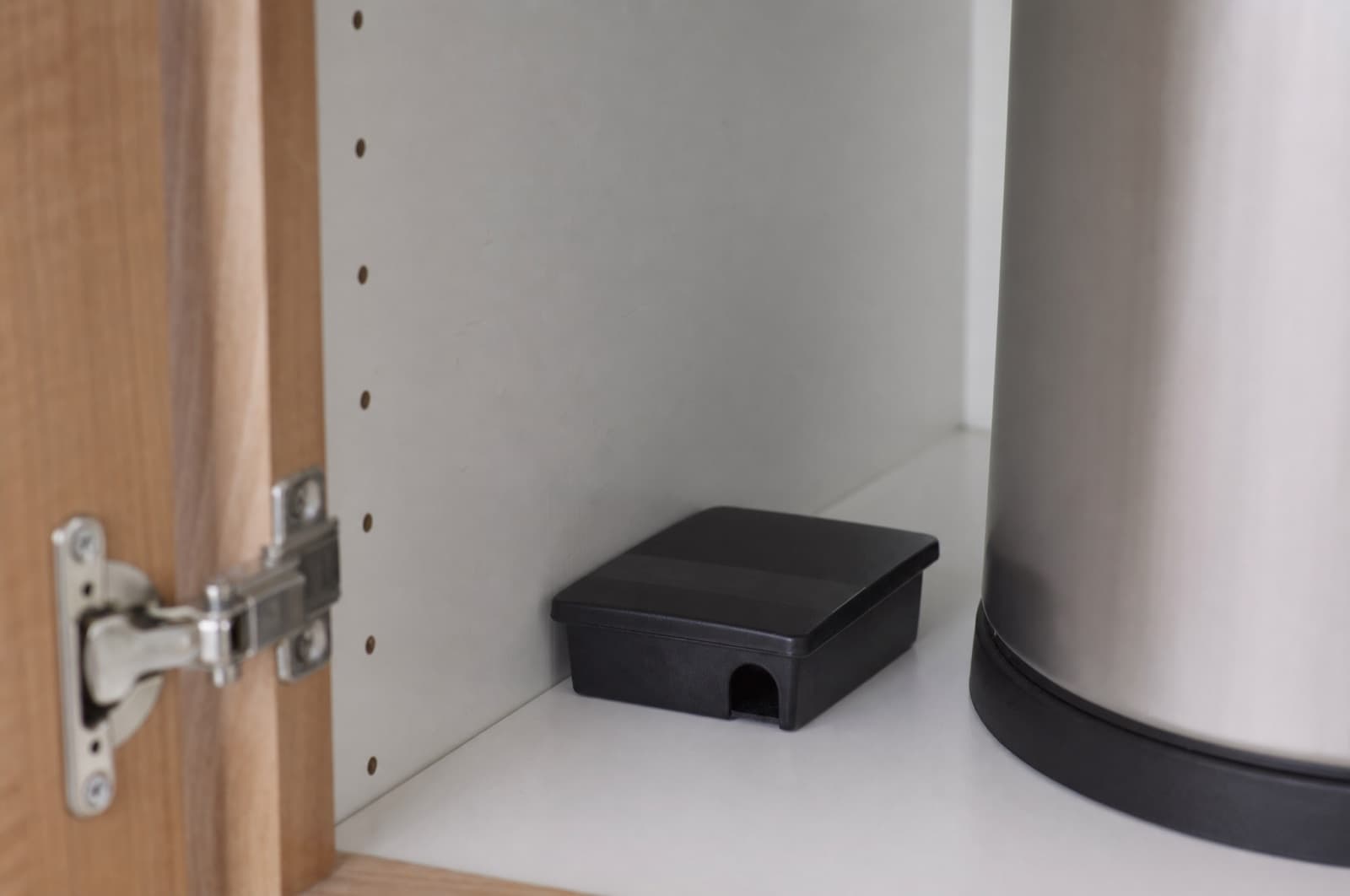
How to Use Double Control Ant Baits by Raid
At a glance
- Efficacy: Workhorse
- Best job: Colony-level reduction of common trailing household ants when every station in the pack is deployed at once, directly on the trail
- Format: Prefilled (enclosed) ant bait stations with two food-matrix formulas — "Double Control" refers to the two bait matrices offered side by side to cover different ant food preferences, not a second active ingredient
- Technique: Easy technique
Does this product actually work?
A genuine workhorse for common household ant trails — the ceiling is density and patience, not the chemistry.
Slow-acting avermectin bait is exactly the mechanism university IPM programs favor for ants: UC IPM explains that bait must be slow enough for a forager to carry it back and share it with the colony before it takes effect, which is how this product reaches the nest a spray never touches. Used correctly — all stations out at once, set on the trail, left undisturbed while ants feed — it earns the workhorse grade for the common household ants it lists. It is not built for carpenter ants or a colony too large for consumer-density baiting, and killing the ants you see with a spray while you're baiting undoes the whole strategy.
Best for
Trailing indoor household ants (Argentine, cornfield, pavement, little black, odorous house) when every station is set out at once, directly on the trail.
Skip it for
Carpenter ants in structural wood, pharaoh ants, or as the sole tool against a large, multi-nest colony.
What it is — and what it's really for
The label is the law. Here's the honest read on the format, the one job it does well, and the job people wrongly buy it for.
The technique walkthrough
Where DIY succeeds or fails is in the placement, patience, and the small pro moves the label never mentions. Follow the label; these are the technique details on top of it.
This bait rewards patience and density above everything else — the two habits that sabotage it are spraying the trail and cleaning up the ants while they're still feeding.
Deploy every station at once
Separate all the stations in the pack and place them together in the first round — thorough control depends on using the whole pack, not holding some in reserve.
Common mistakeSetting out one or two stations 'to test it' and saving the rest — that under-doses the whole strategy from day one.Set stations directly on the trail
Place stations where you actually see ants — corners, under sinks, in cabinets, along baseboards, near plumbing — not just anywhere in the room.
Pro moveUse the adhesive strip to secure stations on walls or under counters right along the trail line, so foragers encounter the bait without detouring.Leave the trail undisturbed
Resist the urge to wipe up the trail or the ants feeding at the station while bait is active.
Common mistakeCleaning up the 'extra' ants recruited to the bait — that breaks the recruitment chain that carries bait back to the colony.Keep sprays away from the stations
Do not spray insecticide near or on the bait stations — a repellent residue keeps ants from feeding on bait they'd otherwise carry home.
CautionBait and repellent chemistry work against each other; using both at once typically performs worse than baiting alone.Replace on schedule
Replace stations per the package interval, or sooner if a trail goes cold, a station dries out, or activity returns after it seemed to stop.
Do & don't
- Deploy the full pack at once, not gradually.
- Set stations directly on active trails, secured with the adhesive strip.
- Leave feeding ants alone — a short-term increase is normal and desired.
- Add extra stations at the heaviest activity spots.
- Replace per the label interval or sooner if activity returns.
- Don't spray insecticide near or on the stations.
- Don't wipe up the trail or the ants feeding at it.
- Don't use just one or two stations against real activity.
- Don't place over food-prep surfaces.
- Don't expect it to solve a carpenter-ant problem.
Where it works vs. where it fails
No product fixes everything. This is the honest boundary — the situations it genuinely handles, and the ones it simply won't.
Where it works
- The ants are common household trailers — Argentine, cornfield, pavement, little black, or odorous house ants
- Every station in the pack is deployed at once, directly on the trail
- Feeding ants and the trail are left undisturbed while the bait works
- No sprays or cleaners are contaminating the stations or the area around them
Where it fails
- The ants are carpenter ants nesting in structural wood — a different pest this product doesn't target
- Pharaoh ants are present, which can fragment into new colonies under the wrong disturbance
- Only one or two stations are deployed against a real, active trail
- A spray or repellent cleaner is used near the stations, contaminating or repelling the bait
- The colony is large or multi-nest and outpaces consumer-density baiting
Mistakes that waste the product
Killing the visible ants with a spray while baiting
It stops recruitment and destroys the colony-transfer effect the bait depends on, so you lose both the spray's short-term knockdown and the bait's real work.
Deploying only a station or two
A sparse deployment misses most of the trail, so foragers never encounter the bait in enough numbers to matter.
Wiping up the trail or cleaning the area mid-feed
It erases the scent trail that recruits more foragers to the bait, cutting the process short before the colony is reached.
What to expect — and when
This bait works on a colony-transfer timeline — judge it over one to two weeks, not the first afternoon, and expect a brief uptick before the decline.
First 24-72 hours
Ants recruit to the bait — you may see MORE ants at the stations than before. This is the bait working, not a failure.
Days 3-14
Trail activity declines as the colony is dosed through shared feeding; fewer foragers appear over successive days.
After 2-3 weeks
Trails should be markedly reduced or gone; persistent, unchanged trailing at this point signals a colony beyond what consumer-density baiting can finish.
When to stop DIY & call a pro
A prefilled dual-bait station depends on ants choosing it over their natural food and carrying enough back to matter — a slow process that stalls against a large or multi-nest colony. These are the honest triggers to stop DIY:
You see large black ants, wood shavings/frass, or rustling in walls
Those point to carpenter ants nesting in structural wood — a wood-destroying pest this bait isn't formulated for and that needs professional inspection.
Trails persist after 2-3 weeks of correct, undisturbed, dense baiting
That's enough time for avermectin's colony-transfer effect to show; continued activity usually means an established or multi-nest colony beyond consumer-density baiting.
New trails keep appearing in different rooms each season
Recurring, shifting activity usually means an unaddressed outdoor nest or entry point that baiting alone won't fix.
You see winged ants swarming indoors
Indoor swarmers can signal an established nest inside the structure — a licensed inspection is the appropriate next step.
When correct, patient baiting still isn't closing a trail, Anchor's licensed NH technicians identify the actual nest — indoors, in a void, or outdoors — and treat the source a retail bait pack can't reach. Free inspection, same-day service across southern and central New Hampshire.
Ant trails not clearing after correct, patient baiting?
Is it safe for pets & kids?
The short version lives here; the full per-species verdict lives on this product's pet-safety page.
The enclosed stations are child-resistant, but should still be kept out of reach of children and pets — the bait inside is a genuine pesticide. Note the label states the bait matrix may contain peanut or peanut by-products, which matters for households managing a food allergy.
Re-entry: No general re-entry wait is required for the enclosed stations themselves, but keep children and pets from handling, chewing, or prying one open.
Household ants in southern & central New Hampshire
Odorous house ants, pavement ants, and little black ants are common trailing nuisance ants in NH homes, especially as they push indoors during warm-weather foraging and again with fall cooling — the pests this bait is genuinely built for. New Hampshire's more troublesome structural ant, the carpenter ant, is a different problem this product doesn't target; UNH Cooperative Extension lists carpenter ants alongside termites as the state's most troublesome structural pests, and they need inspection and often professional treatment rather than a sweet/protein bait station. If you're not sure which ant is trailing through your kitchen, Anchor Pest Services serves Manchester, Nashua, Concord, and the surrounding towns with correct identification and, where needed, licensed treatment.
Service area
Southern New Hampshire
Anchor Pest Services · NH license #782664 · NEPMA member · family-owned since 2017.
Frequently asked
Sources & further reading(4)
- [1]Pomerix Pesticide Database — Raid Max Double Control Ant Baits
Verified active (avermectin B1/abamectin 0.05%), EPA registration and product format facts (facts only, not the efficacy verdict)
manufacturerverified 2026-07-14 - [2]UC IPM — Ants: Pest Notes
Slow-acting bait principle: bait must let foragers carry it back to feed the colony before it takes effect
extensionverified 2026-07-14 - [3]NC State Extension — Tips for Effective Ant Baiting
Warning against disturbing or spraying ants/bait; correct ant-baiting technique
extensionverified 2026-07-14 - [4]UNH Cooperative Extension — Carpenter Ants Fact Sheet
Carpenter ants as a NH structural pest distinct from household trailing ants; call-a-pro escalation
extensionverified 2026-07-14
Written & reviewed by
VerifiedDaniel Brady
NH-Licensed Pesticide Applicator · License #782664 (NHDAMF, RSA 430)
Daniel Brady is the New Hampshire–licensed applicator behind Anchor Pest Services, a family-owned pest control company serving the Manchester area since 2017.
Last updated July 2026
Related products in this category
Same shelf, different jobs — the dot shows each product's honest efficacy verdict at a glance.
Professional Pest Control
When Ant Baiting Hits Its Ceiling
Slow-acting bait genuinely works on common household ants, but carpenter ants and large, multi-nest colonies exceed what a retail pack can finish. Anchor Pest Services treats the actual nest across southern and central New Hampshire. Family-owned since 2017, NH license #782664.
- Nest identification, not just bait placement
- NH-licensed applicators (#782664)
- Free inspection — same-day service across southern NH
NH License #782664 · No obligation · We answer in person
Your next step
- Book a NH pro
Ant Pest Control
Book now - Book a NH pro
Pest Control Services
Licensed, family-owned pest control across southern NH.
Book now - What to do next
Is Raid Double Control Ant Baits Safe for Pets?
Read the answer - What to do next
Is Raid Ant & Roach Killer Spray Safe for Pets?
Read the answer - Also relevant
Is Raid Double Control Ant Baits Safe for Pets?
Read the answer - Also relevant
Chemical Ant Control: Why Bait Beats Spray
Read the answer