
How to Use Kills Ants Ant Killing Bait Stations by Amdro
At a glance
- Efficacy: Workhorse
- Best job: Colony-level reduction of common household ant trails when every station is deployed at once, concentrated on the trail
- Format: Enclosed, prefilled ant bait stations with an adhesive strip for wall/cabinet placement; a dual-matrix food formula for both sweet- and grease-feeding ants
- Technique: Easy technique
Does this product actually work?
A genuine workhorse for common household ant trails — hydramethylnon does the colony-transfer work sprays can't.
Hydramethylnon works on the same slow-acting, colony-transfer principle UC IPM points to when it says properly used baits are 'more effective and safer than sprays' for ants. Deployed correctly — the full pack at once, hugging the trail, undisturbed while ants feed — it's a genuine workhorse against the household ants it lists. The manufacturer itself excludes carpenter, fire, harvester, and pharaoh ants from the target list, and that exclusion is the honest ceiling: reach for a different tool for those species, and don't expect a couple of stations spread thin across a house to keep up with a real trail.
Best for
Trailing indoor household ants (Argentine, odorous house, pavement, cornfield) when every station is deployed at once along the trail.
Skip it for
Carpenter ants, fire ants, harvester ants, or pharaoh ants — the manufacturer excludes all four from the target list, and this bait isn't matched to them.
What it is — and what it's really for
The label is the law. Here's the honest read on the format, the one job it does well, and the job people wrongly buy it for.
The technique walkthrough
Where DIY succeeds or fails is in the placement, patience, and the small pro moves the label never mentions. Follow the label; these are the technique details on top of it.
Density on the trail and patience while ants feed are what make hydramethylnon work — the two habits most likely to sabotage it are spraying nearby and under-deploying.
Place all stations at once
Deploy every station in the pack where ants trail — under sinks, on counters, behind appliances, along baseboards — rather than saving some for later.
Common mistakeUsing just one or two stations 'to see if it works,' which under-doses a real trail from the start.Secure stations on the trail
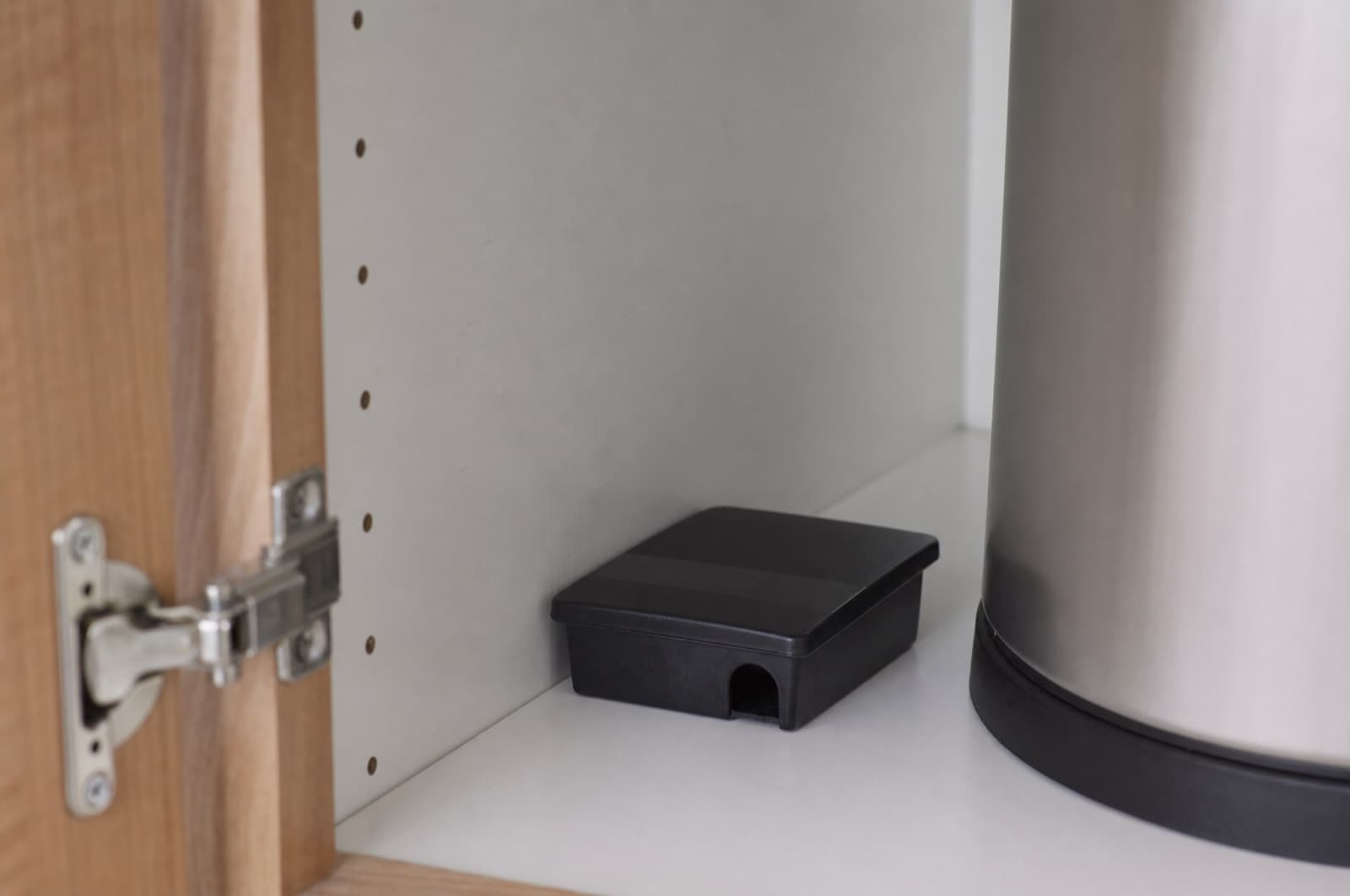
Use the adhesive strip (pre-cut hole facing up, per the manufacturer) to fix stations on walls or cabinets right along the line ants are actually traveling.
Pro moveFollow the trail back toward the entry point and bait there — recruited foragers stream straight to a station placed at the source of the trail.Concentrate on active spots
Add more stations at the heaviest-activity areas rather than spacing the pack evenly across rooms with no ant traffic.
Leave the trail undisturbed
Don't spray, wipe up, or otherwise interfere with ants while they're feeding at a station.
Common mistakeTreating the trail with a contact spray at the same time — it repels ants and stops the colony transfer this bait depends on.Replace when empty or per label
Swap stations out per the label interval or as soon as one looks empty, dried, or contaminated.
Do & don't
- Deploy every station at once, concentrated on active trails.
- Secure stations with the adhesive strip right on the line of travel.
- Leave feeding ants and the trail undisturbed.
- Add extra stations at the busiest spots.
- Replace when empty or per the label interval.
- Don't spray insecticide near the stations.
- Don't use it for carpenter, fire, harvester, or pharaoh ants — it's not labeled for them.
- Don't place over food-prep surfaces.
- Don't use just one or two stations against a real trail.
- Don't expect same-day results.
Where it works vs. where it fails
No product fixes everything. This is the honest boundary — the situations it genuinely handles, and the ones it simply won't.
Where it works
- The ants are common household trailers on the label — Argentine, odorous house, pavement, cornfield
- Every station in the pack is deployed at once, concentrated on the trail
- Ants and the trail are left undisturbed while feeding
- No sprays or cleaners are contaminating stations nearby
Where it fails
- The ants are carpenter, fire, harvester, or pharaoh ants — all excluded from the label
- Only one or two stations are deployed against real activity
- A spray or repellent cleaner is used near the stations
- The colony is large or multi-nest and outpaces consumer-density baiting
- An untreated outdoor nest keeps resupplying the trail
Mistakes that waste the product
Spraying the trail at the same time as baiting
The label's excluded-species list aside, a repellent spray still kills or repels foragers before they can carry hydramethylnon back to the colony, undoing the bait's real work.
Using this bait against carpenter, fire, harvester, or pharaoh ants
The manufacturer explicitly excludes these species from the target list, so results will disappoint no matter how well you place the stations.
Sparse placement — one station for a whole kitchen
Most foragers on a busy trail never encounter a lone station, so the bait sits unused while the trail keeps growing.
What to expect — and when
This bait works on a colony-transfer timeline — the manufacturer's own guidance points to about a week for a noticeable drop, with full effect building over one to two weeks.
First 24-72 hours
An initial rise in ants recruited to the station is normal and expected — it means the bait is being carried back to the colony.
About one week
Fewer ants along the trail, per the manufacturer's guidance, as the colony is progressively dosed.
1-2 weeks
Trail activity should be markedly reduced; persistent, unchanged activity signals an untreated nest or the wrong ant species for this bait.
When to stop DIY & call a pro
Prefilled household stations are matched to a single foraging trail — a satellite-nesting or multi-colony situation simply outnumbers what a few stations can carry away. These are the honest triggers to stop DIY:
You see large black ants, wood shavings, or hear rustling in walls
Carpenter ants are excluded from this bait's label and nest in structural wood — a wood-destroying pest that needs professional inspection.
Trails persist after 1-2 weeks of correct, dense, undisturbed baiting
That's enough time for hydramethylnon's colony-transfer effect to show; continued activity usually means an established colony or an unaddressed source.
Trails keep reappearing from an unfound outdoor nest
A resupplying outdoor colony will keep sending foragers indoors faster than baiting alone can interrupt.
You've confirmed fire, harvester, or pharaoh ants
All three are excluded from this bait's target list and, particularly pharaoh ants, can worsen with the wrong disturbance — a licensed assessment is the safer path.
When correct, dense baiting still isn't closing a trail — or the species turns out to be outside this bait's label — Anchor's licensed NH technicians identify the actual ant and nest and treat what a retail bait can't reach. Free inspection, same-day service across southern and central New Hampshire.
Ant trail still active after correct baiting?
Is it safe for pets & kids?
The short version lives here; the full per-species verdict lives on this product's pet-safety page.
The stations are enclosed and designed to be low-risk around the house, but should still be kept out of reach of children and pets — hydramethylnon is a genuine pesticide even though it's low in acute mammalian toxicity. Never place a station where it could be pried open by a curious pet.
Re-entry: No general re-entry wait is required for the enclosed stations themselves, but keep children and pets from handling or chewing on one.
Household ants in southern & central New Hampshire
The trailing ants this bait targets — odorous house, pavement, cornfield, and Argentine ants — are common seasonal invaders in NH kitchens and bathrooms as warm-weather foraging picks up and again during fall cooling. Carpenter ants, which this bait explicitly excludes, are New Hampshire's real structural concern; UNH Cooperative Extension lists them alongside termites as the state's most troublesome structural pests, and they call for inspection rather than a household ant bait. If you're not sure which ant is trailing through your home, Anchor Pest Services serves Manchester, Nashua, Concord, and the surrounding towns with correct identification and licensed treatment where needed.
Service area
Southern New Hampshire
Anchor Pest Services · NH license #782664 · NEPMA member · family-owned since 2017.
Frequently asked
Sources & further reading(4)
- [1]EPA Pesticide Product Label Search — Amdro Ant Block / Ant Killing Bait Stations (hydramethylnon family)
Hydramethylnon as the active ingredient class and registered use directions for Amdro ant bait products
epa_labelverified 2026-07-14 - [2]Amdro — Ant Killing Bait Stations product page
Product format, dual-matrix bait, and the excluded-species list (carpenter, fire, harvester, pharaoh ants) — facts only, not the efficacy verdict
manufacturerverified 2026-07-14 - [3]UC IPM — Ants: Pest Notes
Slow-acting bait principle; properly used baits are more effective and safer than sprays
extensionverified 2026-07-14 - [4]UNH Cooperative Extension — Carpenter Ants Fact Sheet
Carpenter ants as NH's most troublesome structural ant, distinct from this bait's labeled target species
extensionverified 2026-07-14
Written & reviewed by
VerifiedDaniel Brady
NH-Licensed Pesticide Applicator · License #782664 (NHDAMF, RSA 430)
Daniel Brady is the New Hampshire–licensed applicator behind Anchor Pest Services, a family-owned pest control company serving the Manchester area since 2017.
Last updated July 2026
Related products in this category
Same shelf, different jobs — the dot shows each product's honest efficacy verdict at a glance.
Professional Pest Control
When Household Ant Bait Hits Its Ceiling
Hydramethylnon bait genuinely works on common household ants, but carpenter ants and other excluded species need a different approach entirely. Anchor Pest Services identifies the real problem and treats it, across southern and central New Hampshire. Family-owned since 2017, NH license #782664.
- Correct species ID before treatment
- NH-licensed applicators (#782664)
- Free inspection — same-day service across southern NH
NH License #782664 · No obligation · We answer in person
Your next step
- Book a NH pro
Ant Pest Control
Book now - Book a NH pro
Pest Control Services
Licensed, family-owned pest control across southern NH.
Book now - What to do next
Is Amdro Kills Ants Bait Stations Safe for Pets?
Read the answer - Also relevant
Is Amdro Kills Ants Bait Stations Safe for Pets?
Read the answer - Also relevant
Chemical Ant Control: Why Bait Beats Spray
Read the answer - Related guide
How to Use Max Ant Killing Bait by Combat
Read the answer