
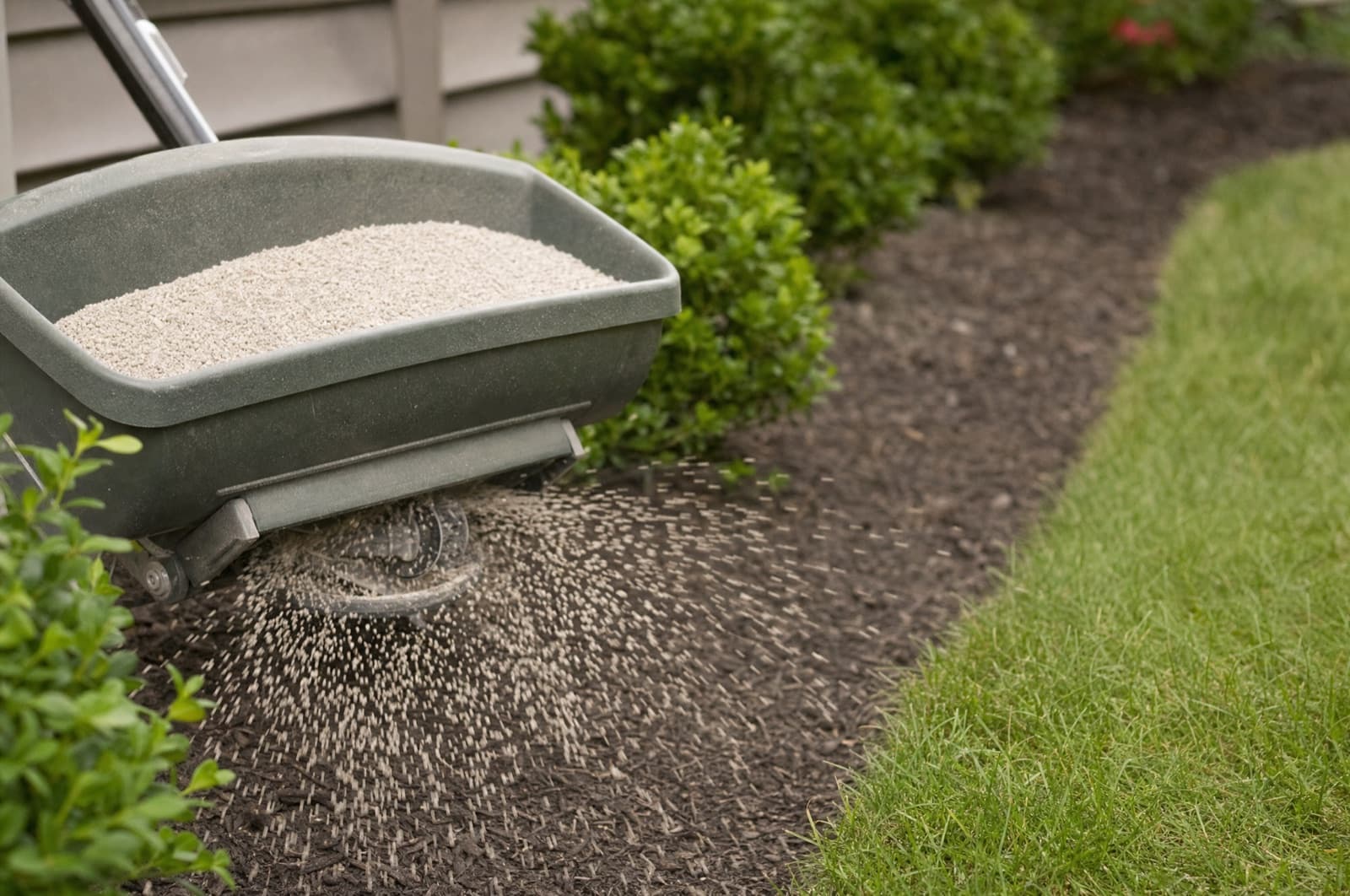
How to Use Amdro Fire Ant Bait Granules
At a glance
- Efficacy: Situational
- Best job: Colony-level control of fire-ant mounds across lawns in regions where fire ants actually establish
- Format: Granular BAIT on a corn-grit/soybean-oil food matrix — broadcast or mound-applied, left dry on the surface (EPA Reg. No. 73342-1)
- Technique: Easy technique
Does this product actually work?
A genuine national workhorse for fire-ant mounds — but situational-to-skip for New Hampshire, where fire ants essentially don't exist.
Where imported fire ants actually live, Mississippi State Extension credits properly applied hydramethylnon bait with 80-90% control, and the slow, colony-transfer mechanism is genuinely well-designed. But imported fire ants are limited by cold and do not establish in New Hampshire's climate, well outside the USDA APHIS quarantine zone — so for a New Hampshire reader, the honest answer is that this is the wrong product for the ant in your yard. We document the correct national-use technique in full below, but if you have ants in New Hampshire, start with Terro T300 or Advion Ant Gel instead.
Best for
Broadcast fire-ant suppression across lawns and mound treatment in the South and warm-winter regions where imported fire ants actually establish.
Skip it for
Any New Hampshire ant problem — carpenter ants, odorous house ants, and pavement ants are NH's real nuisance species, and none of them respond to a fire-ant bait the way fire ants do.
What it is — and what it's really for
The label is the law. Here's the honest read on the format, the one job it does well, and the job people wrongly buy it for.
The technique walkthrough
Where DIY succeeds or fails is in the placement, patience, and the small pro moves the label never mentions. Follow the label; these are the technique details on top of it.
Documented in full for national accuracy — but note the honest NH redirect above before buying this for a New Hampshire yard. The core technique rule: this is a BAIT, so it stays dry.
Confirm ants are actively foraging before applying
Place a small test food item near a mound or trail and confirm ants are actively collecting it; apply generally when soil temperature is above 60°F.
Common mistakeApplying bait when ants aren't foraging (too cold, too wet, or mid-rain) — bait that sits unfound simply degrades.Use fresh bait
Use bait within about 3 months of opening the container — the oil-based matrix goes rancid and loses attractiveness with age.
Common mistakeApplying old, stale bait from a container that's been open for a season or more — it's no longer attractive enough to be carried back.Broadcast for area coverage, or ring individual mounds — never apply directly on top
Use a spreader to broadcast over the treatment area for general suppression, or sprinkle bait in a ring a short distance around (never directly on) an individual mound.
Pro moveFor high mound density, broadcasting the whole area is generally more effective and efficient than treating mound-by-mound.CautionDisturbing the mound itself while applying can cause the colony to relocate before it's fully dosed.Leave it dry — do NOT water it in
Do not water in the bait, and don't apply if rain is expected within about 24 hours; moisture makes the granules soggy and unappealing, killing the carry-back mechanism this product depends on.
Common mistakeWatering in the bait out of habit from other lawn products — that's the technique for a CONTACT granule, and it ruins a bait.Be patient — this is a multi-week process
Expect foraging reduction over 1-4 weeks and colony die-off over 4-8 weeks; extension guidance recommends 2-3 applications per year for sustained control where fire ants are present.
Do & don't
- Apply only when ants are actively foraging and soil/grass is dry
- Use fresh bait, within about 3 months of opening
- Broadcast for area coverage or ring mounds lightly
- Be patient — this is a multi-week colony process
- Don't water it in — that ruins the bait matrix
- Don't apply before expected rain or onto wet/dewy grass
- Don't disturb or dig into the mound directly
- Don't use stale or rancid bait
- Don't apply this in New Hampshire expecting it to solve a local ant problem
Where it works vs. where it fails
No product fixes everything. This is the honest boundary — the situations it genuinely handles, and the ones it simply won't.
Where it works
- Imported or native fire ants are confirmed present and actively foraging
- The bait is fresh and applied dry, with no rain in the following 24 hours
- The application is broadcast or ring-applied without disturbing the mound
- You're in a region where fire ants actually establish (the South, Southwest, warm-winter zones)
Where it fails
- You're in New Hampshire or another region fire ants don't inhabit — there's no colony to carry bait to
- The bait is watered in or applied before rain
- Stale, rancid bait is used
- The mound is disturbed during application, causing the colony to relocate
- The ants present are actually a NH look-alike species (pavement, carpenter, or field ants) misidentified as fire ants
Mistakes that waste the product
Watering in the bait
Moisture ruins the food matrix and kills the carry-back mechanism the whole product depends on.
Buying it for a New Hampshire ant problem
Imported fire ants don't establish in NH's climate, so the bait has no colony to transfer to and simply won't work as marketed.
Using stale bait
The oil-based matrix goes rancid and loses its attractiveness to foraging ants.
Applying before rain or on wet/dewy grass
Wet granules become soggy and unappealing before ants can collect them.
Disturbing the mound while applying
A disturbed colony can relocate before it's fully dosed, undermining control.
What to expect — and when
This is a multi-week colony process where fire ants actually live — and, for a New Hampshire reader, a non-starter regardless of timeline.
1-4 weeks (national use case)
Reduced foraging activity as worker ants carry bait back and the colony is dosed.
4-8 weeks (national use case)
Colony die-off, with extension guidance citing 80-90% control from correctly timed applications.
In New Hampshire
No meaningful timeline applies — the target pest essentially isn't present, so this isn't the right tool regardless of how correctly it's applied.
When to stop DIY & call a pro
For a New Hampshire reader, the most important call-a-pro signal is simple: confirm what you actually have before treating it.
You think you found a 'fire ant' mound in New Hampshire
You almost certainly have a look-alike species, such as a pavement or field ant — professional identification prevents treating the wrong pest with the wrong product.
NH ant activity persists despite correct baiting with a NH-appropriate product
Persistent activity after correct sweet-bait technique usually means a colony larger than homeowner-scale baiting can clear, or a carpenter-ant nest needing a different approach.
You see large black ants or other signs of a structure-damaging colony
That points to carpenter ants, a NH structural pest that this fire-ant bait was never designed to touch.
If you're not sure what's actually in your yard, or NH ant activity keeps coming back despite the right product and technique, Anchor's licensed NH technicians identify the species and treat the real source. Free inspection, same-day service across southern and central New Hampshire.
Not sure what's actually in your NH yard?
Is it safe for pets & kids?
The short version lives here; the full per-species verdict lives on this product's pet-safety page.
Hydramethylnon has low mammalian toxicity but is toxic to fish and aquatic invertebrates, so keep it away from ponds and waterways. Consumer Amdro carries the signal word CAUTION.
Re-entry: Keep children and pets off the treated area during application and until the bait has been picked up by foraging ants or otherwise cleared, per label.
Why this product isn't for New Hampshire
Imported fire ants are limited by cold winters — the range models researchers use to predict where colonies can survive rely on roughly a 10°F mean-annual-minimum-temperature line, and the USDA APHIS federal quarantine for imported fire ants covers 14 states, all in the South and Southwest. New Hampshire sits far outside that range, so a NH homeowner will essentially never have a genuine imported-fire-ant problem. If you're treating what you believe is a fire-ant mound in NH, it's worth confirming the species before applying anything; Anchor Pest Services identifies and treats NH's actual nuisance and structural ants — odorous house, pavement, and carpenter ants — across Manchester, Nashua, Concord, and the surrounding towns.
Service area
Southern New Hampshire
Anchor Pest Services · NH license #782664 · NEPMA member · family-owned since 2017.
Frequently asked
Sources & further reading(6)
- [1]EPA Registered Product Label — Amdro Fire Ant Bait (EPA Reg. No. 73342-1)
Verified active (hydramethylnon 0.73%), granular bait matrix, do-not-water-in directions, target species
epa_labelverified 2026-07-14 - [2]Mississippi State University Extension — Control Fire Ants in Your Yard
80-90% control from correctly applied hydramethylnon bait; bait-vs-contact distinction; patience/multi-week timeline
extensionverified 2026-07-14 - [3]USDA APHIS — Imported Fire Ant Program Manual (Federal Quarantine)
Federal fire-ant quarantine covering 14 southern/southwestern states — New Hampshire is far outside the range
govverified 2026-07-14 - [4]Korzukhin, Porter, Thompson & Wiley, 'Modeling Temperature-Dependent Range Limits for the Fire Ant Solenopsis invicta,' Environmental Entomology 30(4):645 (2001)
Cold-temperature range-limit modeling explaining why imported fire ants can't establish in New Hampshire's climate
academicverified 2026-07-14 - [5]UNH Cooperative Extension — Carpenter Ants Fact Sheet
New Hampshire's actual structural ant problem, used for the NH redirect
extensionverified 2026-07-14 - [6]Amdro — Fire Ant Bait product page
Application directions and use-within-3-months freshness guidance (facts only, not the efficacy verdict)
manufacturerverified 2026-07-14
Written & reviewed by
VerifiedDaniel Brady
NH-Licensed Pesticide Applicator · License #782664 (NHDAMF, RSA 430)
Daniel Brady is the New Hampshire–licensed applicator behind Anchor Pest Services, a family-owned pest control company serving the Manchester area since 2017.
Last updated July 2026
Related products in this category
Same shelf, different jobs — the dot shows each product's honest efficacy verdict at a glance.
Professional Pest Control
The Right Product Starts With the Right Identification
Fire-ant bait is a genuine workhorse for the wrong pest in New Hampshire. Anchor Pest Services identifies the ant you actually have -- carpenter, odorous house, pavement, or another species -- and treats it with targeted, licensed methods across southern and central New Hampshire. Family-owned since 2017, NH license #782664.
- Correct species ID before treatment
- NH-licensed applicators (#782664)
- Free inspection — same-day service across southern NH
NH License #782664 · No obligation · We answer in person
Your next step
- Book a NH pro
Ant Pest Control
Book now - Book a NH pro
Pest Control Services
Licensed, family-owned pest control across southern NH.
Book now - What to do next
Is Amdro Fire Ant Bait Granules Safe for Pets?
Read the answer - What to do next
Is Ant Block Home Perimeter Ant Bait by Amdro Safe for Pets?
Read the answer - Also relevant
Is Amdro Fire Ant Bait Granules Safe for Pets?
Read the answer - Also relevant
Chemical Ant Control: Why Bait Beats Spray
Read the answer