
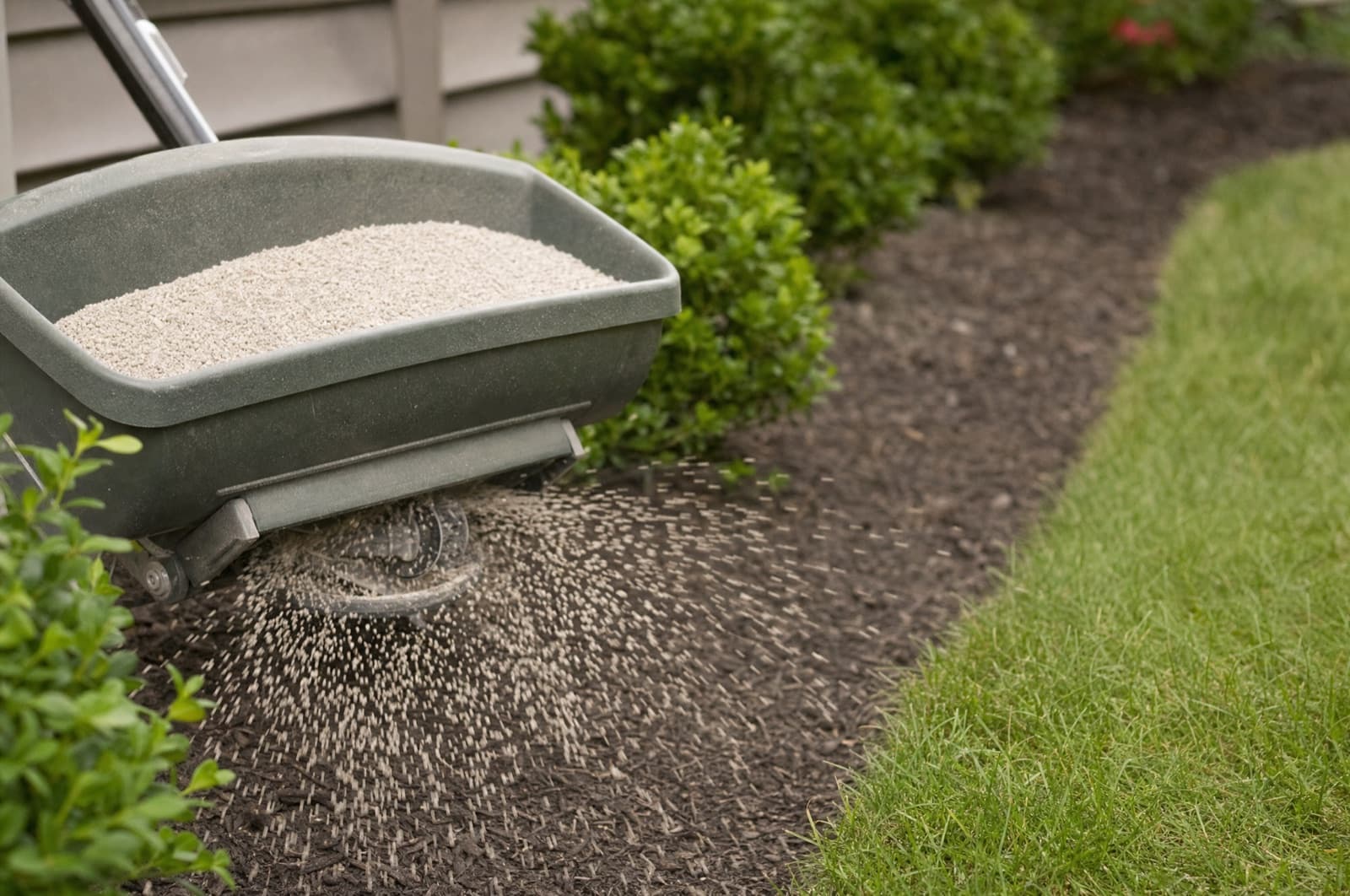
How to Use Outdoor Ant Killer Granules (T901-6) by Terro
At a glance
- Efficacy: Situational
- Best job: Knocking down foraging ants and other listed insects that cross a treated outdoor foundation band or spot-treated ant hill
- Format: Granular CONTACT insecticide in a resealable shaker bag — broadcast as an outdoor band and watered in after application; outdoor use only
- Technique: Easy technique
Does this product actually work?
A situational outdoor contact tool, not a colony solution — and distinct from Terro's own liquid and borax baits.
Despite carrying the Terro name alongside the brand's liquid and dual bait stations, T901-6 works on the opposite principle — it's a contact insecticide, not a bait, and Terro's own customer support confirms it: this granule 'targets ants that come into direct contact with it as they move through treated areas... it will not impact ants that do not walk over the treated zone.' Broadcast and watered in correctly, it genuinely knocks down surface-foraging ants and other listed insects in the treated outdoor band. UC IPM's standard caution applies here as much as to any contact/barrier product: it kills only foragers, the colony rebuilds, and it does nothing for an indoor or in-wall source.
Best for
An outdoor foundation band or spot treatment on visible ant hills, knocking down foragers and other listed insects crossing the treated zone.
Skip it for
Eliminating an ant colony (structurally impossible without a carry-back mechanism), any indoor ant problem, and carpenter-ant structural infestations.
What it is — and what it's really for
The label is the law. Here's the honest read on the format, the one job it does well, and the job people wrongly buy it for.
The technique walkthrough
Where DIY succeeds or fails is in the placement, patience, and the small pro moves the label never mentions. Follow the label; these are the technique details on top of it.
The single most important thing to get right is the opposite of a bait: broadcast the granules, then water them in. This product shares Terro's name with two true baits, but its mechanism and technique are entirely different.
Clear the band and confirm dry conditions
Remove leaf litter and cut back vegetation touching the foundation, and apply only when the grass and soil are dry.
Common mistakeApplying to wet or dew-covered ground, which leads to poor, uneven distribution.Apply a 3-to-10-foot band, or spot-treat a mound
Broadcast a foundation band per the label's width, or apply a smaller measured amount directly around (not on top of) a visible ant hill.
Pro moveReserve this contact product for the outdoor perimeter and mounds; keep any indoor or bait-based ant program in a separate zone entirely.Water in lightly and immediately
Water the treated area lightly right after applying — this activates the lambda-cyhalothrin and moves it into the treated zone. For mounds, water in gently; avoid high-pressure spray.
Common mistakeSkipping the water-in step, or blasting a mound with high-pressure water, which can cause the colony to relocate rather than die in place.Keep people and pets off until dry
Keep children and pets off the treated area until the granules have been watered in and the surface is dry.
CautionThis product is labeled outdoor-use only and is toxic to aquatic life — keep it out of storm drains, ponds, and streams.Reapply on the label's interval, not reactively
Follow the label's reapplication interval and its labeled maximum number of applications per year rather than reapplying every time an ant reappears.
Common mistakeTreating recurring ant activity as a reason to apply more granules — persistent activity usually means the colony itself is untreated, which this product structurally can't reach.
Do & don't
- Water in lightly and immediately after broadcasting
- Apply to dry turf, never wet or dew-covered ground
- Water mounds in gently — no high-pressure spray
- Keep kids and pets off until watered in and dry
- Keep it in a separate zone from any bait placements
- Don't leave the granules dry expecting ants to carry them home — they won't; this is a contact product, not Terro's borax bait
- Don't expect it to reach the queen or the colony
- Don't use high-pressure water on mounds — it can scatter the colony
- Don't apply it indoors — it's labeled outdoor use only
- Don't apply it near or over a bait placement
Where it works vs. where it fails
No product fixes everything. This is the honest boundary — the situations it genuinely handles, and the ones it simply won't.
Where it works
- The goal is knocking down surface-foraging ants and other listed insects along an outdoor foundation band
- You're spot-treating a visible ant hill and can water it in gently
- It's paired with an indoor bait (T300 or T360), kept in a separate zone, for actual colony control
- The problem is genuinely outdoor and surface-level
Where it fails
- The goal is eliminating an ant colony or nest — there's no carry-back mechanism
- Ants are indoors or in a wall void — the label is outdoor-use only
- It's applied near a bait placement (repellent residue contaminates the bait)
- The colony is carpenter ants nesting in structural wood
- It's left dry without watering in — the granules underperform on the surface
Mistakes that waste the product
Not watering it in
This is a contact insecticide, not a bait — without immediate watering, the lambda-cyhalothrin largely stays on the granule surface and underperforms.
Confusing it with Terro's liquid or T360 bait stations
The bait products rely on ants carrying the active home undisturbed; this granule relies on contact and repellency — using bait technique here (leaving it dry, expecting carry-back) wastes the product.
Blasting a mound with high-pressure water
High pressure can cause the colony to relocate rather than die in place, spreading the problem instead of solving it.
Applying near a bait placement
The repellent residue drives ants away from bait they'd otherwise carry back to the colony, undermining any baiting program running nearby.
Exceeding the label's application frequency
Reapplying reactively every time ants are seen wastes product and can exceed the labeled maximum applications per year without addressing the untouched colony.
What to expect — and when
Judge this product on contact knockdown in the treated zone, not on whether ant activity disappears entirely — that requires the colony itself to be addressed.
First ~24 hours after watering in
Contact kill of ants and other listed insects that cross the treated, watered-in band or mound.
Following weeks
Continued residual repellency and contact kill along the treated band, per label.
Ongoing
If the colony or mound queen wasn't directly reached, foraging activity can rebound as new workers replace the ones killed at the surface.
When to stop DIY & call a pro
A contact granule has a real, structural ceiling. These are the honest signals to bridge to a licensed technician:
Ants keep returning despite a correctly watered-in, reapplied treated band
Persistent activity means the colony is untouched — a contact product can't reach the queen or brood.
You see large black ants indoors or moisture-damaged wood
Those point to carpenter ants nesting in structural wood, requiring professional inspection — an outdoor contact granule can't help there.
Ant activity is indoors or seems to originate from a wall void
This product is outdoor-use only per label and never reaches an indoor or in-wall source.
The same ant pressure returns every season despite correct annual treatment
Recurring pressure usually points to a conducive condition or entry-point problem a licensed technician can diagnose and fix at the source.
When a treated perimeter still isn't holding the line, Anchor's licensed NH technicians identify the actual colony or entry pathway and treat the source directly. Free inspection, same-day service across southern and central New Hampshire.
Ants keep coming back after a treated band?
Is it safe for pets & kids?
The short version lives here; the full per-species verdict lives on this product's pet-safety page.
Lambda-cyhalothrin contact granules are labeled for outdoor use only and can cause moderate eye irritation on contact. The practical precaution is simple: keep people and pets off the treated area until it's watered in and dry, and never apply it indoors.
Re-entry: Keep children and pets off the treated area until the granules have been watered in and the surface is fully dry.
Using a contact granule correctly in New Hampshire
Southern and central New Hampshire's pavement and odorous house ants push indoors as trails warm in spring and again in fall, and a correctly watered-in outdoor band can reduce surface pressure at the foundation. But NH's real structural ant threat is carpenter ants, and this outdoor contact granule was never built to reach a carpenter-ant nest in wood — that's a signal to call Anchor, not to apply more granules. Anchor Pest Services serves Manchester, Nashua, Concord, and the surrounding towns.
Service area
Southern New Hampshire
Anchor Pest Services · NH license #782664 · NEPMA member · family-owned since 2017.
Frequently asked
Sources & further reading(6)
- [1]Terro — Outdoor Ant Killer Plus / T901-6 product page
Contact-kill-plus-residual-repellency mechanism, band/mound application directions, water-in instructions, labeled pest list (facts only, not the efficacy verdict)
manufacturerverified 2026-07-14 - [2]Augusta Farmers' Coop — Terro Outdoor Ant Killer Granules spec sheet
Verified active ingredient and concentration (lambda-cyhalothrin 0.04%)
manufacturerverified 2026-07-14 - [3]UC Statewide IPM Program — Ants (Home & Landscape)
Perimeter/contact treatments kill only foraging ants without killing the colony/queens; colony quickly rebuilds
extensionverified 2026-07-14 - [4]Mississippi State University Extension — 'Control Fire Ants in Your Yard'
The bait-vs-contact-granule distinction and why gentle, not high-pressure, watering is used on mounds
extensionverified 2026-07-14 - [5]NPIC — Lambda-cyhalothrin General Fact Sheet
Lambda-cyhalothrin class (pyrethroid) and contact mode of action
npicverified 2026-07-14 - [6]UNH Cooperative Extension — Carpenter Ants Fact Sheet
Carpenter ants as New Hampshire's most troublesome structural ant — a call-a-pro escalation this outdoor granule can't address
extensionverified 2026-07-14
Written & reviewed by
VerifiedDaniel Brady
NH-Licensed Pesticide Applicator · License #782664 (NHDAMF, RSA 430)
Daniel Brady is the New Hampshire–licensed applicator behind Anchor Pest Services, a family-owned pest control company serving the Manchester area since 2017.
Last updated July 2026
Related products in this category
Same shelf, different jobs — the dot shows each product's honest efficacy verdict at a glance.
Professional Pest Control
When a Contact Granule Still Isn't Enough
A treated outdoor band reduces surface foraging, but it can't eliminate a colony, a carpenter-ant nest, or an indoor source. Anchor Pest Services treats the actual source with targeted, licensed methods across southern and central New Hampshire. Family-owned since 2017, NH license #782664.
- Targeted colony/nest treatment, not just a surface band
- NH-licensed applicators (#782664)
- Free inspection — same-day service across southern NH
NH License #782664 · No obligation · We answer in person
Your next step
- Book a NH pro
Ant Pest Control
Book now - Book a NH pro
Pest Control Services
Licensed, family-owned pest control across southern NH.
Book now - What to do next
Is Terro Outdoor Ant Killer Granules (T901-6) Safe for Pets?
Read the answer - Also relevant
Is Terro Outdoor Ant Killer Granules (T901-6) Safe for Pets?
Read the answer - Also relevant
Chemical Ant Control: Why Bait Beats Spray
Read the answer - Related guide
How to Use Terro Liquid Ant Baits (T300)
Read the answer