
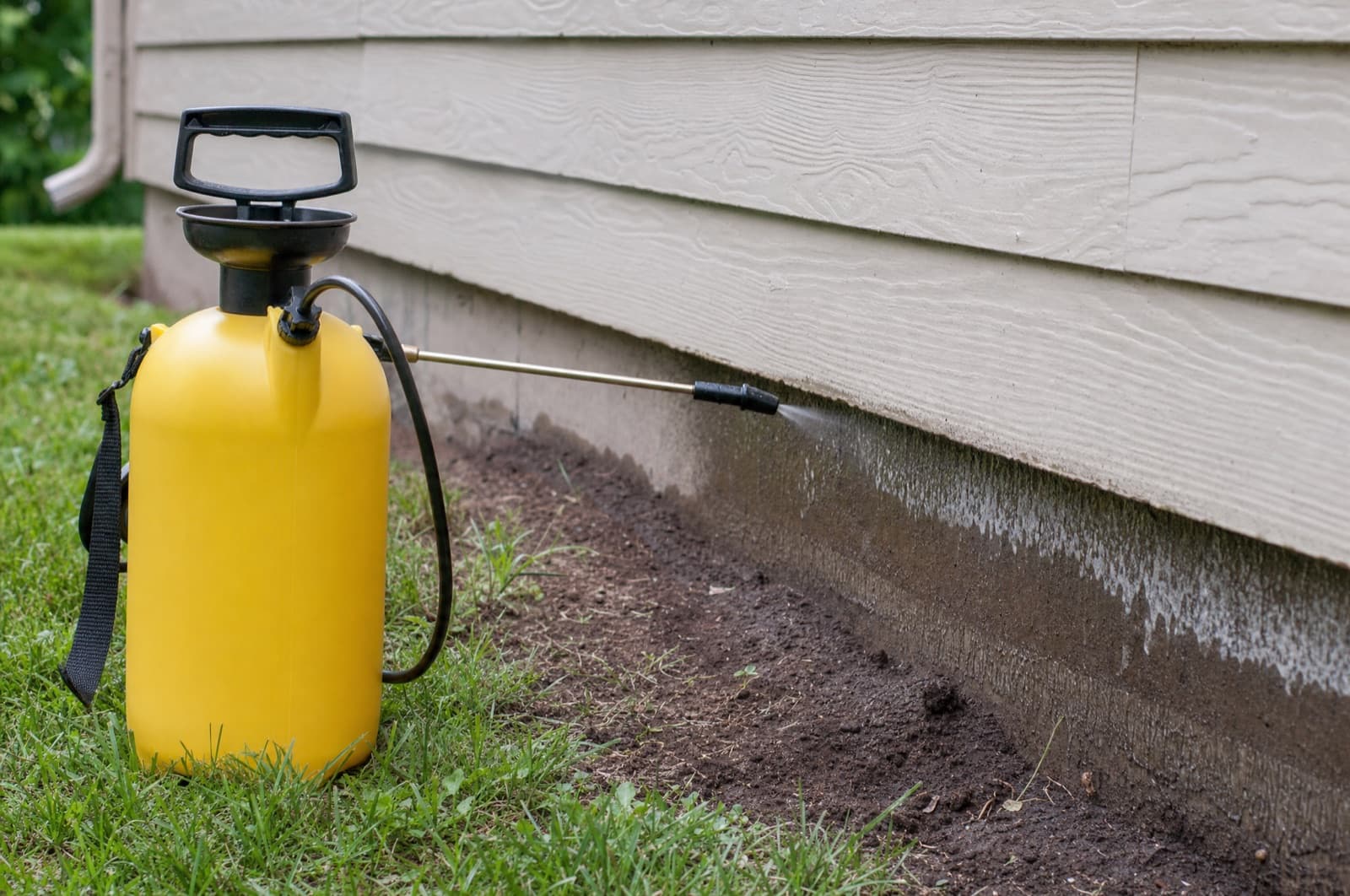
How to Use Ortho Home Defense Max Indoor Insect Barrier
At a glance
- Efficacy: Workhorse
- Best job: Laying a clean, continuous indoor residual band on non-porous surfaces where the 12-month claim genuinely applies
- Format: Ready-to-use (RTU) liquid with a Comfort Wand or battery-powered sprayer — single active (bifenthrin only, no zeta-cypermethrin), formulated to dry fast with no fumes, and positioned specifically for indoor use
- Technique: Easy technique
Does this product actually work?
A genuine indoor workhorse on non-porous surfaces — the 12-month claim is real, but only there.
Ortho's manufacturer support confirms this single-active bifenthrin formula is built and positioned specifically for indoor non-porous surfaces, where the up to 12-month claim is genuinely earned — not a marketing number stretched past what it can deliver. Applied as a clean, continuous band there, it's a real workhorse. But it never reaches a colony or nest, its residual life shortens considerably on porous surfaces, and it isn't formulated as an outdoor perimeter product — treat it as the indoor half of a barrier strategy, not the whole thing.
Best for
A clean, continuous indoor residual band on non-porous surfaces (tile, sealed baseboard, finished basement) to reduce crawling-insect activity for a genuinely long stretch.
Skip it for
Colonies or nests already established indoors, porous-surface longevity, or as a substitute for exterior perimeter treatment.
What it is — and what it's really for
The label is the law. Here's the honest read on the format, the one job it does well, and the job people wrongly buy it for.
The technique walkthrough
Where DIY succeeds or fails is in the placement, patience, and the small pro moves the label never mentions. Follow the label; these are the technique details on top of it.
This is an easy product to apply well, but the entire 12-month promise hinges on choosing the right surfaces — treat porous material the same way and the residual life quietly collapses.
Choose non-porous surfaces first
Prioritize tile, sealed baseboard, finished basement floors, and other non-porous surfaces — the 12-month claim depends entirely on this choice.
Pro moveWalk the space first and mentally map which runs are non-porous before you start spraying, rather than treating the whole perimeter uniformly.Lay the band
Hold the wand roughly 12 inches from the surface and lay a continuous 4-inch band along baseboards, thresholds, and entry lines. Spray until slightly wet — never soaked.
CautionKeep off food, dishes, and food-prep surfaces.Keep the band unbroken
Maintain one continuous line around the room's perimeter and entry points — a gap is simply a spot insects will reroute to.
Common mistakeStopping partway around a room because the visible activity was in one corner — the whole perimeter, not just the trouble spot, needs the band.Let it dry fully
Let the band dry completely before people or pets re-enter the treated room.
Refresh porous areas sooner
On any porous surface you did treat, plan to refresh well before the 12-month mark — that claim doesn't travel to raw concrete, unsealed wood, or carpet edges.
Common mistakeAssuming 'up to 12 months' applies uniformly to every surface in the house — it's a non-porous best case, not a universal guarantee.
Do & don't
- Prioritize non-porous surfaces for the real 12-month residual life
- Keep the band continuous around the full perimeter and entry points
- Let it dry fully before re-entry
- Refresh porous surfaces well before a year
- Don't expect 12 months on porous or outdoor surfaces
- Don't treat it as a cure for a colony or nest already indoors
- Don't spray over ant or roach bait placements
- Don't apply to runoff — slightly wet is enough
Where it works vs. where it fails
No product fixes everything. This is the honest boundary — the situations it genuinely handles, and the ones it simply won't.
Where it works
- Laying a continuous indoor band on non-porous surfaces like tile and sealed baseboard
- Reducing crawling-insect activity along entry lines for a genuinely long stretch
- Treating fleas and ticks tracked in indoors on the surfaces where residual holds
- Formulated for fast drying with no fumes, so it's a reasonable choice for occupied indoor spaces
Where it fails
- A colony or nest is already established indoors — it reaches foragers, not the source
- The surface is porous — raw concrete, unsealed wood, carpet — where the 12-month claim doesn't apply
- German cockroaches are the target (widespread pyrethroid resistance)
- You need exterior perimeter protection — this product isn't formulated for outdoor use
Mistakes that waste the product
Treating porous surfaces and expecting 12 months
The headline claim is a non-porous indoor best case; porous surfaces lose the active's bioavailability far sooner, so protection lapses quietly.
Leaving a gap in the band
Any break in the perimeter is simply a route insects reroute to, undoing the barrier premise even if the rest of the room is well treated.
Using it as a cure for an indoor colony
Like every perimeter/residual pyrethroid, it kills exposed foragers, not the colony or nest behind them, so persistent activity means the source is untouched.
Applying it outdoors
This product is formulated and positioned for indoor use; using it as an outdoor perimeter product isn't what it's built or labeled for.
Spraying over bait placements
The repellent residue drives ants or roaches away from bait you wanted them to carry back to the colony.
What to expect — and when
This is a prevention tool whose real strength is surface-dependent — judge the 12-month claim only on the non-porous runs you actually treated that way.
First day
Contact knockdown of insects that touch the fresh band.
Days 1-7
Noticeably reduced indoor activity as the residual band intercepts crawling insects at entry lines.
Weeks-to-months, surface-dependent
Non-porous surfaces hold the residual close to the labeled claim; porous surfaces fade much sooner and need earlier refreshing.
When to stop DIY & call a pro
A long-residual indoor band lowers the count of insects walking your baseboards without removing whatever keeps sending them there. These are the signals the job has outgrown a spray-can:
Insects keep entering despite a clean, continuous, correctly-surfaced band
Persistent entry after correct application usually means an established colony or an entry point the indoor band can't reach or fix.
You see large black ants indoors or moisture-damaged wood
Those point to carpenter ants nesting in structural wood, a wood-destroying pest that needs licensed inspection.
Cockroaches persist after treatment
German cockroaches carry widespread pyrethroid resistance and live in harborage a surface band never contacts.
The same rooms need retreatment every few weeks even on non-porous surfaces
That pattern points to an ongoing entry source or interior harborage beyond what a residual band was designed to solve.
When an indoor band keeps needing retreatment or activity keeps returning, Anchor's licensed NH technicians find and treat the actual source. Free inspection, same-day service across southern and central New Hampshire.
Indoor band not holding the line?
Is it safe for pets & kids?
The short version lives here; the full per-species verdict lives on this product's pet-safety page.
This product is a pyrethroid and is highly toxic to fish, so keep it away from aquariums and any indoor water features during application. Around pets and kids, the practical rule is simple: stay off the treated band until it's fully dry.
Re-entry: Keep children and pets off treated surfaces until the band is fully dry.
Indoor barriers and NH's heated-structure pests
German cockroaches can't survive away from heated structures, and fleas and ticks get tracked indoors year-round in southern and central New Hampshire homes — both are exactly the kind of pressure a non-porous indoor band is built to reduce. But this product's strength stops at the indoor surface it's applied to; it isn't a substitute for exterior prevention or for treating an established indoor colony. Anchor Pest Services handles both halves of that job across Manchester, Nashua, Concord, and the surrounding towns.
Service area
Southern New Hampshire
Anchor Pest Services · NH license #782664 · NEPMA member · family-owned since 2017.
Frequently asked
Sources & further reading(4)
- [1]EPA Pesticide Product Label System — Ortho Home Defense Max Indoor Insect Barrier, Reg. No. 239-2699
Verified single active (bifenthrin 0.05%), indoor non-porous 12-month claim, no-fumes fast-dry formulation
epa_labelverified 2026-07-14 - [2]Ortho / ScottsMiracle-Gro manufacturer support — Home Defense product line Q&A
Confirms this SKU's single-active (bifenthrin-only) formulation, distinct from the dual-active Indoor & Perimeter product — facts only
manufacturerverified 2026-07-14 - [3]NPIC — Bifenthrin General Fact Sheet
Bifenthrin class, residual behavior, and fish toxicity
npicverified 2026-07-14 - [4]Etang et al., Malaria Journal (2011) — surface-dependent pyrethroid residual
General evidence that pyrethroid residual life varies sharply by surface porosity
academicverified 2026-07-14
Written & reviewed by
VerifiedDaniel Brady
NH-Licensed Pesticide Applicator · License #782664 (NHDAMF, RSA 430)
Daniel Brady is the New Hampshire–licensed applicator behind Anchor Pest Services, a family-owned pest control company serving the Manchester area since 2017.
Last updated July 2026
Related products in this category
Same shelf, different jobs — the dot shows each product's honest efficacy verdict at a glance.
Professional Pest Control
When an Indoor Barrier Isn't Enough
A residual band reduces activity, but it can't eliminate a colony, nest, or resistant roach population already living inside. Anchor Pest Services treats the actual source with targeted, licensed methods across southern and central New Hampshire. Family-owned since 2017, NH license #782664.
- Targeted source treatment, not just an indoor band
- NH-licensed applicators (#782664)
- Free inspection — same-day service across southern NH
NH License #782664 · No obligation · We answer in person
Your next step
- Book a NH pro
Pest Control Services
Licensed, family-owned pest control across southern NH.
Book now - What to do next
Is Home Defense Max Indoor Insect Barrier by Ortho Safe for Pets?
Read the answer - What to do next
Is Ortho Home Defense Insect Killer for Indoor & Perimeter Safe for Pets?
Read the answer - Also relevant
Is Home Defense Max Indoor Insect Barrier by Ortho Safe for Pets?
Read the answer - Also relevant
Chemical Ant Control: Why Bait Beats Spray
Read the answer - Related guide
How to Use Ortho Home Defense Insect Killer for Indoor & Perimeter
Read the answer