
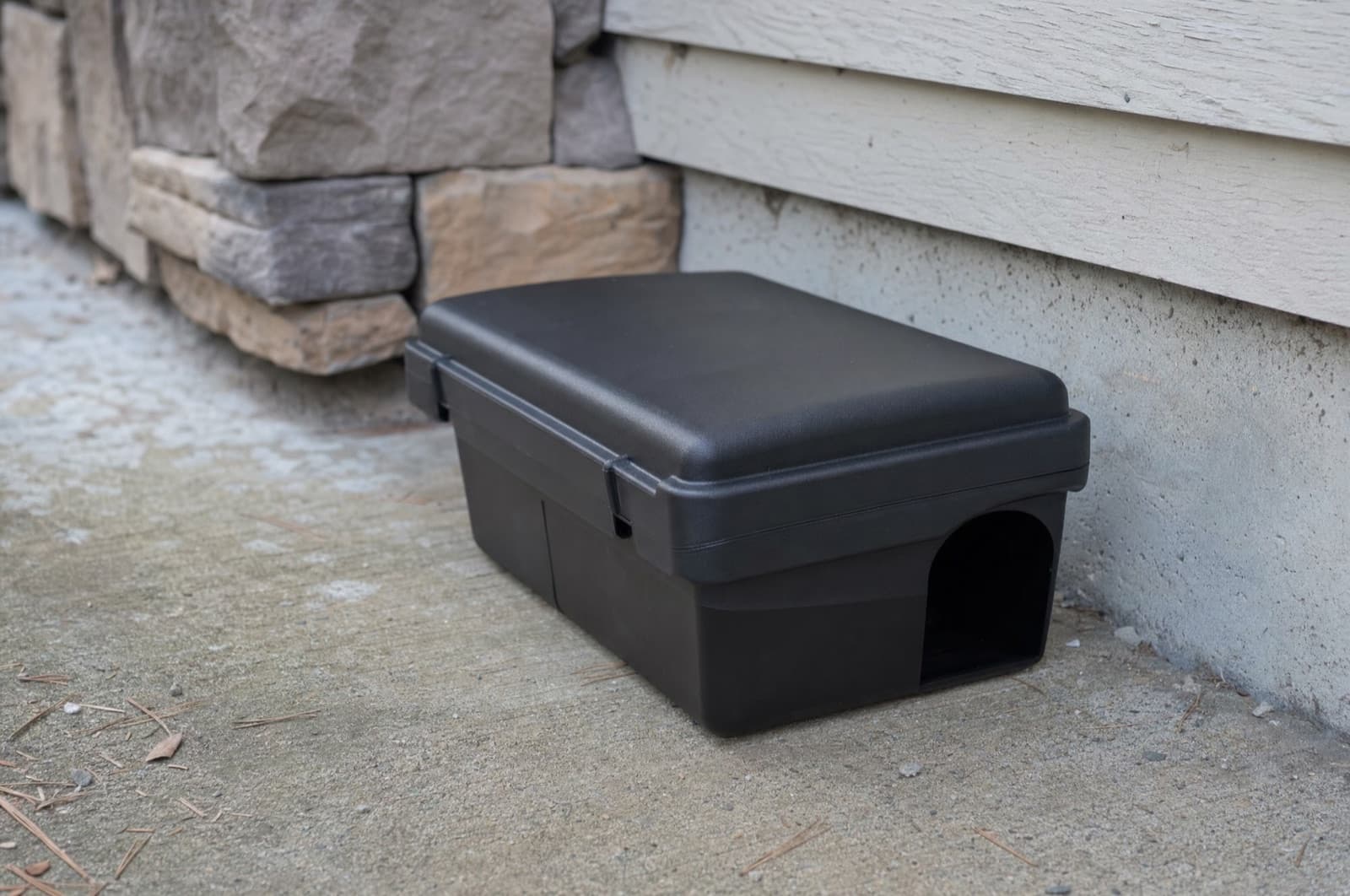
How to Use Kaput Rat & Mouse Bait with Warfarin by Scimetrics
At a glance
- Efficacy: Situational
- Best job: Maintenance baiting for users who specifically want the oldest, best-understood anticoagulant with a widely available antidote
- Format: Place-pack/bait block format secured inside a tamper-resistant station; labeled for Norway rats, roof rats, house mice, and, per label, deer mice, white-footed mice, and voles
- Technique: Moderate technique
Does this product actually work?
The oldest, best-understood anticoagulant — reliable with patience, but multi-feed and vulnerable to resistant populations.
Warfarin is the original anticoagulant rodenticide, and it still works — but only with sustained, uninterrupted feeding over several days, and first deaths typically don't appear until around 4-5 days in. That's why 'multi-feed' matters as a technique concept: an interrupted supply, or a population with warfarin resistance, defeats it outright. Secured correctly in tamper-resistant stations with a continuous supply, it's a legitimate, well-understood tool for maintenance baiting — but it's slower and less forgiving of gaps than the second-generation baits elsewhere in this cluster, and it does nothing about the entry point.
Best for
Users who specifically want a well-established first-generation anticoagulant with a readily available, vet-administered antidote.
Skip it for
Warfarin-resistant rodent populations, or anyone needing a fast result — warfarin depends on sustained, repeated feeding over several successive days.
What it is — and what it's really for
The label is the law. Here's the honest read on the format, the one job it does well, and the job people wrongly buy it for.
The technique walkthrough
Where DIY succeeds or fails is in the placement, patience, and the small pro moves the label never mentions. Follow the label; these are the technique details on top of it.
Warfarin rewards patience and station discipline more than any other bait in this cluster — the multi-feed mechanism is the whole story.
Inspect and confirm runway evidence
Walk the interior and exterior perimeter for droppings, gnaw marks, and rub marks along walls before placing bait.
Secure bait inside a tamper-resistant station
Place packs/blocks inside a locked station along the walls and runways identified.
CautionNever place loose; wear gloves when handling.Space close for mice, wider for rats, flush to walls
Position stations at label-appropriate intervals along the confirmed runway.
Provide an uninterrupted, continuous supply
Check regularly and keep fresh bait available — warfarin's multi-feed mechanism only works if rodents can feed on consecutive days.
Pro movePlan for continuous availability from the start rather than a one-time set-and-check.Common mistakeRemoving bait too early because you don't see immediate results, which leaves rodents sub-lethally dosed instead of finishing the job.Watch for signs of resistance
If well-maintained bait shows no feeding decline after a couple of weeks, suspect a warfarin-resistant population rather than a placement problem.
Sanitation and exclusion
Remove competing food and seal entry points — bait reduces the population present, it doesn't stop the next one from entering.
Do & don't
- Use in tamper-resistant stations only.
- Provide a continuous, uninterrupted supply.
- Space correctly for mice vs. rats.
- Watch for signs of resistance.
- Pair with sanitation and exclusion.
- Don't expect single-feed results.
- Don't remove bait early.
- Don't place loose.
- Don't ignore signs of a non-responding, possibly resistant, population.
- Don't skip exclusion.
Where it works vs. where it fails
No product fixes everything. This is the honest boundary — the situations it genuinely handles, and the ones it simply won't.
Where it works
- The household specifically wants a first-generation anticoagulant with a well-known antidote
- A continuous, uninterrupted bait supply can be maintained for several days
- The rodent population isn't warfarin-resistant
- Baiting is paired with sanitation and exclusion
Where it fails
- The population shows resistance — no feeding response despite correct, continuous bait
- Bait supply is interrupted or pulled early
- Fast results are needed — warfarin's multi-feed design is inherently slow
- Entry points remain unsealed, letting new rodents replace the ones removed
Mistakes that waste the product
Pulling bait early
Warfarin needs several consecutive days of feeding; stopping early under-doses rodents.
Assuming no results means bad placement
It may mean resistance instead — a real, documented limitation of warfarin.
Placing bait loose
Unsafe and against label direction.
Skipping exclusion
Even successful baiting doesn't fix the entry point.
What to expect — and when
Warfarin is the slowest, most patience-dependent active in this cluster — judge it on sustained decline over more than a week, not a fast result.
First few days
Rodents locate bait and begin the repeated feeding warfarin requires.
About days 4-5
First deaths typically appear if feeding has been consistent.
1-2 weeks
Sign declines if supply stayed continuous; if it hasn't, that's the most common reason for a stall.
When to stop DIY & call a pro
Warfarin's slow, resistance-vulnerable profile means these signals point to a professional program sooner rather than later:
No feeding decline after 2-3 weeks of correctly maintained, continuous bait
That's the clearest sign of a warfarin-resistant population, which needs a different active or a professional program.
You find evidence of rats, not just mice
Rat-scale problems need denser, licensed placement and inspection.
Activity spans multiple rooms or floors
That points to an established colony, not a single incursion.
Exclusion work is beyond what you can identify or complete
Sealing entry points is the actual long-term fix, and professional inspection finds gaps a homeowner misses.
When warfarin's slow, multi-feed pace or a resistant population outpaces DIY, Anchor's licensed NH technicians bring a broader toolkit and the exclusion work that finishes the job. Free inspection, same-day service across southern and central New Hampshire.
Bait maintained but no decline in activity?
Is it safe for pets & kids?
The short version lives here; the full per-species verdict lives on this product's pet-safety page.
Warfarin is a first-generation anticoagulant, so both primary ingestion and secondary poisoning (a pet eating a fed rodent) are real risks — Vitamin K1 is the antidote, administered by a vet or doctor, never at home. Keep bait secured in a locked, tamper-resistant station at all times.
Re-entry: Keep the bait station locked and out of reach of children and pets at all times, not just during placement.
Patience matters most in New Hampshire's peak rodent season
Mice and rats in southern and central New Hampshire don't wait out winter outdoors — they move into heated buildings as fall cover and food disappear, with Norway rats often burrowing in against foundations first. Warfarin depends on several consecutive days of feeding, so it rewards starting a disciplined, continuously stocked baiting program before that indoor push builds rather than after activity is heavy. Anchor Pest Services treats both the population and the entry points across Manchester, Nashua, Concord, and the surrounding towns.
Service area
Southern New Hampshire
Anchor Pest Services · NH license #782664 · NEPMA member · family-owned since 2017.
Frequently asked
Sources & further reading(4)
- [1]EPA Registered Product Label — Kaput Rat & Mouse Bait (Reg. No. 72500-6)
Verified active (warfarin), place-pack format, and expanded target-pest list including deer mice and voles
epa_labelverified 2026-07-14 - [2]GreenBook — Kaput Rat & Mouse Bait product listing
Product format facts (facts only, not the efficacy verdict)
manufacturerverified 2026-07-14 - [3]NPIC — Rodenticides General Fact Sheet
First-generation anticoagulant multi-feed mechanism and Vitamin K1 antidote
npicverified 2026-07-14 - [4]EPA — Restrictions on Rodenticide Products
First- vs. second-generation anticoagulant distinction; first-generation actives usually require multiple feedings
govverified 2026-07-14
Written & reviewed by
VerifiedDaniel Brady
NH-Licensed Pesticide Applicator · License #782664 (NHDAMF, RSA 430)
Daniel Brady is the New Hampshire–licensed applicator behind Anchor Pest Services, a family-owned pest control company serving the Manchester area since 2017.
Last updated July 2026
Related products in this category
Same shelf, different jobs — the dot shows each product's honest efficacy verdict at a glance.
Professional Pest Control
When Patience Alone Isn't Working
Warfarin needs sustained feeding, and some populations resist it entirely. Anchor Pest Services diagnoses what a stalled bait program actually means and brings the exclusion work that finishes the job across southern and central New Hampshire. Family-owned since 2017, NH license #782664.
- Diagnosis of resistance vs. placement issues
- NH-licensed applicators (#782664)
- Free inspection — same-day service across southern NH
NH License #782664 · No obligation · We answer in person
Your next step
- Book a NH pro
Rodent Control
Book now - Book a NH pro
Pest Control Services
Licensed, family-owned pest control across southern NH.
Book now - What to do next
Is Kaput Rat & Mouse Bait with Warfarin Safe for Pets?
Read the answer - What to do next
Is Kaput Ground Squirrel Bait Safe for Pets?
Read the answer - Also relevant
Is Kaput Rat & Mouse Bait with Warfarin Safe for Pets?
Read the answer - Also relevant
Chemical Rodent Control: Rodenticides, Risks & the Rules
Read the answer