
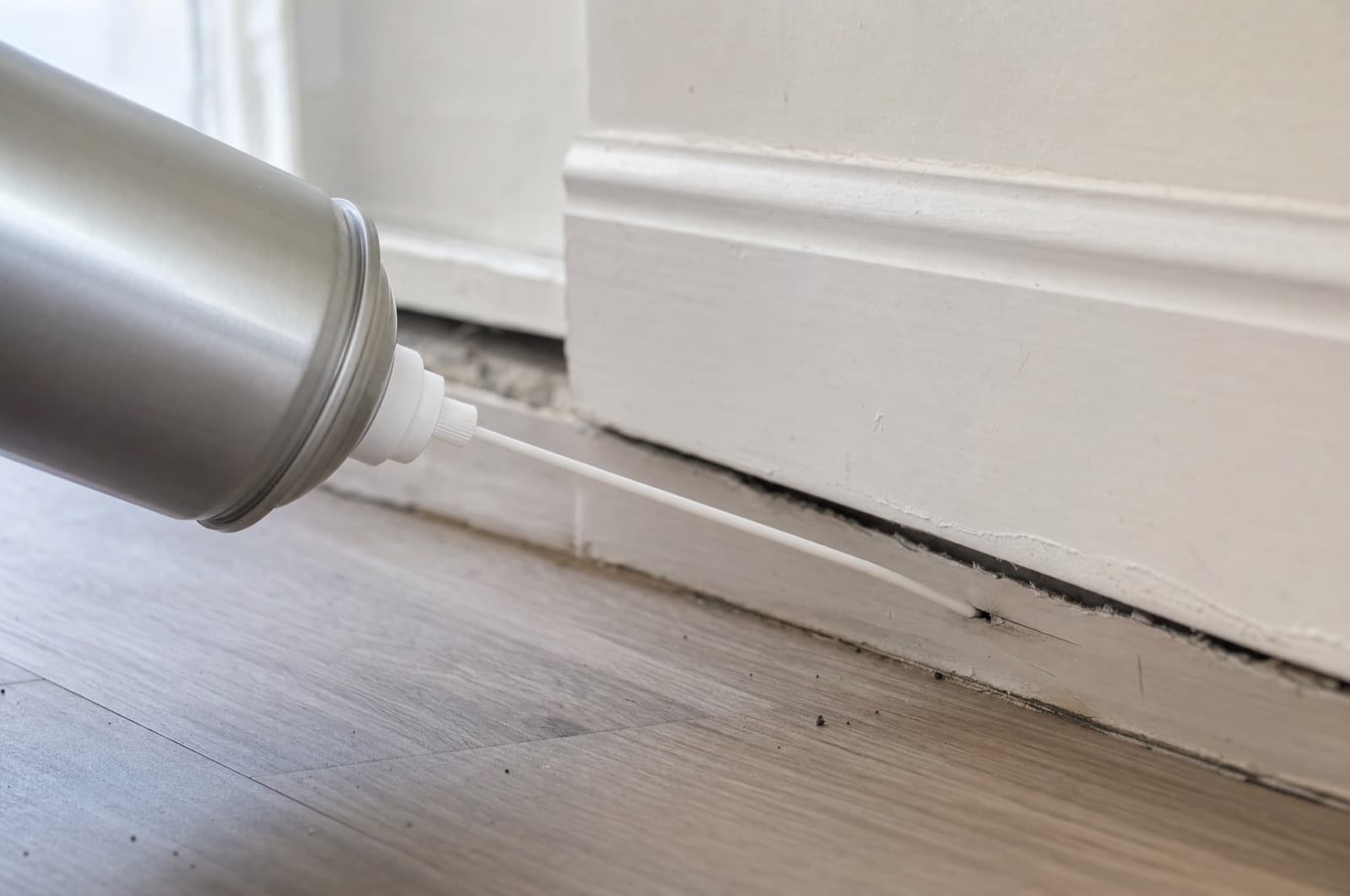
How to Use Terminate Termite & Carpenter Ant Killer by Spectracide
At a glance
- Efficacy: Overrated
- Best job: Killing exposed carpenter ants, carpenter bees, and wood-boring beetle adults on contact, and adding a supplemental perimeter band
- Format: Liquid barrier/contact product — a ready-to-use version with an AccuShot sprayer, or a dilutable concentrate — for outdoor foundation/perimeter and localized wood-surface treatment
- Technique: Moderate technique
Does this product actually work?
Overrated for the job its own name promises — Spectracide's label admits this can't protect a structure from termites; situational only for exposed carpenter ants and wood-boring beetles.
This is the most honesty-critical page in the cluster: a product named 'Terminate Termite & Carpenter Ant Killer' cannot terminate a termite problem, and the manufacturer says so on its own label. University extensions are blunt about the same point — the University of Missouri Extension states there are 'no do-it-yourself termite control measures that effectively achieve the desired results.' For exposed carpenter ants, carpenter bees, and wood-boring beetles it contacts directly, the lambda-cyhalothrin does a real job. For subterranean termites — the pest most people buy this product to solve — it is overrated by definition, and any sign of termite activity is a call-a-pro trigger regardless of how carefully you apply it.
Best for
Contact-killing exposed carpenter ants, carpenter bees, and wood-boring beetle adults, or adding a supplemental band around a foundation.
Skip it for
Any expectation that this product protects your home from termites. Spectracide's own label calls termite use 'localized control only' and states it is 'not recommended as sole protection against termites.'
What it is — and what it's really for
The label is the law. Here's the honest read on the format, the one job it does well, and the job people wrongly buy it for.
The technique walkthrough
Where DIY succeeds or fails is in the placement, patience, and the small pro moves the label never mentions. Follow the label; these are the technique details on top of it.
The technique here matters for carpenter ants and wood-boring beetles — but no amount of correct application turns this into termite protection, and that caveat has to come first.
Rule out termites first
Before treating anything, check for termite signs — mud tubes along the foundation, discarded swarmer wings, or wood that sounds hollow or is damaged. If you find any, stop and get a professional inspection instead of treating.
CautionThis product's own label states it is not recommended as sole protection against termites — any termite sign is a call-a-pro trigger, not a spray-it-yourself situation.Identify exposed carpenter-ant or beetle activity
Look for visible galleries, entry points, sawdust-like frass, or carpenter bee holes on exterior wood.
Treat exposed activity directly
Apply to visible galleries, tunnels, and entry points per label; for carpenter bees, treat active tunnels and plug the holes after giving the product time to contact any bees inside.
Apply a supplemental perimeter band, if desired
Apply around foundations, woodpiles, or decks per label as a supplemental nuisance-pest measure — explicitly not as sole termite protection.
Common mistakeBelieving a perimeter band or gallery treatment protects the structure from subterranean termites — the label says directly that it doesn't.Mix the concentrate exactly per label, if using it
If using the dilutable concentrate rather than the ready-to-use AccuShot version, measure to the exact label ratio — the label is the law here just as with any concentrate.
Pro moveUse this product for what it genuinely does — surface/wood-boring nuisance pests — and treat any termite sign as a reason to call a professional, not spray more.
Do & don't
- Treat exposed carpenter ants, carpenter bees, and wood-boring beetles directly
- Use it as a supplemental measure only, never sole termite protection
- Follow label mixing exactly if using the concentrate
- Get a professional termite inspection at the first sign of activity
- Don't rely on it to protect your home from subterranean termites
- Don't treat it as a substitute for soil or foundation termiticide treatment
- Don't ignore mud tubes, swarmers, or damaged wood and keep spraying
- Don't spray over ant or roach bait placements
Where it works vs. where it fails
No product fixes everything. This is the honest boundary — the situations it genuinely handles, and the ones it simply won't.
Where it works
- Exposed carpenter ants, carpenter bees, or wood-boring beetle adults need direct contact kill
- A supplemental perimeter band around a foundation, deck, or woodpile is wanted alongside other measures
- Localized, visible activity on exterior wood needs a spot treatment
- The goal is nuisance-pest reduction, not structural termite protection
Where it fails
- Subterranean termites are present or suspected — this product's own label disclaims sole termite protection
- A carpenter-ant nest is hidden inside structural wood, not just visible at an entry point
- Anyone expects a soil-termiticide-level barrier from a surface/wood-contact product
- Mud tubes, swarmers, or hollow/damaged wood are found — those need inspection, not more spray
Mistakes that waste the product
Using it as termite protection
The label itself disclaims this use — the structure stays at real risk from an active subterranean colony while the homeowner believes it's protected.
Wrong dilution with the concentrate
Too weak underperforms even for the carpenter-ant/beetle job it's actually built for; too strong wastes product and violates the label.
Treating only visible carpenter-ant foragers
Killing ants at an entry point doesn't reach a nest hidden deeper in structural wood, so activity can continue or return.
Spraying over ant or roach bait
The repellent pyrethroid residue drives foragers away from bait they'd otherwise carry back to a colony.
What to expect — and when
Set expectations by pest: contact kill and a supplemental band for what's exposed, and no reliable structural termite protection under any circumstance.
On contact
Exposed carpenter ants, carpenter bees, and wood-boring beetles die on direct contact.
Following days to weeks
A supplemental residual band continues affecting nuisance pests that contact treated surfaces.
Any timeframe, for termites
No reliable structural protection develops from this product alone — termite activity continues in the colony regardless of how thoroughly you apply it, because the label itself limits termite use to localized, supplemental control.
When to stop DIY & call a pro
This page carries the hub's strongest call-a-pro message: for structural termites, professional treatment isn't the ceiling after DIY fails — it's the starting point.
Any mud tubes, swarmers indoors, or damaged/hollow structural wood
These are termite signs, and per multiple university extensions, effective termite control is not a do-it-yourself job — it requires licensed soil termiticide or baiting systems.
Carpenter ants active in structural wood, not just at an exterior entry point
UNH Extension calls carpenter ants, alongside termites, New Hampshire's most troublesome structural pest — a nest inside wood needs professional inspection and treatment.
You're unsure whether you're seeing termite or carpenter-ant damage
Misidentifying the pest means misapplying the product — a professional inspection resolves the identification and the treatment plan together.
Any suspected termite activity at all, regardless of how minor it looks
A subterranean termite colony can number in the millions underground long before visible damage appears — early professional inspection is far cheaper than delayed discovery.
For anything beyond exposed carpenter ants and wood-boring beetles at an accessible entry point, Anchor's licensed NH technicians provide the structural termite inspection and targeted treatment this product's own label says it can't. Free inspection, same-day service across southern and central New Hampshire.
Seeing signs of termites or carpenter ants in structural wood?
Is it safe for pets & kids?
The short version lives here; the full per-species verdict lives on this product's pet-safety page.
Keep people and pets off treated areas until dry; this product is not for use on pets and is toxic to aquatic life, so avoid runoff into storm drains, ponds, or waterways.
Re-entry: Keep children and pets off treated surfaces until fully dry.
Termites and carpenter ants are both real NH problems — this product only reaches one of them
UNH Cooperative Extension lists carpenter ants alongside termites as New Hampshire's most troublesome structural pests — eastern subterranean termites are present in southern NH (a slight-to-moderate risk zone, swarming March-May) and carpenter ants are the state's dominant structural ant. This product can genuinely help with exposed carpenter-ant or beetle activity on exterior wood, but for either pest established in structural wood, especially termites, the label itself points you to a licensed professional. Anchor Pest Services provides that structural inspection and treatment across Manchester, Nashua, Concord, and the surrounding towns.
Service area
Southern New Hampshire
Anchor Pest Services · NH license #782664 · NEPMA member · family-owned since 2017.
Frequently asked
Sources & further reading(5)
- [1]Spectracide Terminate — Safety Data Sheet & label (Reg. No. 9688-176-8845 / 9688-231-8845)
Verified active (lambda-cyhalothrin), format, labeled targets, and the 'for localized control only' / 'not recommended as sole protection against termites' disclaimer language
manufacturerverified 2026-07-14 - [2]Spectracide — Terminate Termite & Carpenter Ant Killer product page
Ready-to-use AccuShot sprayer format and application description (facts only)
manufacturerverified 2026-07-14 - [3]University of Missouri Extension — Subterranean Termites (Publication G7420)
'There are no do-it-yourself termite control measures that effectively achieve the desired results' — postconstruction treatment requires a licensed PMP
extensionverified 2026-07-14 - [4]UNH Cooperative Extension — Carpenter Ants Fact Sheet
Carpenter ants, alongside termites, are New Hampshire's most troublesome structural pest
extensionverified 2026-07-14 - [5]NPIC — Lambda-cyhalothrin General Fact Sheet
Lambda-cyhalothrin pyrethroid class and behavior
npicverified 2026-07-14
Written & reviewed by
VerifiedDaniel Brady
NH-Licensed Pesticide Applicator · License #782664 (NHDAMF, RSA 430)
Daniel Brady is the New Hampshire–licensed applicator behind Anchor Pest Services, a family-owned pest control company serving the Manchester area since 2017.
Last updated July 2026
Related products in this category
Same shelf, different jobs — the dot shows each product's honest efficacy verdict at a glance.
Professional Pest Control
Real Termite & Carpenter Ant Protection
No consumer spray or foam protects a structure from subterranean termites — that takes a licensed inspection and targeted soil or bait treatment. Anchor Pest Services provides exactly that across southern and central New Hampshire. Family-owned since 2017, NH license #782664.
- Licensed structural termite & carpenter-ant inspection
- NH-licensed applicators (#782664)
- Free inspection — same-day service across southern NH
NH License #782664 · No obligation · We answer in person
Your next step
- Book a NH pro
Ant Pest Control
Book now - Book a NH pro
Pest Control Services
Licensed, family-owned pest control across southern NH.
Book now - What to do next
Is Terminate Termite & Carpenter Ant Killer by Spectracide Safe for Pets?
Read the answer - What to do next
Is Spectracide Ant Shield Granules Safe for Pets?
Read the answer - Also relevant
Is Terminate Termite & Carpenter Ant Killer by Spectracide Safe for Pets?
Read the answer - Also relevant
Chemical Ant Control: Why Bait Beats Spray
Read the answer