
How Do I Prevent Pests from Attacking Leaves?
Preventing leaf pests is an Integrated Pest Management habit — healthy plants, sanitation, and monitoring — most of it ordinary care you can do yourself.
At a glance
- The verdict: Routine — an IPM habit
- Who fixes it: You
- Category: Leaf Treatments & Remedy Myths
The short answer
Prevent leaf pests the way extension programs recommend: with Integrated Pest Management (IPM), keeping plants healthy and unstressed, scouting regularly, and using least-toxic controls only when needed. The EPA's IPM framework puts prevention first as "the first line of pest control," which is cheaper and safer than reacting to an outbreak after the fact. Most of this is routine care you can do yourself, with no professional required for the typical garden or houseplant situation.
Who actually fixes this?
Start here
You
Prevention is achieved through your own plant-care habits — right plant/right place, watering, nutrient management, sanitation, and monitoring — not a product or a professional visit.
- Garden center — Monitoring reveals an actual pest that needs a registered, least-toxic treatment.
- UNH Extension — Prevention steps aren't working and you're not sure why — UNH Cooperative Extension can help pinpoint the cause.
The details, straight
Start with prevention (IPM step one)
EPA states that "as a first line of pest control, IPM programs work to manage the crop, lawn, or indoor space to prevent pests from becoming a threat." That means choosing the right plant for the right location, resistant varieties where available, and good overall growing conditions before a pest problem ever starts.
Manage nutrients and water
Avoid excess nitrogen, since Clemson HGIC notes it "promote[s] succulent, nutritious new growth, which is preferred by aphids" and can boost their reproduction. Water at the base of the plant and in the morning, which limits both foliar disease and the stressed, humid conditions many pests exploit.
Improve airflow and sanitation
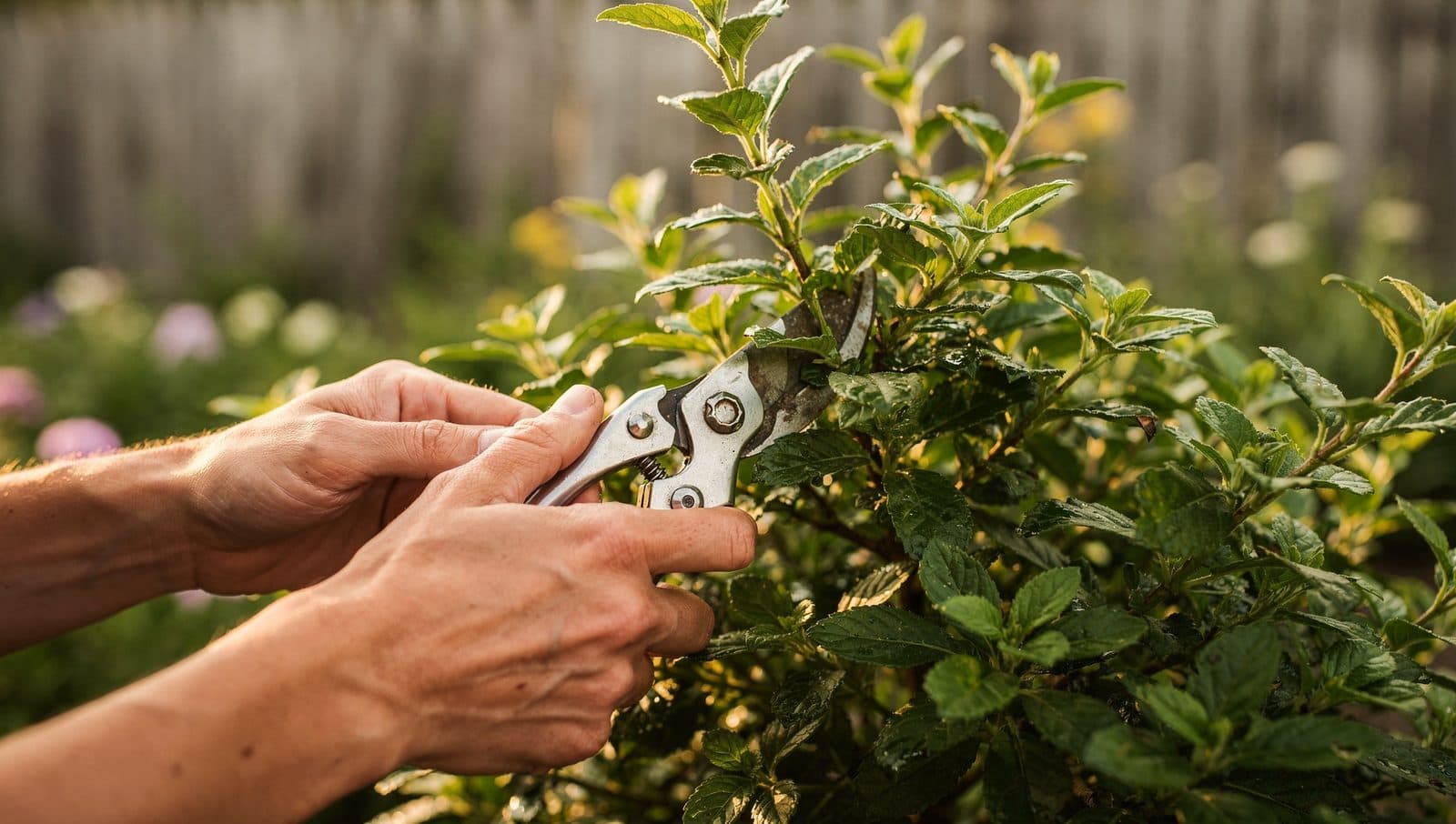
Proper spacing and pruning improve air circulation around foliage, and removing and disposing of infested or diseased plant material promptly — rather than letting it linger nearby — reduces the chance of pests or pathogens spreading to healthy growth, per University of Missouri Extension.
Monitor, identify, and escalate only as needed
Scout leaves, including undersides, routinely, and identify problems accurately — UConn IPM notes that misidentification "is a common cause of pest control failure." Use mechanical and cultural controls first, protect natural enemies, and treat with least-toxic registered products only when monitoring actually shows it's warranted, rather than spraying preventively.
Key takeaways
- EPA's IPM framework treats prevention as "the first line of pest control," ahead of any spray.
- Avoid excess nitrogen fertilizer, which promotes the soft new growth that aphids prefer.
- Water at the base and in the morning to limit both disease and pest-friendly humid conditions.
- Good spacing, airflow, and prompt removal of infested or diseased material reduce pest spread.
- Scout regularly and identify accurately before treating — misidentification is a common cause of failed control.
Prevention is an IPM habit, not a spray schedule
Healthy plants, good sanitation, and regular scouting prevent more pest problems than any preventive chemical ever will.
See leaf-pest prevention basicsIPM timing in a New Hampshire garden
UNH Cooperative Extension's integrated pest management guidance for New Hampshire gardeners leans on the same first step professionals use: scout early and often, starting at bud-break, so problems are caught small. New Hampshire's short growing season — roughly a mid-to-late-May last frost to a late-September or early-October first frost in central areas — concentrates that scouting window. Anchor Pest Services applies IPM to the structural and yard pests around your home, not garden leaf pests, but Extension is the authority for the plant side.
NH-licensed applicator #782664 (NHDAMF, RSA 430) · NEPMA member · family-owned since 2017.
Related questions
Sources(4)
- [1]U.S. EPA — Integrated Pest Management (IPM) Principles
Prevention as the first line of pest control
govverified 2026-07-14 - [2]Clemson HGIC — Integrated Pest Management (IPM) for Aphids
Excess nitrogen promotes aphid-preferred growth
extensionverified 2026-07-14 - [3]University of Missouri Extension — Diagnosing Plant Problems (MG13)
Sanitation and airflow reduce pest/disease spread
extensionverified 2026-07-14 - [4]UConn IPM — Integrated Pest Management
Misidentification is a common cause of pest control failure
extensionverified 2026-07-14
Written & reviewed by
VerifiedDaniel Brady
NH-Licensed Pesticide Applicator · License #782664 (NHDAMF, RSA 430)
Daniel Brady is the New Hampshire–licensed applicator behind Anchor Pest Services, a family-owned pest control company serving the Manchester area since 2017.
Last updated 2026-07-14
Your next question
Honest pest help for New Hampshire homes
Leaf Pest Prevention Is Plant Care — But Your Home Is Our Job
Keeping pests off your garden or houseplants is plant care, and we'll always tell you so honestly. Where Anchor Pest Services genuinely helps is the pests around your home — rodents, ants, ticks, and moisture pests drawn to leaf litter and debris against the foundation. Family-owned since 2017, NH license #782664, serving Manchester, Nashua, Concord and nearby towns.
- Identification-first — IPM plant care, done right, rarely needs a pro
- NH-licensed applicators (#782664) for the structural pests around your home
- Rodent, ant, and tick control across southern and central New Hampshire
NH License #782664 · No obligation · We answer in person
Your next step
- Book a NH pro
Pest Control Services
Licensed, family-owned pest control across southern NH.
Book now - Related guide
How Can I Prevent Leaf Miners?
Read the answer - Related guide
How Can I Keep Leaves from Attracting Bugs Again?
Read the answer - Related guide
How Often Should I Treat Leaves for Pests?
Read the answer - Related guide
How Often Should I Inspect Tree Leaves?
Read the answer - Related guide
How Do I Disinfect Leaves Naturally?
Read the answer