
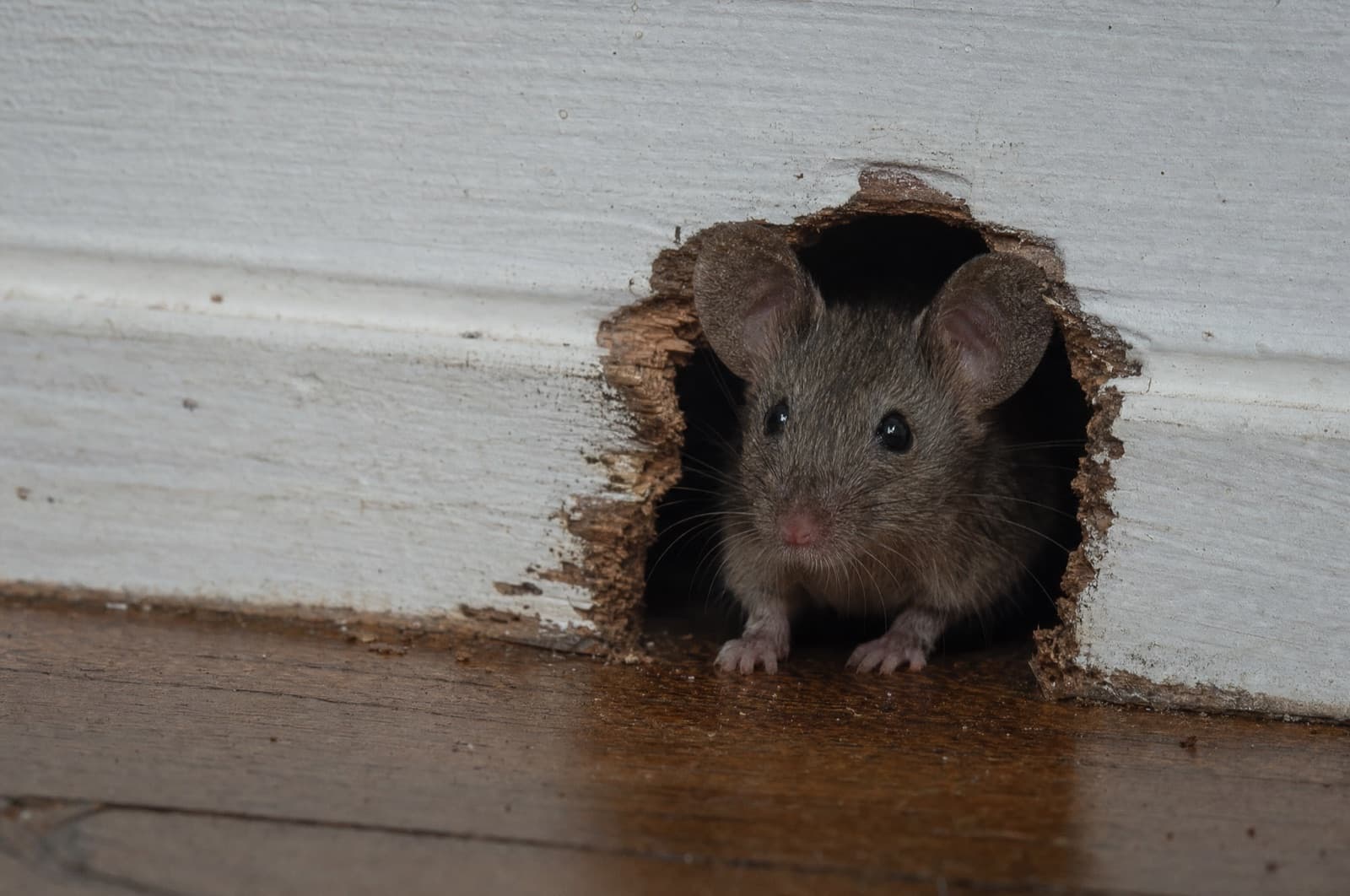
How Small of a Hole Can a Mouse Get Through?
At a Glance
- Short answer: About ¼ inch (6 mm) — the width of a standard pencil.
- Key fact: The mouse's skull, not its body, is the only real limit on the gap it can pass through.
- NH relevance: Common ¼-inch gaps in NH homes: the sill plate/foundation joint, HVAC and plumbing penetrations, worn door thresholds, and window-frame edges.
- Action needed: Check for daylight under exterior doors and around utility penetrations — if light shows, a mouse can enter.
The short of it
A house mouse can squeeze through any opening larger than about ¼ inch — roughly the width of a standard pencil. This is the CDC's own figure, and it's smaller than most homeowners assume. The skull is the limiting factor: a mouse's ribcage isn't rigidly fused, so once its head clears an opening, the rest of its body compresses through behind it. That's about half the gap a rat needs (½ inch), which is why a crack that looks trivial can still be a mouse doorway.
How Small of a Hole Can a Mouse Get Through — By the Numbers
¼ in
Minimum gap size a house mouse can squeeze through
6 mm
Metric equivalent of the ¼-inch threshold
Pencil
CDC's reference object for the ¼-inch gap
½
Roughly the fraction of a rat's gap that a mouse needs
The gap sizes that let rodents in
The skull, not the body, sets the minimum gap a rodent can squeeze through — and a mouse needs only about half the gap a rat does.
mouse
0.25 min gap
the width of a standard pencil (CDC's own reference)
The skull is the widest rigid structure; a mouse's flexible ribcage and low body fat let it compress substantially once the head clears the opening.
rat
0.5 min gap
about the size of a dime; a quarter-sized hole is comfortably passable
Same skull-limited mechanism as mice, but a rat's larger skull means it needs roughly double the gap.
Bottom line — Seal any opening ¼ inch or larger to exclude mice; because rats need about ½ inch, mouse-level sealing also covers rat exclusion, but the reverse isn't true.
The full picture
Why the skull is the only hard limit
A mouse's bones aren't rigidly fused the way a human's are, and its ribcage can compress. With very little body fat, a mouse can flatten itself substantially to fit through a tight space. The limiting factor is the skull — the broadest rigid part of its body. As long as the head passes through an opening, the shoulders, hips, and tail slip through right behind it. Mice also use their whiskers to judge whether their head will fit before committing to an opening, the same behavior seen in rats at the larger ½-inch threshold.
Where these gaps hide in NH homes
Because ¼ inch is so small, exclusion is unforgiving — a crack that looks trivial to a homeowner is a doorway to a mouse. Common ¼-inch gaps in New Hampshire homes include the junction of the sill plate and foundation, gaps around HVAC and plumbing penetrations, worn door thresholds, edges of window frames, and siding joints at corners. A simple test: if you can see daylight beneath a closed exterior door, the gap is large enough for a mouse to use.
Mouse vs. rat: don't seal to only one threshold
A mouse needs about half the gap a rat does — ¼ inch versus ½ inch. That means sealing only the larger, more obvious rat-sized gaps will still leave a home vulnerable to mice through smaller cracks. Because mice readily gnaw soft materials to enlarge marginal openings over time, extension guidance is to seal with steel wool or copper mesh backed by caulk, or ¼-inch, 24-gauge hardware cloth — never caulk or foam alone.
Bottom line — Seal any gap ¼ inch or larger — about pencil-width — with steel wool or copper mesh anchored by caulk, or 24-gauge ¼-inch hardware cloth. Because that's half the gap a rat needs, mouse-proofing a home requires closing smaller openings than rat exclusion alone would catch.
A pencil-width gap is all it takes
Anchor's licensed NH technicians inspect sill plates, thresholds, and utility penetrations for every ¼-inch-plus opening.
Why this matters in New Hampshire
Mice press indoors hardest in the weeks bracketing Manchester's first hard frost (~Oct 19 at 50% probability, ~Oct 29 at 80%, NOAA 1991–2020), when outdoor food and shelter disappear. Because their entry threshold is only ¼ inch, completing seal-up before that window — checking sill plates, utility penetrations, and door thresholds — is the highest-leverage move for NH homeowners across Anchor's service area.
Key local data
Much of southern and central NH's older housing stock has fieldstone or rubble foundations and wood sill plates that give rodents ground-level entry (UNH Cooperative Extension exclusion guidance).
- NH-licensed applicator · #782664
- Same-day service
- Family-owned since 2017
Service Area Map
Southern New Hampshire
Frequently asked
Written & reviewed by
VerifiedDaniel Brady
NH-Licensed Pesticide Applicator · License #782664 (NHDAMF, RSA 430)
Daniel Brady is the New Hampshire–licensed applicator behind Anchor Pest Services, a family-owned pest control company serving the Manchester area since 2017.
Professional Rodent Control
If a Pencil Fits, a Mouse Fits
Anchor Pest Services finds and seals every ¼-inch-plus opening with materials mice can't chew, then addresses the population already inside. Family-owned since 2017, NH license #782664.
- Same-day service across southern NH
- NH-licensed applicators (#782664)
- Free inspection — no flat-price guesswork
NH License #782664 · No obligation · We answer in person
Your next step
- Book a NH pro
Rodent Control
Book now - Next step
Where Do Mice Go in the Winter? NH Mouse Timing Guide
Read the answer - Related guide
How Big of a Hole Can a Rat Squeeze Through?
Read the answer - Related guide
Does Steel Wool Stop Mice From Entering?
Read the answer - Related guide
What Steps Prevent Mice From Entering a Home?
Read the answer - Related guide
What Time of Year Are Mice Most Likely to Enter Houses?
Read the answer