
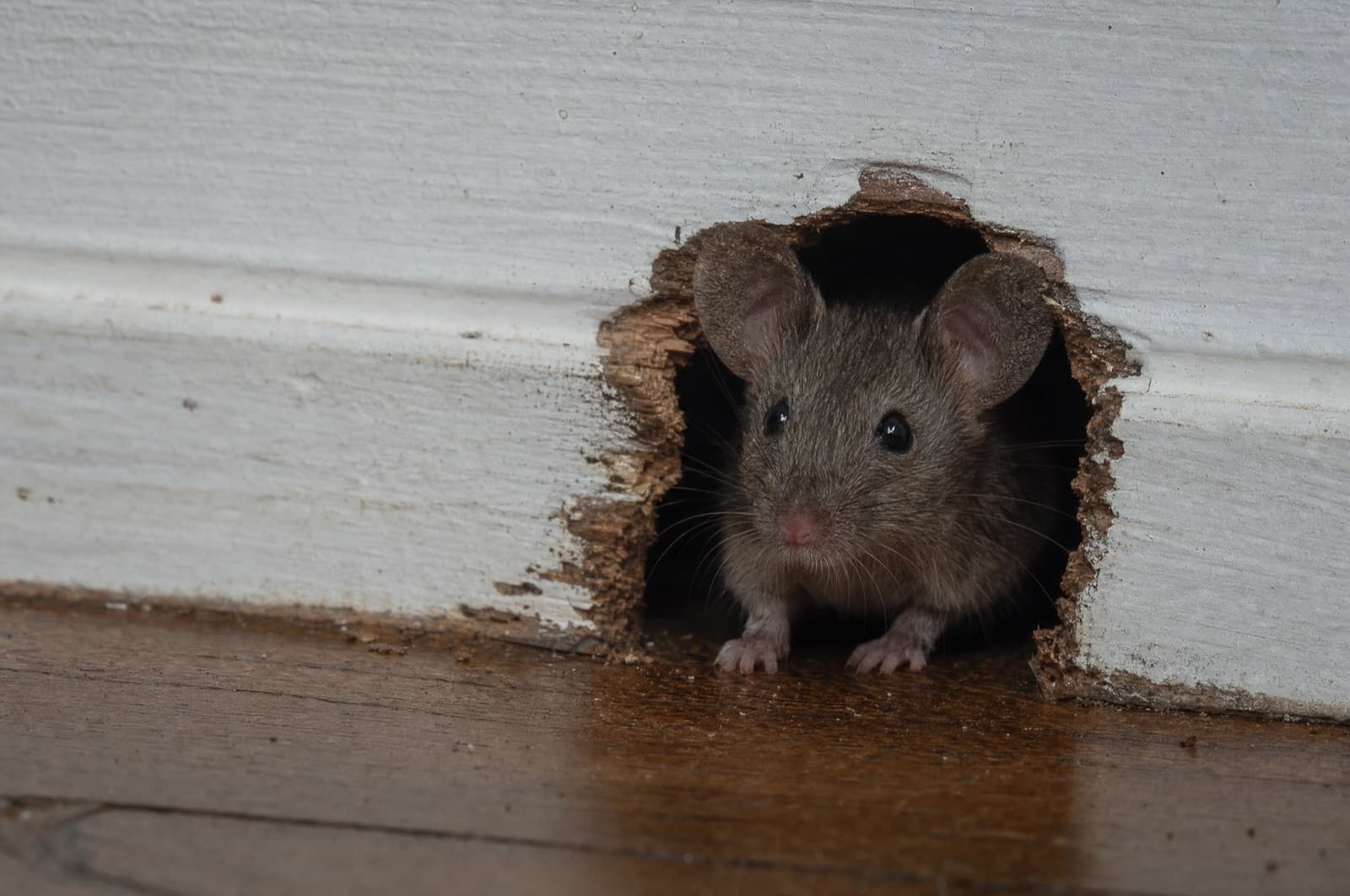
How Big of a Hole Can a Rat Squeeze Through?
At a Glance
- Short answer: Any gap larger than about ½ inch (roughly 13 mm) — about a dime-to-quarter-sized opening.
- Key fact: The rat's skull, not its body, sets the minimum passable gap.
- NH relevance: Common ½-inch-plus gaps in NH homes: foundation utility penetrations, door thresholds without proper sweeps, mortar joints, and roof/soffit vents.
- Action needed: Inspect the foundation and utility penetrations with a flashlight; seal anything a quarter can pass through.
The short of it
A rat can enter through any opening larger than roughly ½ inch (about 13 mm) across. That's smaller than most homeowners expect — about the size of a dime, and easily passable if a quarter fits through. Rats need roughly double the gap a mouse needs (¼ inch), because a rat's skull is simply larger, but the mechanism is the same: the skull is the only rigid limit, and a flexible, unfused ribcage lets the rest of the body follow once the head clears.
How Big of a Hole Can a Rat Squeeze Through — By the Numbers
½ in
Minimum gap size an adult rat can squeeze through
13 mm
Metric equivalent of the ½-inch threshold
2×
Roughly the gap a rat needs versus a mouse (¼ inch)
Quarter
Conservative field-test object — if it fits, a rat fits
The gap sizes that let rodents in
The skull, not the body, sets the minimum gap a rodent can squeeze through — and a rat needs roughly double the gap a mouse does.
rat
0.5 min gap
about the size of a dime; a quarter-sized hole is comfortably passable
The skull is the widest rigid structure; a rat's hinged, unfused ribcage and soft tissue compress to follow once the head clears the opening.
mouse
0.25 min gap
the width of a standard pencil
Same skull-limited mechanism as rats, but a mouse's smaller skull means it needs only about half the gap a rat does.
Bottom line — Seal any opening ½ inch or larger to exclude rats; because mice need only ¼ inch, sealing to the rat threshold alone will still leave mouse-sized gaps open.
The full picture
Why the skull, not the body, sets the limit
A rat's skeleton is highly flexible. Its rib cage is hinged at the spine rather than rigidly fused the way a human's is, so the body can flatten and elongate to pass through a gap. The skull is the widest rigid structure the animal has, which is why professionals use a simple working rule: if the head fits, the rest follows. Rats also use their whiskers to test whether an opening is passable before committing to it.
Where these gaps show up in NH homes
The most common ½-inch-or-larger gaps show up around utility-pipe penetrations at the foundation, under exterior doors lacking a proper threshold or sweep, in mortar joints between foundation blocks, and around roof vents and soffits. A simple flashlight test works: if daylight is visible under a closed door or around a pipe, the gap is large enough for a rat to use, and it will only get wider as the rat gnaws at the edges.
Rat vs. mouse: two different thresholds
Rats need roughly double the gap a mouse needs — about ½ inch versus a mouse's ¼ inch. That difference matters practically: a home sealed only against mice, using ¼-inch mesh or minor caulking, will still admit rats through larger gaps that were left unaddressed. Because the mechanism (skull-limited, flexible-body squeeze) is identical across both species, extension guidance treats them as one exclusion problem sized to the larger, rat threshold wherever both species are a concern.
Bottom line — Seal any gap ½ inch or larger with materials rats can't chew — steel wool packed with sealant, 19-gauge ½-inch hardware cloth, sheet metal, or mortar — rather than relying on caulk or foam alone. If a quarter passes through an opening, treat it as rat-passable and close it.
Not sure which gaps are rat-sized?
Anchor's licensed NH technicians inspect your foundation, utility penetrations, and thresholds for every ½-inch-plus opening.
Why this matters in New Hampshire
As Manchester's first hard frost approaches (~Oct 19 at 50% probability, ~Oct 29 at 80%, NOAA 1991–2020), rats actively search for ½-inch-plus gaps to reach warm, watered shelter for the winter. Sealing the foundation, utility penetrations, and door thresholds before that window closes off the entry points rats rely on most across southern and central NH's older housing stock.
Key local data
Older southern-NH homes with unlined foundation vents, stone cellars, and softwood trim offer rodents ready entry and chewable material (UNH Cooperative Extension).
- NH-licensed applicator · #782664
- Same-day service
- Family-owned since 2017
Service Area Map
Southern New Hampshire
Frequently asked
Sources (5)
- [1]
- [2]
- [3]
- [4]
- [5]
Written & reviewed by
VerifiedDaniel Brady
NH-Licensed Pesticide Applicator · License #782664 (NHDAMF, RSA 430)
Daniel Brady is the New Hampshire–licensed applicator behind Anchor Pest Services, a family-owned pest control company serving the Manchester area since 2017.
Professional Rodent Control
A Dime-Sized Gap Is All a Rat Needs
Anchor Pest Services finds and seals every ½-inch-plus opening around your home with materials rats can't chew, then traps the population already inside. Family-owned since 2017, NH license #782664.
- Same-day service across southern NH
- NH-licensed applicators (#782664)
- Free inspection — no flat-price guesswork
NH License #782664 · No obligation · We answer in person
Your next step
- Book a NH pro
Rodent Control in New Hampshire
Mice and rats move indoors every fall. We trap, seal entry points and keep them out.
Book now - Next step
When Are Rats Most Active? NH Rat Timing Guide
Read the answer - Related guide
How Small of a Hole Can a Mouse Get Through?
Read the answer - Related guide
What Materials Can Rats Not Chew Through?
Read the answer - Related guide
Can Rats Chew Through Walls or Floors?
Read the answer - Related guide
What Steps Prevent Rats From Coming Back?
Read the answer