
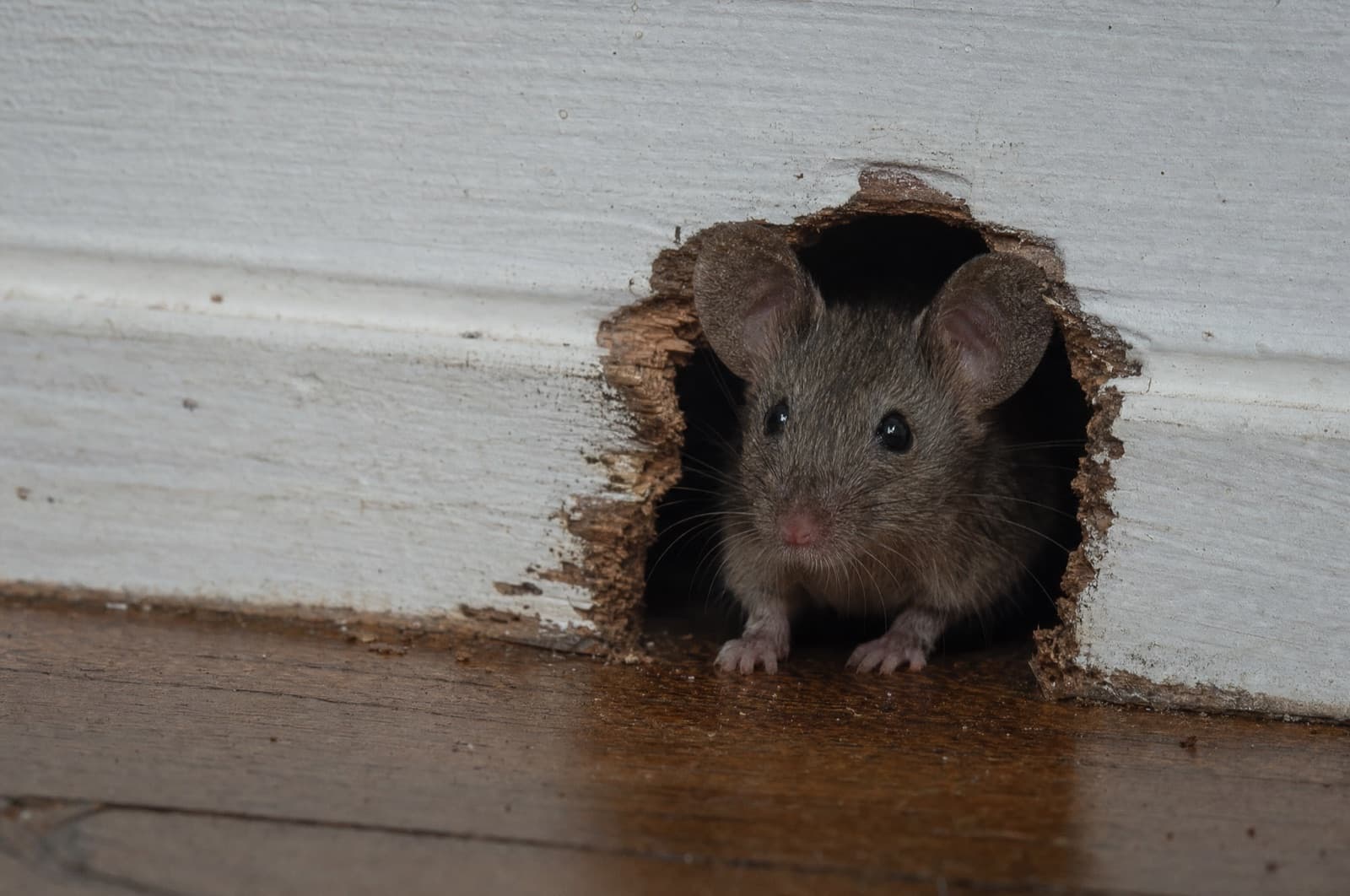
How Do I Store Food to Keep Mice Away?
At a Glance
- Short answer: Airtight glass, metal, or heavy hard-plastic containers with tight lids, elevated off the floor.
- Key fact: Mice can't chew glass or metal — paper boxes, bags, and cellophane offer no real protection.
- NH relevance: Complete food-proofing before Manchester's fall frost window (~Oct 19–29), when mice press indoors hardest.
- Action needed: Transfer dry goods to sealed containers now, and pair with exclusion — storage alone won't stop mice already inside.
The short of it
Store all dry goods and pet food in airtight glass, metal, or heavy-duty hard-plastic containers with tight lids, keep items elevated and off the floor, and clean up crumbs and spills promptly. Utah State University Extension is specific: metal, glass, and heavy plastic containers with tight-fitting lids resist rodents, while paper boxes, plastic bags, and cellophane packaging are easily accessible to them. But because mice need very little food and hoard what they find in hidden voids, storage alone won't clear an existing problem — it has to pair with sealing every gap ¼ inch or larger.
How Do I Store Food to Keep Mice Away — By the Numbers
¼ inch
Smallest gap mice need — storage alone can't block this
3 tiers
Best containers: glass, metal, then heavy gasket-sealed plastic
Daily
Recommended frequency for wiping crumbs and spills
The full picture
What actually resists mice
Utah State University Extension is specific: metal containers, glass bottles, and heavy plastic containers with tight-fitting lids are resistant to rodents, while paper boxes, plastic bags, and cellophane packages are easily accessible. Mice cannot chew through glass or metal; a thick hard-plastic container with a gasket seal is a solid second tier. Airtight seals also reduce the odor cues that draw mice in the first place.
Why storage alone isn't enough
Two realities make storage necessary but not sufficient. First, mice need very little food and are nibblers, so even crumbs sustain them — sanitation must be thorough, not just about big containers. Second, mice hoard food in hidden voids, so removing visible food may not immediately reduce an existing population. That's why extension guidance always pairs storage with exclusion: sealing every gap ¼ inch or larger with materials mice can't chew through.
Bottom line — Transfer dry goods and pet food into airtight glass, metal, or heavy hard-plastic containers, keep them elevated, and clean up crumbs daily. Do this alongside sealing entry points ¼ inch or larger — storage and exclusion each solve half the problem.
Pantry secured, but still seeing signs?
Food storage cuts the draw, but a ¼-inch gap is all a mouse needs. Anchor's licensed NH technicians handle the exclusion side of the equation.
Why this matters in New Hampshire
Complete food-proofing before the fall frost window — Manchester's first hard frost lands around October 19 at 50% probability and October 29 at 80% (NOAA 1991–2020) — when mice press indoors hardest across the Manchester–Nashua–Concord service area.
Key local data
Deer mice (Peromyscus) are the hantavirus-relevant species in NH; NH DHHS reports no confirmed case acquired in-state to date.
- NH-licensed applicator · #782664
- Same-day service
- Family-owned since 2017
Service Area Map
Southern New Hampshire
Frequently asked
Written & reviewed by
VerifiedDaniel Brady
NH-Licensed Pesticide Applicator · License #782664 (NHDAMF, RSA 430)
Daniel Brady is the New Hampshire–licensed applicator behind Anchor Pest Services, a family-owned pest control company serving the Manchester area since 2017.
Preventive Rodent Control
Storage Is Half the Answer — Exclusion Is the Other Half
Anchor Pest Services pairs sanitation guidance with professional gap-sealing across southern and central NH, so mice can't get to what's left. Family-owned since 2017, NH license #782664.
- Free inspection — no flat-price guesswork
- NH-licensed applicators (#782664)
- Preventive plans across southern & central NH
NH License #782664 · No obligation · We answer in person
Your next step
- Book a NH pro
Rodent Control
Book now - Next step
How can I tell if I have rodents in my walls during winter?
Read the answer - Related guide
What Food Sources Attract Mice the Most?
Read the answer - Related guide
What Steps Prevent Mice From Entering a Home?
Read the answer - Related guide
How Small of a Hole Can a Mouse Get Through?
Read the answer - Related guide
What Food Sources Attract Mice the Most?
Read the answer