
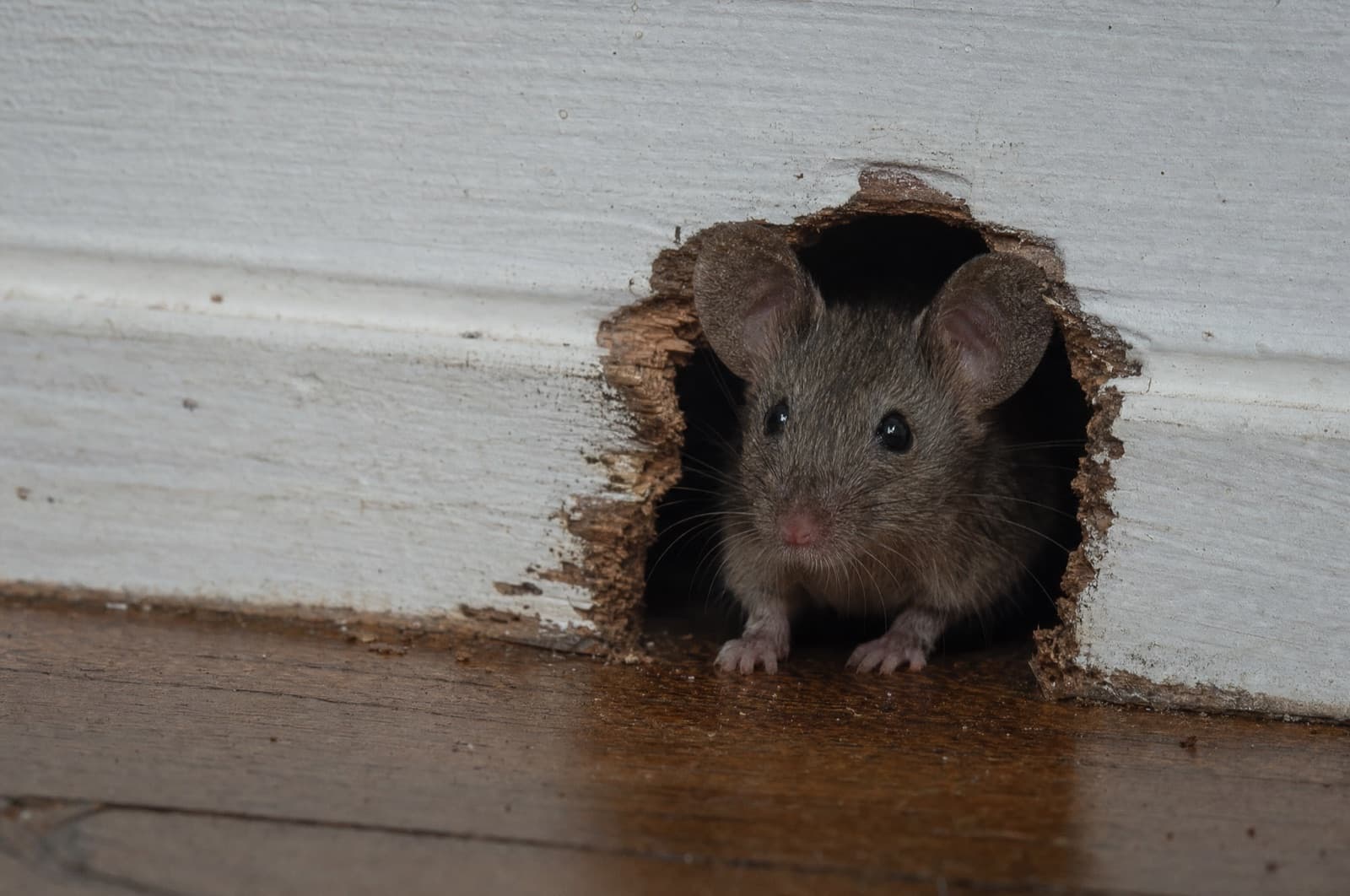
What Noises Do Rats Make in Walls?
At a Glance
- Short answer: Gnawing, scratching, climbing, and squeaking or fighting sounds, mostly after dark.
- Key fact: Rats sound heavier and louder than mice — deeper gnawing, audible thumps — due to their larger body size.
- NH relevance: Wall and attic noise after dusk in NH homes commonly signals roof rats or Norway rats settling in for the season.
- Action needed: Don't rely on sound alone — confirm species with droppings, gnaw marks, or grease trails before choosing a control method.
The short of it
University of Missouri Extension lists the acoustic signature of rats plainly: gnawing, climbing in walls, squeaks, and fighting noises, concentrated at their most active times — mainly after dusk and through the night, since rats are nocturnal. Because rats are much heavier than mice, their gnawing and climbing tend to sound louder and deeper, sometimes including audible thumps, while mice produce quicker, lighter scratching and higher-pitched squeaks. That size-based loudness contrast is a reasonable inference rather than a precisely measured rule, so pair what you hear with visual signs — droppings, gnaw marks, grease trails — before concluding which species you have.
What Noises Do Rats Make in Walls — By the Numbers
4
Common rat wall sounds: gnawing, climbing, scratching, squeaking/fighting
Dusk+
Typical time rat wall noise begins, since rats are nocturnal
Louder
Rat gnawing/climbing vs. mouse sounds, due to greater body size
2
Species this noise could be — confirm with visual signs, not sound alone
The full picture
The documented rat sound profile
University of Missouri Extension names the specific noises associated with rat activity: gnawing, climbing in walls, squeaks, and fighting noises, concentrated during the periods rats are most active. Because rats are nocturnal, that activity — and the noise that comes with it — clusters after dusk and through the night, often from wall voids, the attic, or spaces behind cabinets.
Rat sounds vs. mouse sounds
The practical difference between a rat and a mouse in the wall largely comes down to size. Rats are considerably heavier than mice, so their gnawing tends to sound deeper and more forceful, and their movement can produce audible thumps as they climb or shift position — sounds a much lighter mouse simply can't generate. Mice, also nocturnal, tend to produce faster, lighter scratching and higher-pitched squeaks. This loudness comparison is a reasonable inference from the documented body-size difference; extension sources confirm the individual behaviors (gnawing, climbing, squeaking) and the nocturnal timing more directly than a formally measured volume study.
Confirm with signs, not sound alone
Because ears alone are an imperfect diagnostic, pair what you hear with visible evidence before deciding on a control approach: rat droppings are larger with blunt ends (roughly ½–¾ inch) versus a mouse's smaller, pointed pellets; gnaw marks and grease trails differ in scale; and rats generally need a larger entry gap (about ½ inch) than mice (about ¼ inch). Getting the species right matters because trap sizing, bait placement, and exclusion gap targets differ between the two.
What to do about it
Any repeated in-wall noise at night — regardless of species — points to active rodent presence and warrants the same sequence: identify which species you're likely dealing with using the signs above, set appropriately sized traps at wall lines and known travel routes, confirm the noise and any droppings have stopped for several days, and only then seal the entry point. Never seal while there's still activity, since a live rodent trapped inside a wall or attic will die there and decay for weeks.
Bottom line — Rat wall noise is gnawing, scratching, climbing, and squeaking or fighting, typically starting at dusk and louder/heavier than mouse sounds due to body size — but confirm with droppings and gnaw marks before treating, since sound alone isn't a precise species ID.
Hearing noises in the walls at night?
Anchor identifies the species from the signs, not guesswork, then traps and confirms vacancy before sealing anything.
Why this matters in New Hampshire
Wall and attic noise after dark tends to rise across southern and central New Hampshire homes as Manchester's first hard frost approaches — about October 19 at 50% probability, October 29 at 80% (NOAA 1991–2020) — when rats and mice both push indoors for warmth. Noticing the noise early, before a colony is established for winter, makes trapping and confirming vacancy considerably faster.
Key local data
Older southern-NH homes with unlined foundation vents, stone cellars, and softwood trim offer rodents ready entry and chewable material (UNH Cooperative Extension).
- NH-licensed applicator · #782664
- Same-day service
- Family-owned since 2017
Service Area Map
Southern New Hampshire
Frequently asked
Sources (2)
- [1]
- [2]
Written & reviewed by
VerifiedDaniel Brady
NH-Licensed Pesticide Applicator · License #782664 (NHDAMF, RSA 430)
Daniel Brady is the New Hampshire–licensed applicator behind Anchor Pest Services, a family-owned pest control company serving the Manchester area since 2017.
Professional Rodent Control
Wall Noise Diagnosed Correctly, Then Solved
Anchor Pest Services confirms whether it's rats or mice using droppings and gnaw evidence, not sound alone, then traps and seals in the right order. Family-owned since 2017, NH license #782664.
- Same-day service across southern NH
- NH-licensed applicators (#782664)
- Free inspection — no flat-price guesswork
NH License #782664 · No obligation · We answer in person
Your next step
- Book a NH pro
Rodent Control
Book now - Next step
Do rodents count as fall invaders too?
Read the answer - Related guide
How Do I Get Rats Out of an Attic?
Read the answer - Related guide
How Do I Get Rid of Mice in Walls?
Read the answer - Related guide
When Are Rats Most Active Indoors?
Read the answer - Related guide
What Noises Do Mice Make at Night?
Read the answer