
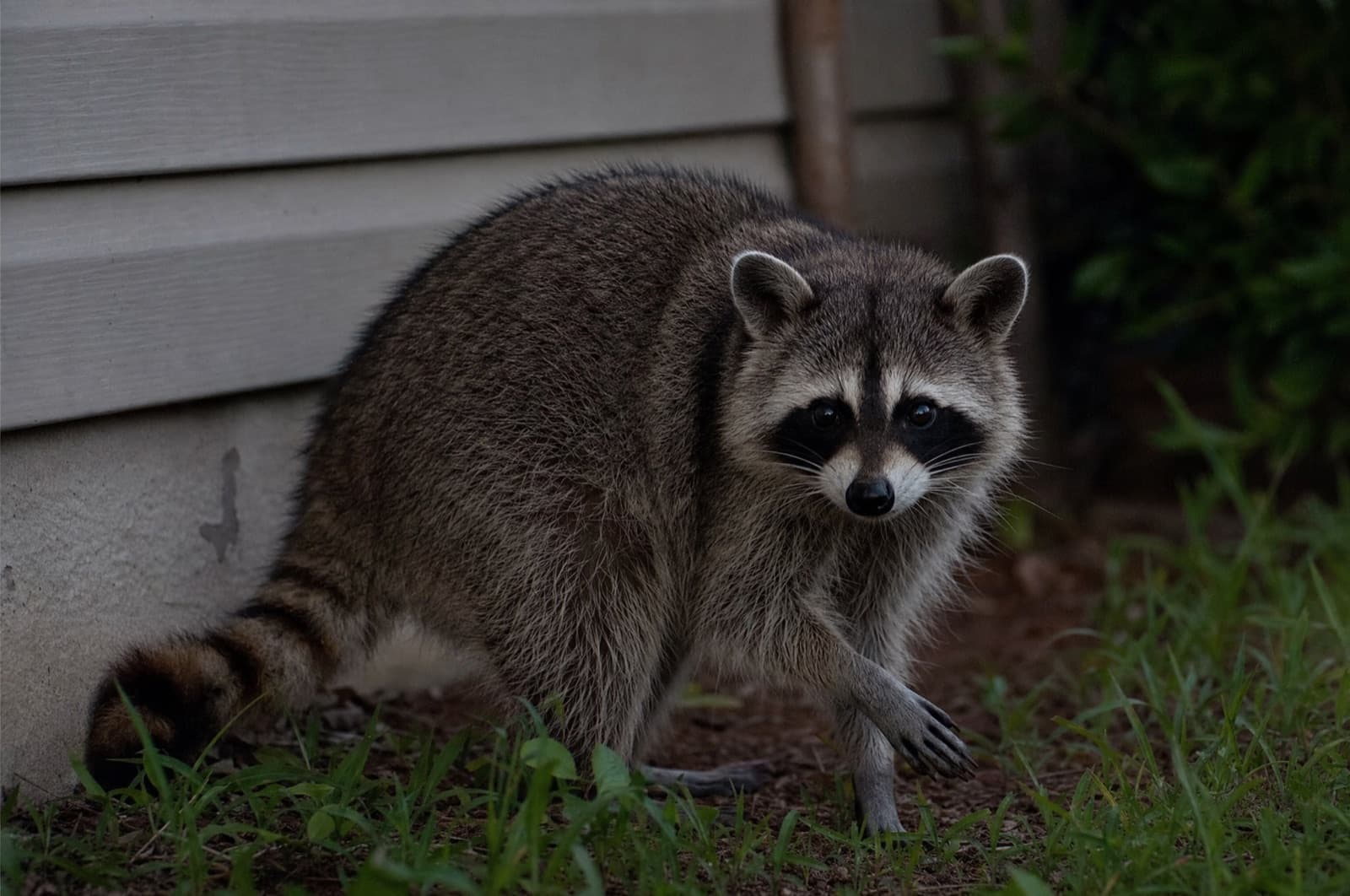
When Are Raccoons Active? Winter, Night & NH Timing
At a glance
- Activity pattern: NocturnalActive sunset to sunrise — Mass Audubon / ICWDM
- Winter strategy: Torpor, not hibernationEnters torpor in extended cold (commonly cited ~15°F), sleeps days to weeks on fat, wakes to forage — Mass Audubon / ICWDM
- Den sites: Attics, chimneys, garage voids, crawlspaces, porch voidsWarmer and drier than a tree cavity — Mass Audubon / ICWDM
- Breeding: Mate Jan–Feb; kits born ~April~9-week (63-day) gestation; first litters often born inside structures — Mass Audubon / ICWDM
Activity pattern
Nocturnal
Active sunset to sunrise — Mass Audubon / ICWDM
Winter strategy
Torpor, not hibernation
Enters torpor in extended cold (commonly cited ~15°F), sleeps days to weeks on fat, wakes to forage — Mass Audubon / ICWDM
Den sites
Attics, chimneys, garage voids, crawlspaces, porch voids
Warmer and drier than a tree cavity — Mass Audubon / ICWDM
Breeding
Mate Jan–Feb; kits born ~April
~9-week (63-day) gestation; first litters often born inside structures — Mass Audubon / ICWDM
The short of it
Raccoons are nocturnal and do NOT truly hibernate — they enter breakable winter torpor below about 15°F and den in NH attics, chimneys, and crawlspaces, waking to forage on mild nights.
When are they active — the whole year at a glance
Raccoons are active in New Hampshire every month, but the calendar swings between mating, denning, and birthing depending on the season.
Best window to act · Fall (September–October), before raccoons settle into winter dens, and late summer once kits are independent. Avoid sealing during the April–June kit season unless a professional confirms no young are present.
Peaks track late-winter mating (Feb) and spring kit-rearing (Apr–Jun); den-seeking climbs toward Manchester's ~Oct 19 first frost (50% probability, NOAA 1991–2020).
What time of day are they active?
Raccoons are strictly nocturnal, foraging from sunset to sunrise. Winter bends that rule: rather than braving the coldest part of the night, a hungry raccoon may shift to the warmest hours of the day instead.
Daytime foraging can be normal in winter, exploiting warmer daylight temperatures. But a raccoon that is active by day AND disoriented, staggering, aggressive, or paralyzed should be treated as a possible rabies case — do not approach it, and contact animal control. Any bite or scratch is a medical emergency.
A day in their clock
- Dusk (foraging onset)active
- Nightpeak
- Pre-dawnactive
- Daytimelow
Winter behavior
Homeowners often ask whether raccoons hibernate. They don't — but what they do instead explains why one can show up in your yard mid-winter.
Winter torpor
Naturally, tree cavities. In NH suburbs, raccoons frequently den in attics, chimneys, garage ceiling voids, crawlspaces, and under porches — all warmer and drier than a tree. They may share dens with other raccoons for warmth.
Move in
Fall den-seeking runs roughly September through November, ahead of the frost; torpor settles in through November and December.
Winter torpor
Naturally, tree cavities. In NH suburbs, raccoons frequently den in attics, chimneys, garage ceiling voids, crawlspaces, and under porches — all warmer and drier than a tree. They may share dens with other raccoons for warmth.
Spring exit
Torpor breaks roughly February–March, but pregnant females stay in the den and give birth around April — making spring the highest-risk season for raccoons raising young inside a home, not an exit from it.
A year in the life
Raccoon activity follows a predictable New Hampshire cycle even though the animals are present all year.
- 01
Spring
Kits are typically born around April after a roughly nine-week gestation, and attics make prime birthing dens. Because kits are immobile for weeks, spring is the highest-risk season for humane timing — sealing a den now can trap dependent young inside.
- 02
Summer
Mothers rear kits through June, producing the year's heaviest attic damage, then juveniles begin exploring independently by July and family groups forage together through August.
- 03
Fall
Raccoons gorge to build fat reserves and seek out winter dens as temperatures fall toward the ~Oct 19 frost. This is the best exclusion window of the year, once kits from the spring litter are fully independent.
- 04
Winter
Below roughly 15°F, raccoons enter torpor and can sleep for days to weeks on stored fat, but they are not true hibernators — they rouse and forage on milder nights or warm winter days, which is why they can still be removed from a den in January or February.
Raccoons in southern New Hampshire
Raccoons are common throughout Manchester, Nashua, and Concord, drawn to attics, chimneys, and garage voids that stay far warmer than a natural den tree through the region's long winters. Because they never fully hibernate, NH's cold season doesn't remove the risk — it concentrates it, with mating-season commotion in late winter followed by an April birthing peak inside structures.
Key local data
Raccoons are the primary reservoir of the raccoon rabies variant across the northeastern U.S., and NH Fish & Game classifies them as a rabies-vector species whose live relocation is restricted by state rule — one reason attic and chimney den removal in southern NH should go through a licensed wildlife control operator rather than DIY trapping (NH Fish & Game; CDC). Fall den-seeking accelerates as temperatures drop toward Manchester's ~Oct 19 average first hard frost (NOAA 1991–2020).
We serve these communities
- NH-licensed applicator · #782664
- Same-day service
- Family-owned since 2017
Service Area Map
Southern New Hampshire
Timing your treatment
Because raccoons wake every few days even during torpor, winter isn't off-limits for removal — but timing around the spring kit season matters a great deal.
Wildlife & Exclusion
Free inspection and same-day wildlife & exclusion service across southern New Hampshire. NH-licensed #782664. Because raccoons are a rabies-vector species and NH restricts relocation, DIY removal is discouraged — use a licensed wildlife control operator.
Learn more about this pestFrequently asked
Sources & references
- Mass Audubon — Raccoons
nocturnal activity, winter torpor vs. hibernation, den sites, spring kit timing
- Internet Center for Wildlife Damage Management (ICWDM) — Raccoons
torpor behavior, ~63-day gestation, denning in structures, damage management
- CDC — Rabies: Wild Animals
raccoons as a leading Northeast rabies reservoir; bite/scratch exposure guidance
- NH Fish & Game — Nuisance Wildlife
rabies-vector species handling and relocation restrictions
- Garden.org — Frost Dates, Manchester NH (NOAA 1991–2020)
Manchester first hard frost ~Oct 19
Editorial disclaimer: This content is provided for informational purposes only and does not constitute pest control advice. Every property is unique — consult a licensed professional for guidance specific to your situation. Anchor Pest Services is licensed in New Hampshire (#782664).
Written & reviewed by
VerifiedDaniel Brady
NH-Licensed Pesticide Applicator · License #782664 (NHDAMF, RSA 430)
Daniel Brady is the New Hampshire–licensed applicator behind Anchor Pest Services, a family-owned pest control company serving the Manchester area since 2017.
Last updated Jul 2026
Anchor Pest Services
Whatever the season — we handle the timing for you.
Same-day service across Southern New Hampshire. NH-licensed #782664, family-owned since 2017. We track the local calendar so you don't have to guess the right window.
- NH-licensed applicator
- Same-day service
- Pet & family-conscious
NH License #782664 · No obligation · We answer in person
Your next step
- What to do next
Raccoons in New Hampshire — Rabies, Removal & the Law
Read the answer - Related guide
Where Do Opossums Live in the Winter? NH Timing Guide
Read the answer - Related guide
Where Do Squirrels Go in the Winter? NH Timing Guide
Read the answer - Also relevant
Raccoons in New Hampshire — Rabies, Removal & the Law
Read the answer - Also relevant
Where Do Raccoons Go In The Winter?
Read the answer - Also relevant
Why do raccoons break into attics?
Read the answer