
Raccoons in New Hampshire — Rabies, Removal & the Law
Also called Coon · Masked bandit
Raccoons are New Hampshire's dominant terrestrial rabies vector and the primary host of raccoon roundworm (Baylisascaris procyonis) — a parasite whose eggs no common disinfectant kills. They are a regulated furbearer in NH, meaning out-of-season nuisance removal requires a licensed Wildlife Control Operator. April through May is chimney birthing season; sealing a mother away from her kits causes serious harm. Call a pro for any colony, latrine, or attic situation.
- Rabies share
- ~29% of U.S. wildlife rabies cases
- Second to bats (~35%); current CDC National Rabies Surveillance
- Roundworm eggs
- ~20,000 eggs per gram of feces
- Become infectious after 2–4 weeks; no common disinfectant kills them (CDC)
- Weight
- 4–23 lb (avg 13–15 lb in NH)
- Body 24–37 in; tail 7.5–16 in; Procyon lotor
- Birthing season
- April–May in NH chimneys
- Gestation ~63 days; 1–8 kits per litter; NH Fish & Game
- NH legal status
- Regulated furbearer
- Out-of-season nuisance removal requires a licensed WCO; NH Fish & Game
- Latrine risk
- Communal latrines on roofs and in attics
- Major Baylisascaris egg accumulation site; never clean without PPE
New Hampshire's most dangerous nuisance wildlife species
Raccoons (Procyon lotor) are intelligent, adaptable, and among the most conflict-prone wildlife species in New Hampshire. Their combination of rabies risk, roundworm hazard, chimney birthing, attic damage, and legal complexity puts them in a different category from most nuisance animals.
On rabies: raccoons account for roughly 29% of confirmed wildlife rabies cases in the United States — second only to bats. NH's dominant terrestrial rabies variant is the raccoon-associated strain, and NH DHHS 2024–2025 surveillance reports list multiple confirmed rabid raccoons across the state, including in Bedford and Dover. A raccoon that is active in daylight is not automatically rabid — raccoons sometimes forage in daylight, especially nursing mothers — but daylight activity combined with disorientation, stumbling, or unprovoked aggression is a serious warning sign requiring immediate caution and a call.
On roundworm: raccoon roundworm (Baylisascaris procyonis) is shed in feces at roughly 20,000 eggs per gram. Those eggs become infectious after 2–4 weeks in the environment and are not killed by any common household disinfectant. The CDC cleanup protocol requires removal followed by heat — boiling water, a propane flame-gun, or incineration. Fewer than 25 human U.S. cases have been documented, but those cases are often severe, causing neurological damage or death.
On the law: raccoons are a regulated furbearer in New Hampshire. Out-of-season nuisance removal — which is most of what homeowners actually need — requires a licensed Wildlife Control Operator (WCO) issued by NH Fish & Game. This is not bureaucratic formality; it reflects the genuine complexity of safe, legal raccoon removal.
How to identify a raccoon
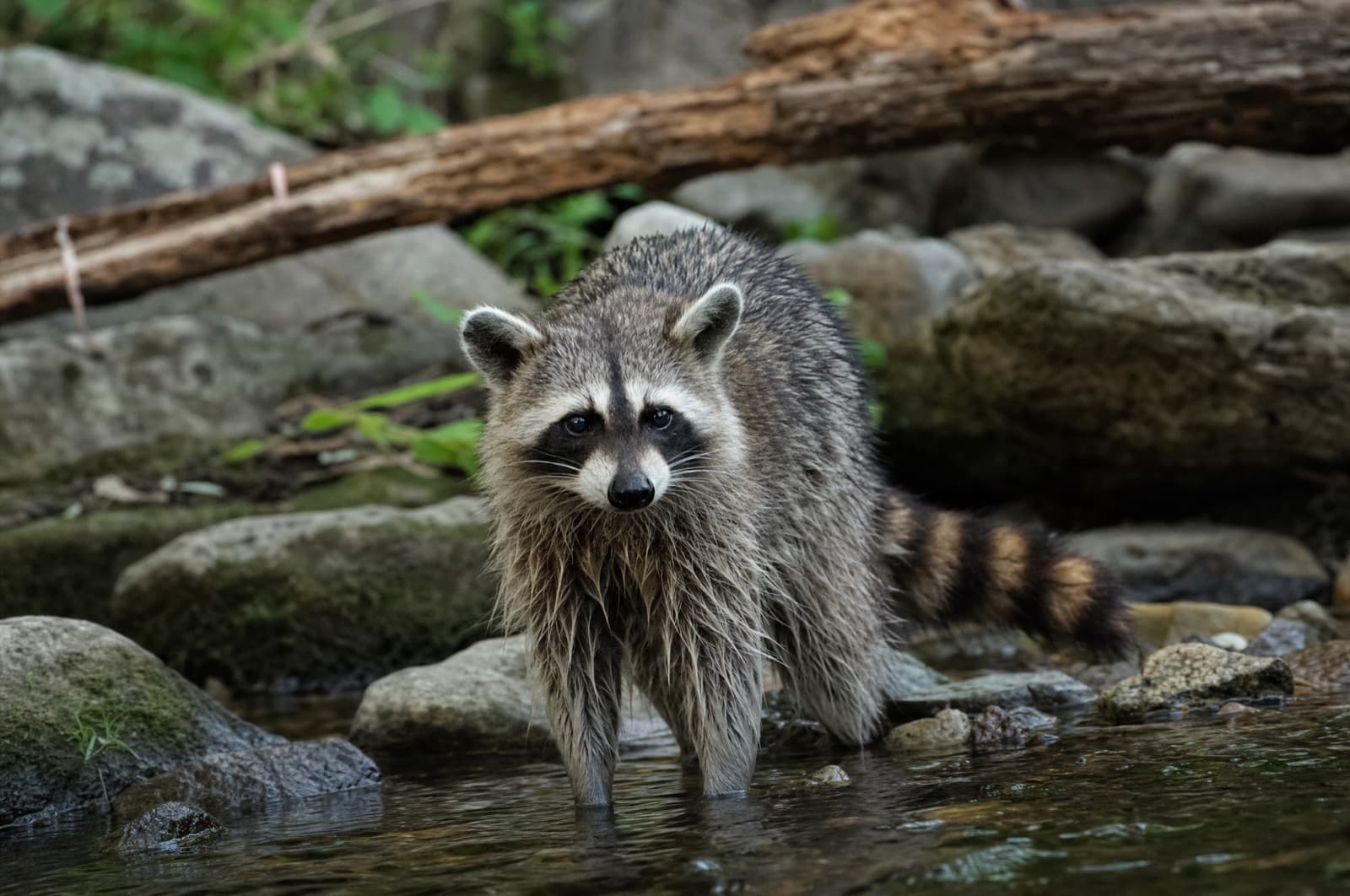
Raccoons are one of the most visually distinctive mammals in New Hampshire. The black facial mask and ringed tail are unmistakable in good light. Size and build separate them from any comparable species.
Common raccoon
- Scientific name
- Procyon lotor
- Family
- Procyonidae
- Size
- Body 603–950 mm; tail 192–405 mm; weight 1.8–10.4 kg (avg 6–7 kg); 4–23 lb in practical terms
- Coloration
- Grizzled gray-brown body; distinctive black facial mask edged in white; bushy tail with 4–7 alternating brown and black rings
- Habitat
- Highly adaptable — forested areas near water, suburban neighborhoods, agricultural land, urban parks; uses attics, chimneys, crawlspaces, and hollow trees for denning.
- Active season
- Year-round; reduced activity in severe NH cold (not a true hibernator — enters torpor in extended cold spells)
- Diet
- Omnivore — crayfish, frogs, fish, insects, eggs, fruit, nuts, carrion, garbage, garden produce, pet food
- Reproduction
- Mating January–March; gestation ~63 days; 1–8 kits born April–May; one litter per year; NH Fish & Game notes chimneys as a common NH birthing site
- Lifespan
- Rarely exceeds 5 years in the wild; 2–3 years average
Present statewide in New Hampshire; highest densities in suburban and agricultural areas near water.
The tells — key ID features
- Black facial mask — a dark band across both eyes extending to the cheeks, edged with white; most reliable single field mark.
- Ringed tail — alternating brown and black bands on a bushy tail, 7.5–16 inches long.
- Dexterous five-fingered forepaws that produce human-like handprint tracks.
- Stocky, hunched build with a waddling gait; much heavier than an opossum or cat.
- Grizzled gray-brown fur, coarser in winter; animals appear larger in cold months.
- Communal latrines — raccoons return repeatedly to the same elevated site (roof corners, attic joists, woodpile tops) to defecate.
Size, to scale
4–23 lb; body up to 37 inches
Size of a medium to large dog; noticeably heavier and broader than a house cat
Opossum
How to tell — Opossums have a pointed white face with no mask, a naked unringed tail, and a slimmer build. Raccoons are stockier with a black mask and ringed tail.
Housecat
How to tell — Housecats lack the black facial mask and tail rings, are lighter, and do not produce the characteristic five-fingered handprint track.
Signs of a problem
Raccoons are loud, destructive, and leave very distinctive evidence. If you have raccoons in or near your home, you will generally know it.
Heavy nighttime thumping or rolling noises in the attic or chimney
What it means — Raccoons are large enough to be clearly audible through ceilings; the sound is heavier and more deliberate than squirrel or mouse activity.
Tipped, destroyed, or raided trash cans
What it means — Raccoons have dexterous forepaws and will open many latch and bungee-style trash can lids. Widespread spillage rather than a small access hole is a raccoon signature.
Communal latrines — piles of tubular feces in one location
What it means — Raccoons repeatedly use the same site: roof valleys, attic corners, woodpile tops, or deck surfaces. Feces often contain undigested berries, seeds, or insect parts. Do not disturb without gloves and a respirator.
Five-fingered handprint tracks in mud, snow, or soft soil
What it means — Raccoon tracks resemble a small human handprint with five distinct finger impressions. Front and rear prints differ in length, often appearing in pairs.
Damaged soffit, fascia, or roof edges
What it means — Raccoons enter attics by pulling back soffit sections or ripping at deteriorated fascia boards. The damage typically shows claw and bite marks on wood or aluminum.
Scratching, chittering, or whining sounds from a chimney in spring
What it means — A nursing female with kits in an uncapped chimney — April and May are the peak period in NH. Do not attempt to cap or smoke out the chimney until the family has left.
The real risks, calibrated
Raccoons present a more serious risk profile than most NH nuisance wildlife. Rabies and roundworm are genuine public health concerns; attic damage can be extensive; and the legal framework around removal adds complexity.
Rabies — NH's dominant terrestrial vector
SevereOnset: Only through bite or scratch, or mucous membrane exposure to saliva
Raccoons account for ~29% of U.S. wildlife rabies cases. NH's dominant terrestrial rabies variant is raccoon-associated. Any bite or scratch: call NH DHHS at (603) 271-4496 IMMEDIATELY. Do not wait. Rabies post-exposure prophylaxis is nearly 100% effective when started promptly.
Raccoon roundworm (Baylisascaris procyonis)
SevereOnset: After handling contaminated feces or soil; 2–4 weeks for eggs to become infectious after deposit
Infected raccoons shed ~20,000 Baylisascaris eggs per gram of feces. Eggs survive for years in soil, are not killed by bleach or most common disinfectants, and can cause severe or fatal neurological disease in humans. Fewer than 25 U.S. human cases documented, but outcomes are often severe. CDC cleanup protocol: remove all feces, then treat surfaces with boiling water or propane flame-gun. Never disturb a latrine without N95 respirator and disposable gloves.
Attic and chimney structural damage
HighOnset: Accumulates over weeks to months
A raccoon colony in an attic will compress and contaminate insulation (which must be replaced), damage vapor barriers, gnaw wiring, and create entry points for water. Chimney nesting debris is a fire hazard. Remediation costs can be substantial.
Leptospirosis and other parasites
ModerateOnset: Contact with urine-contaminated water or soil
Raccoons can shed leptospirosis bacteria in urine, which is a risk near standing water sources and in basements or crawlspaces with raccoon activity. Standard PPE and handwashing reduce risk.
DIY — what works, what backfires
Raccoon situations are among the least suitable for DIY wildlife management in New Hampshire. The combination of rabies risk, roundworm contamination, and legal regulated-furbearer status makes this a strong candidate for licensed professional help. That said, prevention is solidly within homeowner reach.
What actually works
- Cap chimneys BEFORE April — before birthing season begins. A stainless steel cap with mesh sides is the single most effective prevention measure for chimney denning.
- Secure trash cans with heavy bungee cords or locking lids rated for raccoon access — standard lids are not sufficient.
- Call NH DHHS at (603) 271-4496 IMMEDIATELY for any human or pet bite or scratch from a raccoon. Do not wait and observe the animal.
- Hire a licensed Wildlife Control Operator for any colony, attic, latrine, or chimney situation — this is the legally correct and safest path for out-of-season removal in NH.
- Have latrines professionally cleaned; do not attempt solo cleanup of a raccoon latrine in an attic or confined space without professional-grade PPE and knowledge of the CDC protocol.
- Contact USDA Wildlife Services NH at (603) 223-6832 for guidance on damage situations.
What backfires
- Do not disturb a raccoon latrine without at minimum disposable gloves and an N95 respirator — Baylisascaris eggs are not killed by bleach, Lysol, or any common household disinfectant.
- Do not trap and handle raccoons yourself for out-of-season removal — doing so without a WCO license violates NH regulations.
- Do not seal a chimney or attic entry point in April or May without confirming no nursing female is inside; sealing a mother away from her kits causes suffering, structural damage as she attempts to return, and potentially orphaned kits.
- Do not assume a daytime raccoon is rabid — but DO take daytime activity plus disorientation, stumbling, circling, or unprovoked aggression as an immediate warning sign requiring distance and a call.
- Do not use poison — it is illegal for raccoon control, inhumane, and creates secondary poisoning risks for pets and raptors.
Raccoons in New Hampshire: what makes them different here
New Hampshire's raccoon population carries the raccoon-variant rabies strain — the dominant terrestrial rabies type in the Northeast. NH DHHS publishes annual zoonotic disease reports that regularly list raccoons as the most frequently confirmed rabid species in the state, with confirmed cases appearing in communities throughout Anchor's service area including Bedford and Dover in 2024–2025 reporting periods. April and May are especially high-risk months in NH: nursing mothers seek enclosed, elevated cavities — uncapped chimneys are a preferred site — and will defend their kits aggressively. Never seal a chimney in spring without first confirming it is unoccupied. Old NH homes with large masonry chimneys or unfinished attic spaces are particularly prone to raccoon colonization.
Peak season
Year-round; mating January–March; birthing April–May; peak attic/chimney activity spring through fall
We serve these communities
- NH-licensed applicator · #782664
- Same-day service
- Family-owned since 2017
Service Area Map
Southern New Hampshire
When to call a pro for raccoon removal
For raccoons, 'when to call a pro' is almost always the answer. The rabies and roundworm hazards, the legal requirement for a WCO for out-of-season removal, and the scope of attic remediation all exceed safe DIY scope. A licensed wildlife control operator can legally trap and remove, assess and seal all entry points, and coordinate with a qualified remediator for attic insulation replacement and latrine cleanup.
When to call a pro
- Any raccoon in your attic, chimney, or crawlspace — especially April through May.
- A communal latrine on your roof, in your attic, or in another confined space.
- Any bite or scratch — call NH DHHS (603) 271-4496 first, then a licensed WCO.
- A raccoon displaying disorientation, stumbling, circling, or aggression in daylight.
- Repeated nightly raiding of trash or pet food that prevention measures have not resolved.
- You need entry points identified and sealed after removal.
Cap chimneys before April
A stainless steel chimney cap with mesh sides prevents raccoons from entering to birth kits — the single most consequential raccoon prevention step for NH homeowners with masonry chimneys.
Secure trash and eliminate outdoor food
Locking or bungee-secured trash lids, no outdoor pet food after dusk, and harvest of fallen fruit removes the food incentives that draw raccoons into residential areas.
Inspect and repair roof and soffit
Raccoons enter attics through deteriorated or loose soffit panels and fascia boards. An annual fall inspection and prompt repair of any gaps closes entry points before winter denning season in NH.
Remove woodpile and brush staging near the house
Woodpiles stacked against a wall and brush piles near the foundation provide raccoon latrines and daytime resting cover. Move them away from the structure.
Not sure it's a common raccoon?
A licensed NH technician can confirm the species and tell you honestly whether it's a DIY fix or a job for a pro — free inspection, same-day service across Southern New Hampshire.
Frequently asked questions
Sources(6)
- [1]Animal Diversity Web — Procyon lotor
Body measurements, weight range, lifespan, reproductive data
academicverified 2026-06-30 - [2]NH Fish & Game — Raccoon Species Profile
NH-specific biology, chimney birthing, rabies carrier status, regulated furbearer classification
govverified 2026-06-30 - [3]NH Fish & Game — Wildlife Control Operators
WCO licensing requirement for out-of-season nuisance removal in NH
govverified 2026-06-30 - [4]CDC — Baylisascaris Infection
Roundworm egg shedding rate, egg survival, disinfectant ineffectiveness, cleanup protocol, human case count
govverified 2026-06-30 - [5]CDC Emerging Infectious Diseases — Raccoon Roundworm Encephalitis
Clinical severity of human Baylisascaris cases; neurological outcomes
govverified 2026-06-30 - [6]NH DHHS — Zoonotic Diseases and Rabies Reports 2024–2025
NH confirmed rabid raccoon cases 2024–2025; Bedford and Dover locations; raccoon-variant rabies strain prevalence
govverified 2026-06-30
Written & reviewed by
VerifiedDaniel Brady
NH-Licensed Pesticide Applicator · License #782664 (NHDAMF, RSA 430)
Daniel Brady is the New Hampshire–licensed applicator behind Anchor Pest Services, a family-owned pest control company serving the Manchester area since 2017.
Last updated 2026-06-30

New Hampshire pest control
Dealing with common raccoons in your home?
Anchor Pest Services identifies and handles common raccoon problems across southern and central New Hampshire. Family-owned since 2017, NH license #782664.
- NH-licensed applicators (#782664)
- Same-day service · free inspection
- Family-owned since 2017
Your next step
- Fall guide
Fall Pest Control in New Hampshire
What matters before frost: the fall invader window, mice at the foundation, and what to seal first.
Read the answer - What to do next
Where Do Raccoons Go In The Winter?
Read the answer - What to do next
When Are Raccoons Active? Winter, Night & NH Timing
Read the answer - What to do next
Natural Small Mammal Control: Exclusion Works, Repellents Mostly Don't
Read the answer - Also relevant
Why do raccoons break into attics?
Read the answer - Also relevant
Can raccoons tear up shingles or roof vents?
Read the answer