
Cigarette Beetles in New Hampshire: Spices, Signs & Control
Also called Tobacco beetle
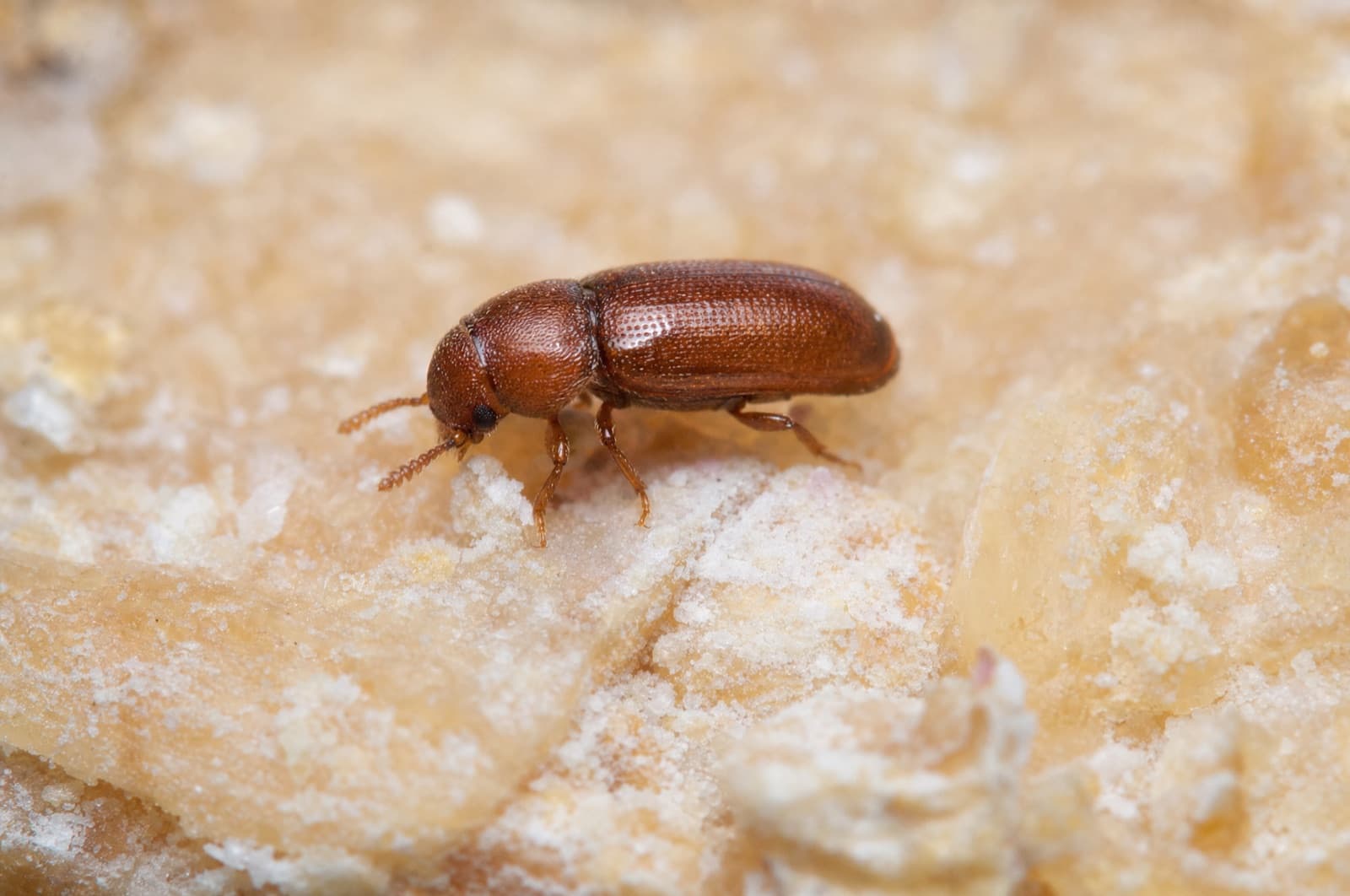
The cigarette beetle is a small, humpbacked, reddish-brown pantry pest that infests dried spices, herbs, pet food, cereal, and tobacco. It doesn't bite, sting, or harm your home — the problem is contaminated food. Find and discard the infested source package (start with red ground spices), clean the shelf, and store dry goods in airtight containers.
- Adult size
- ~2–3 mm (about 1/8 inch), oval, reddish-brown
- Penn State Extension; University of Florida IFAS
- Key ID vs. drugstore beetle
- Smooth wing covers + uniformly serrated (saw-like) antennae
- Penn State Extension
- Preferred foods
- Spices, dried herbs, tobacco, cereals, pet food, dried flowers
- Penn State Extension
- Life cycle
- ~30–100 eggs per female; egg-to-adult ~40–50 days in ideal conditions
- Oklahoma State University Extension
- Generations per year
- 1 generation in colder regions; 5–6 in warm regions
- Clemson HGIC
- Flight
- Strong flier, attracted to light
- University of Florida IFAS
The beetle in your spice rack — and how to find the one infested jar
If you're finding small reddish-brown beetles near your pantry, especially around spices and dried herbs, the cigarette beetle is the likely culprit. It's a humpbacked, seed-sized pantry pest that infests dried plant material — red ground spices, herbs, pet food, tobacco, and cereals — and it does not bite, sting, or damage your home.
The fix is not spraying. Extension services across the United States, including UNH Cooperative Extension, are clear: for pantry pests, remove and discard the infested source and store food airtight. Insecticides near food are ineffective and can contaminate your pantry.
The diagnostic edge this page provides is the spice-rack source-finder: cigarette beetles have a strong preference for red ground spices — paprika, chili powder, cayenne, curry — and long-stored dried herbs. Start your search there, then move to pet food and birdseed. A close look at suspect packages — pour contents onto a white plate under a bright light — reveals live larvae, cast skins, or fine frass that confirms the source.
Also useful: the smooth-wing-versus-serrated-antenna ID that separates this beetle from its near-twin, the drugstore beetle.
How to identify a cigarette beetle — and separate it from the drugstore beetle
The cigarette beetle is tiny, humpbacked, and reddish-brown. The humpbacked profile — head tucked down, thorax arched — is the quickest visual tell. To distinguish it from the nearly identical drugstore beetle, examine the wing covers and antennae under magnification: smooth wing covers plus uniformly serrated (saw-tooth) antennae = cigarette beetle. Grooved wing covers plus a three-segmented clubbed antenna = drugstore beetle.
Cigarette beetle
- Scientific name
- Lasioderma serricorne
- Family
- Ptinidae (formerly Anobiidae)
- Size
- ~2–3 mm (approximately 1/8 inch)
- Coloration
- Reddish-brown to yellowish-brown; fine hairs on wing covers
- Habitat
- Pantries, spice racks, pet food bags, tobacco, dried flower arrangements, museums
- Active season
- Year-round in heated NH homes
- Diet
- Spices, dried herbs, cereals, pet food, tobacco, dried flowers, book paste
- Reproduction
- ~30–100 eggs per female; egg-to-adult approximately 40–50 days under ideal conditions
- Lifespan
- Adults approximately 2–4 weeks
Pan-tropical origin; worldwide in heated structures; documented in NH kitchens (UNH Extension)
The tells — key ID features
- Humpbacked side profile — head tucked down, thorax arched — the quickest visual tell.
- Smooth, fine-haired wing covers with no lengthwise grooves.
- Uniformly serrated (saw-tooth) antennae along their entire length.
- Small oval reddish-brown body ~2–3 mm; may be mistaken for a tiny fly in flight.
- Often seen flying to windows and lights near the kitchen or pantry.
- C-shaped, hairy, creamy-white larvae inside infested packages.
Size, to scale
2–3 mm
About the size of a pinhead or a sesame seed
Drugstore beetle
How to tell — Nearly identical size but drugstore beetle has grooved (striated) wing covers and antennae ending in a distinct 3-segmented club; cigarette beetle has smooth wings and uniformly saw-like antennae.
Furniture beetle (woodborer)
How to tell — Similar family but bores into wood for breeding — not a pantry food pest.
Sawtoothed grain beetle
How to tell — Elongate and flat with six distinct thoracic 'teeth'; the cigarette beetle is humpbacked and oval, not flat with neck projections.
Signs of a problem
These signs narrow the source from 'somewhere in the pantry' to the specific infested container.
Tiny 'shot holes' in packaging of spices or pet food
What it means — Adults emerged from inside or chewed entry holes — the source is that package.
Small reddish beetles flying to windows or lights near the kitchen
What it means — Adults active nearby; an infested source is close — begin searching the spice rack.
Cast skins, fecal pellets, or pupal cases in dried herbs
What it means — Larval development inside confirmed; the infested package needs to be found and discarded.
Beetles inside long-stored red ground spices (paprika, chili, cayenne, curry)
What it means — Classic cigarette-beetle source — red spices sitting for months are the #1 starting point.
A cigar or cigarette that 'pops' when lit
What it means — A larva inside the tobacco — a quirky but real sign of cigarette-beetle activity.
Webbing-free clumping or fine dust in spice jars
What it means — Larval feeding debris — not webbing (that would be Indian meal moth); beetles have been active in this container.
The real risks, calibrated
The cigarette beetle is a food and property nuisance — not a health threat. The risks are to your pantry goods, not to you.
Food contamination
ModerateOnset: Ongoing while source package exists
Infested spices, herbs, and pet food contain live insects, cast skins, and frass and must be discarded.
Spread to neighboring packages
ModerateOnset: Within weeks of an unresolved source
Adults fly to adjacent packages; one infested jar can colonize an entire spice rack.
Museum and book damage
Low riskOnset: Over months in collection environments
Can damage dried botanical collections, insect collections, and book bindings — low risk in typical homes.
Rapid population buildup in warm pantries
ModerateOnset: Weeks to months
Heated NH pantries can support multiple generations per year, allowing populations to grow quickly.
Biting, stinging, or disease
Low riskOnset: N/A
None — the cigarette beetle does not bite, sting, or transmit disease and causes no structural damage.
DIY — what works, what backfires
The fix for a cigarette-beetle infestation is source removal and airtight storage — not spraying the pantry shelf.
What actually works
- Start your inspection with red ground spices — paprika, chili powder, cayenne, curry — and all long-stored dried herbs. Pour suspect contents onto a white plate under a bright light to check for live larvae, cast skins, or fine frass.
- Inspect and discard infested packages; seal them in a plastic bag and remove from the house immediately.
- Vacuum shelves, cracks, and crevices after removing all packages to clear remaining insects and debris.
- Store dry goods in airtight glass, metal, or hard rigid plastic containers — soft plastic and cardboard are inadequate barriers.
- Use pheromone traps to identify which area of the pantry the beetles are coming from; replace traps regularly.
- Refrigerate or freeze seldom-used spices — cold storage prevents development.
What backfires
- Don't spray insecticide on or near food, food surfaces, or pantry shelving — not recommended by extension services and risks contaminating food.
- Don't rely on pheromone traps alone to eliminate an infestation; they monitor and catch adults but don't touch larvae in the source.
- Don't keep questionable packages 'just to see' — any container with signs of beetles should be discarded promptly.
Cigarette beetles in New Hampshire pantries
UNH Cooperative Extension lists the cigarette beetle among the less common (but documented) pantry pests in New Hampshire kitchens. While outdoor populations cannot survive NH winters, heated homes allow year-round breeding — making an unresolved pantry source a multi-generation problem even in January. The UNH food-salvage standard applies: heat suspect food at 130°F for 30 minutes or freeze at 0°F for four days, then repackage in airtight jars. Refrigerating seldom-used spices is a simple NH-specific prevention step for the long winters when pantry goods sit unused for months.
Peak season
Year-round in heated homes; no NH outdoor population in winter
You might actually have
- Drugstore beetle (near-twin; smooth wing vs. grooved wing is the separator)
- Indian meal moth (moths and webbing, not small hard-bodied beetles)
We serve these communities
- NH-licensed applicator · #782664
- Same-day service
- Family-owned since 2017
Service Area Map
Southern New Hampshire
When to call a pro for cigarette beetles
If beetles persist for more than three weeks after you've cleaned the pantry and discarded all suspect packages, an undiscovered source remains — often in a less obvious location like dried decorative items, pet food stored in a secondary room, or food debris in cabinet cracks. A licensed technician can locate these hidden sources and treat cracks and crevices with appropriate products. Anchor Pest Services (NH #782664, F1) offers General Pest Control with a free quote and same-day service.
When to call a pro
- Beetles persist more than three weeks after you've discarded suspect food and cleaned the shelves.
- You're finding beetles but can't locate any infested source despite a thorough inspection.
- The infestation involves a museum, rare book collection, or dried botanical collection requiring specialized care.
- Beetles are appearing in a room adjacent to the pantry, suggesting spread to secondary storage areas.
Airtight containers for all spices and dried goods
Transfer spices, dried herbs, and grain products from their original packaging to airtight glass or metal jars. This is the single most effective prevention step.
Buy small quantities and rotate stock
Keep 2–4 months of spices on hand; discard outdated goods. Red ground spices sitting for a year are a primary risk.
Store pet food and birdseed away from the pantry
Pet food bags and birdseed kept in pantries or mudrooms are frequent unnoticed sources. Store in sealed hard containers in a separate area.
Not sure it's a cigarette beetle?
A licensed NH technician can confirm the species and tell you honestly whether it's a DIY fix or a job for a pro — free inspection, same-day service across Southern New Hampshire.
Frequently asked questions
Sources(8)
- [1]Penn State Extension — Cigarette Beetle
size, smooth wings/serrated antennae ID, major food hosts
extensionverified 2026-06-30 - [2]University of Florida IFAS — Cigarette Beetle (IN153)
size, flight behavior, light attraction
extensionverified 2026-06-30 - [3]
- [4]Oklahoma State University Extension — Drugstore and Cigarette Beetles
egg count, life cycle 40–50 days
extensionverified 2026-06-30 - [5]Clemson HGIC — Cigarette Beetles
generations per year (1 cold / 5–6 warm)
extensionverified 2026-06-30 - [6]Purdue Extension — E-239 Stored-Product Insects
pantry pest biology overview
extensionverified 2026-06-30 - [7]UNH Cooperative Extension — Kitchen Pests Fact Sheet
NH pantry pest list, salvage standard (130°F/30 min or 0°F/4 days)
extensionverified 2026-06-30 - [8]
Written & reviewed by
VerifiedDaniel Brady
NH-Licensed Pesticide Applicator · License #782664 (NHDAMF, RSA 430)
Daniel Brady is the New Hampshire–licensed applicator behind Anchor Pest Services, a family-owned pest control company serving the Manchester area since 2017.
Last updated 2026-06-30

New Hampshire pest control
Dealing with cigarette beetles in your home?
Anchor Pest Services identifies and handles cigarette beetle problems across southern and central New Hampshire. Family-owned since 2017, NH license #782664.
- NH-licensed applicators (#782664)
- Same-day service · free inspection
- Family-owned since 2017
Your next step
- What to do next
How to Get Rid of Cigarette Beetles
Read the answer - What to do next
What Attracts Cigarette Beetles to Your House?
Read the answer - What to do next
How to Get Rid of Drugstore Beetles
Read the answer - Related guide
Drugstore Beetles in New Hampshire: Signs, Hidden Sources & Control
Read the answer - Related guide
Spider Beetles in New Hampshire: Not a Spider — Here's the Real ID
Read the answer