
What Attracts Cigarette Beetles to Your House?
At a glance
- Short answer: Cigarette beetles aren't lured in by your pantry. They almost always arrive already inside a dried product you bought.
- The verdict: You didn't attract it — you carried it in
The attractant verdict
Four possible answers to why this species turned up. Three stay unlit — and that's the argument: the honest answer could have been any of them, and for this species it wasn't.
Cigarette beetles aren't lured in by your pantry. They almost always arrive already inside a dried product you bought.
Our own previous page said cigarette beetles are "drawn to homes primarily because they are searching for food sources, particularly dried plant materials," phrasing that makes it sound like the beetle went looking for your pantry specifically.
A dried product — most often spices, tobacco, dried flowers, or pet food — that already contained eggs or larvae when it was purchased, typically contaminated during milling, processing, or storage before it ever reached your home.
“Cigarette beetles don't go looking for your pantry. The infested product usually gets there first, and the beetle is already inside it.”
Why it's here, in full
The product usually arrives infested
Extension entomology is consistent on this point: cigarette beetle infestations "usually begin when infested dry goods are brought into the home," with the problem often starting before purchase, when eggs or larvae are already present from a warehouse, mill, or retail stockroom. UF/IFAS documents the beetle's extraordinarily broad diet — dried tobacco, spices, dried flowers, cereal, pet food, and dozens of other stored goods — which is exactly why a contaminated product can slip past a store's own inspection and end up on a home shelf undetected.
Our old page's "searching for food sources" framing skips past that entirely and implies the beetle is scouting kitchens. It isn't; the food source already had the beetle's eggs in it when it was purchased.
The honest secondary route: it can fly, and it likes light
Unlike some stored-product pests, cigarette beetles can fly and are drawn to light, so a real — if secondary — pathway exists for adults to enter from outside or move between rooms and units once established somewhere nearby. That's worth naming rather than flattening away, because a reader who's seen a beetle near a window shouldn't be told it's impossible. But extension guidance is clear that the anchoring, larger-scale infestation almost always traces back to a specific contaminated product, not to beetles independently finding their way to a pantry from outdoors. The practical distinction: check the product, not the house.
How to tell it's actually this species
Real signs only — a species with four honest tells gets four, and stops. Where a sign is weak on its own, we say so.
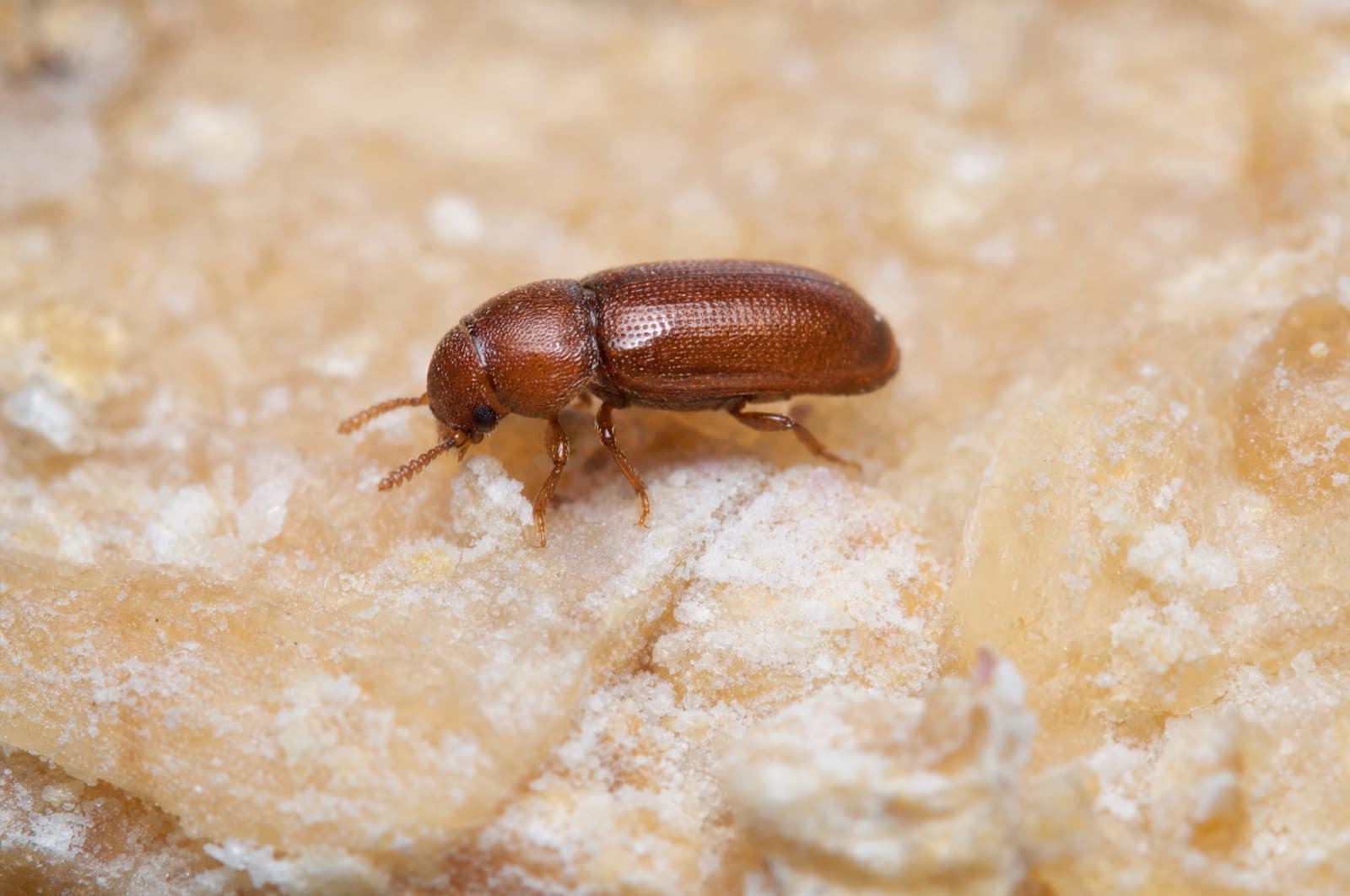
Small reddish-brown beetles, roughly the size of a match head, found in or near dried spices, tobacco, or pet food
Fine, powdery debris (frass) inside a package of dried goods, sometimes with small round exit holes
An unusual musty or altered odor coming from a container of stored spices, dried flowers, or tobacco
Could be something else: Odor changes can also come from ordinary product staleness; it's suggestive, not definitive, on its own.
Adult beetles found near a window or light fixture, consistent with this species' ability to fly toward light
Could be something else: A beetle at a window may simply be moving toward light rather than confirming an active infestation nearby.
Want cigarette beetles gone?
This page only answers why it's here. Every removal step for this exact species — what to seal, what to set, what actually works — lives on its own dedicated guide.
Two questions, two pages
Here: why it turned up at all — the honest answer, blame removed.
There: the step-by-step removal guide for this exact species.
Key takeaways
- Cigarette beetles don't go looking for your pantry. The infested product usually gets there first, and the beetle is already inside it.
- Cleanliness isn't the deciding factor here — the actual vector is what matters.
- What actually matters: food.
- If it's already inside, removal is a different question — see /top-diy-methods/cigarette-beetle.
Found cigarette beetles in stored goods?
This page is about why they showed up. Locating the infested product and removal steps are covered at /top-diy-methods/cigarette-beetle.
Frequently asked
Sources(2)
- [1]UF/IFAS Entomology — Cigarette Beetle, Lasioderma serricorne (EENY-227)
Cigarette beetle's broad diet of dried goods and its ability to fly and be attracted to light
extensionverified 2026-07-17 - [2]Iowa State University Extension — Cigarette and Drugstore Beetles
Infestations typically beginning with an already-infested dried product brought into the home
extensionverified 2026-07-17
Written & reviewed by
VerifiedDaniel Brady
NH-Licensed Pesticide Applicator · License #782664 (NHDAMF, RSA 430)
Daniel Brady is the New Hampshire–licensed applicator behind Anchor Pest Services, a family-owned pest control company serving the Manchester area since 2017.
Last updated Jul 2026
The product usually arrives infested
Dealing with cigarette beetles in your pantry?
Same-day inspections across southern and central New Hampshire — we'll help you find the source product, not just the beetles.
- Family-owned in Manchester since 2017
- NH commercial applicator #782664, category F1
- We will tell you when the answer is do nothing
NH License #782664 · No obligation · We answer in person
Your next step
- What to do next
Cigarette Beetles in New Hampshire: Spices, Signs & Control
Read the answer - Also relevant
How to Get Rid of Cigarette Beetles
Read the answer - Also relevant
Where Do Beetles Go In The Winter?
Read the answer - Related guide
What Attracts Spider Beetles to Your House?
Read the answer - Also relevant
Chemical Pantry Beetle Control: Why You Shouldn't Spray
Read the answer