
Why Are My Leaves Covered in Webs?
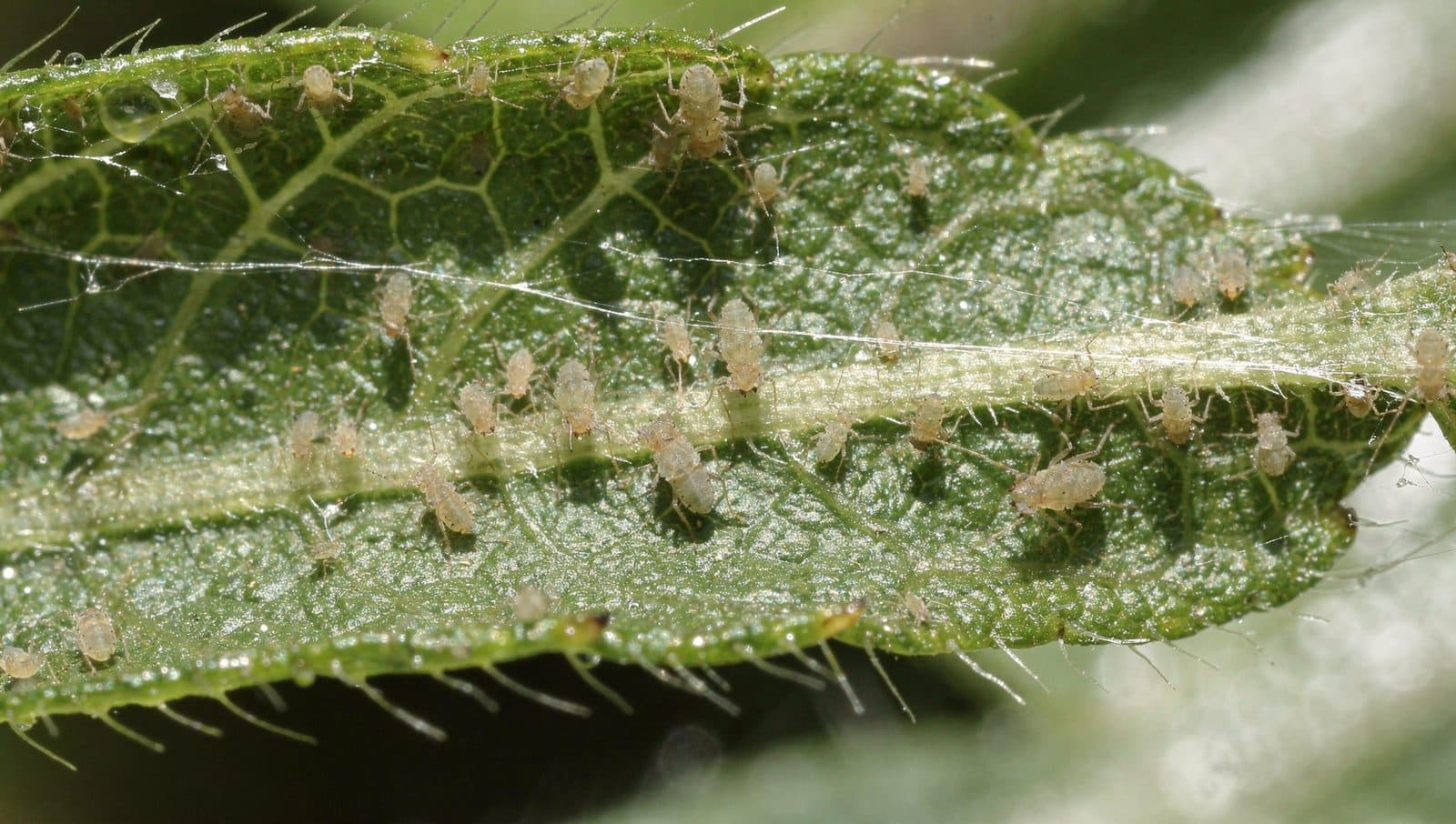
Fine webbing on leaves paired with yellow-white stippling is the spider mite signature — tiny arachnids, not insects, that thrive in hot, dry weather.
At a glance
- The verdict: Likely a pest — spider mites
- Who fixes it: You
- Category: Leaf-Pest ID & Environmental Factors
The short answer
Fine, silky webbing on leaf undersides and between stems, paired with tiny yellow-white speckling called stippling, is the signature of spider mites — tiny arachnids, not insects, that thrive in hot, dry conditions. The classic confirmation test: hold a sheet of white paper under a branch, tap it firmly, and watch for moving specks. If the web is a large geometric orb with a spider sitting in it, that's a beneficial garden spider, not a pest; if it's a dense silk tent packed with caterpillars and frass, that's tent caterpillars or fall webworm instead.
Who's the likely culprit?
The sign: fine or silky webbing on leaves, stems, or between branches
- Spider mitesTop suspect
Fine, powdery, non-geometric webbing on leaf undersides paired with stippling on top. Naturalenemies.com's field guidance states plainly: "Fine webbing on plant leaves is most commonly caused by spider mites." Purdue Extension notes mite populations favor heat — at a daily high-low of 95°F/75°F, mite numbers can double in half the time it takes at 75°F/55°F. Tap a branch over white paper; moving specks confirm the ID.
- Garden or orb-weaver spidersLook-alike
A large, geometric web spanning open space between branches, usually with a visible spider sitting in it. These are beneficial predators, not a plant pest, and the simplest tell is the easiest: look for the spider — mite webbing never has one you can see.
- Tent caterpillars or fall webwormLook-alike
A dense, opaque silk tent built at a branch tip or fork, containing visible caterpillars and dark frass droppings inside. This is a chewing-insect problem, not a mite problem, and needs a different response entirely.
- Mealybug waxLook-alike
Cottony or waxy white material at leaf joints that can superficially resemble webbing up close, but it's a waxy secretion rather than true silk strands, and the insect producing it sits still rather than moving across a web.
Who actually fixes this?
Start here
You
A firm hose-off followed by insecticidal soap or horticultural oil on leaf undersides handles the large majority of spider mite outbreaks without any professional involvement.
- Garden center — You need a registered insecticidal soap or horticultural oil labeled for mites.
- UNH Extension — You're not sure whether it's mite webbing, a beneficial spider's web, or tent caterpillars — UNH Extension's Insect & Arthropod ID service will confirm it.
- Certified arborist — The webbing is on a large tree rather than a garden plant or small shrub you can reach and treat.
The details, straight
The paper-tap test that confirms it
Because spider mites are barely visible to the naked eye, the practical confirmation isn't spotting the mite itself — it's the tap test. Hold a plain sheet of white paper flat under a webbed, stippled branch and tap it sharply a few times. Spider mites dislodge and land on the paper as tiny moving specks, sometimes leaving a faint reddish or greenish smear if you drag a finger across them. This takes under a minute and is more reliable than trying to eyeball a mite directly on the leaf.
Why hot, dry weather is the mite trigger
Spider mites are a heat-and-drought pest, not a rain-and-humidity one — the opposite of most fungal leaf problems. Purdue Extension's data shows mite reproduction accelerating sharply as temperatures climb: at a daily high-low of 95°F/75°F, populations can double in half the time it takes at a cooler 75°F/55°F. That's why a hot, dry stretch in a New Hampshire summer, especially on plants in full southern exposure, is exactly when a mild mite presence can explode into visible webbing within a week or two.
Ruling out the two most common look-alikes
Before treating for mites, rule out the two things people most often confuse with mite webbing. A geometric, spoke-and-spiral orb web spanning open air between branches, especially with a spider visibly sitting in it, is a beneficial garden spider doing you a favor by eating other insects — leave it alone. A dense, opaque silk tent wrapped around a branch tip, packed with visible caterpillars and dark pellet-like frass, is tent caterpillars or fall webworm, a chewing-insect problem that calls for a completely different response than a mite treatment would.
Key takeaways
- Fine, non-geometric webbing plus yellow-white stippling is the spider mite signature.
- Confirm with the white-paper tap test — moving specks mean mites are present.
- Hot, dry weather accelerates mite populations dramatically; mite numbers can double in half the time in a heat wave versus mild weather.
- A geometric web with a visible spider is a beneficial predator, not a pest.
- A dense silk tent full of caterpillars is tent caterpillars or webworm — a different problem entirely.
Not sure it's mites?
A geometric web with a spider, or a silk tent full of caterpillars, needs a completely different response than spider mites do.
See the full culprit IDSpider mites in a New Hampshire summer
Spider mites peak in hot, dry weather, so in New Hampshire outdoor flare-ups cluster into the warm stretch of the short growing season (roughly mid-May to late September), while indoors they can persist year-round on houseplants overwintered through the long heating season. UNH Cooperative Extension's Insect & Arthropod ID service can confirm mites versus a true insect if the fine webbing and stippling leave you unsure, since the treatment differs. Either way this is a plant-care issue — the mites live on your foliage, not in your home — so Anchor handles the structural and yard pests around the house and routes the plant side to UNH Extension or a garden center.
NH-licensed applicator #782664 (NHDAMF, RSA 430) · NEPMA member · family-owned since 2017.
Related questions
Sources(4)
- [1]University of Minnesota Extension — Spider Mites
Spider mite biology, webbing, and stippling identification
extensionverified 2026-07-14 - [2]University of Maryland Extension — Mites in Home Gardens
Fine webbing on undersides and stippling on top as the spider mite tell
extensionverified 2026-07-14 - [3]Purdue University Extension — Spider Mites (E-42)
Mite population growth rate accelerating with heat
extensionverified 2026-07-14 - [4]UNH Cooperative Extension — Insect & Arthropod Identification
Free NH ID service to confirm mite vs. spider vs. caterpillar webbing
extensionverified 2026-07-14
Written & reviewed by
VerifiedDaniel Brady
NH-Licensed Pesticide Applicator · License #782664 (NHDAMF, RSA 430)
Daniel Brady is the New Hampshire–licensed applicator behind Anchor Pest Services, a family-owned pest control company serving the Manchester area since 2017.
Last updated 2026-07-14
Your next question
Honest pest help for New Hampshire homes
Spider Mites Are Plant Care — But Your Home Is Our Job
Webbing on your leaves is a garden-pest question, and we'll always say so. Where Anchor Pest Services genuinely helps is the pests around your home — rodents, ants, ticks, and moisture pests drawn to yard debris and foundation clutter. Family-owned since 2017, NH license #782664, serving Manchester, Nashua, Concord and nearby towns.
- We tell you spider mites live on the plant, not in your home
- NH-licensed applicators (#782664) — same-day help, quote at no charge
- Rodent, ant, tick, and moisture-pest control across southern and central NH
NH License #782664 · No obligation · We answer in person
Your next step
- Next step
Do spiders cause property damage?
Read the answer - What to do next
Mechanical Spider Control: Web Removal That Actually Works
Read the answer - What to do next
How to Get Rid of Common Garden Spiders
Read the answer - Also relevant
House Spider in New Hampshire: ID, Webs & Control
Read the answer - Related guide
Should I Use Insecticidal Soap on Leaves?
Read the answer