
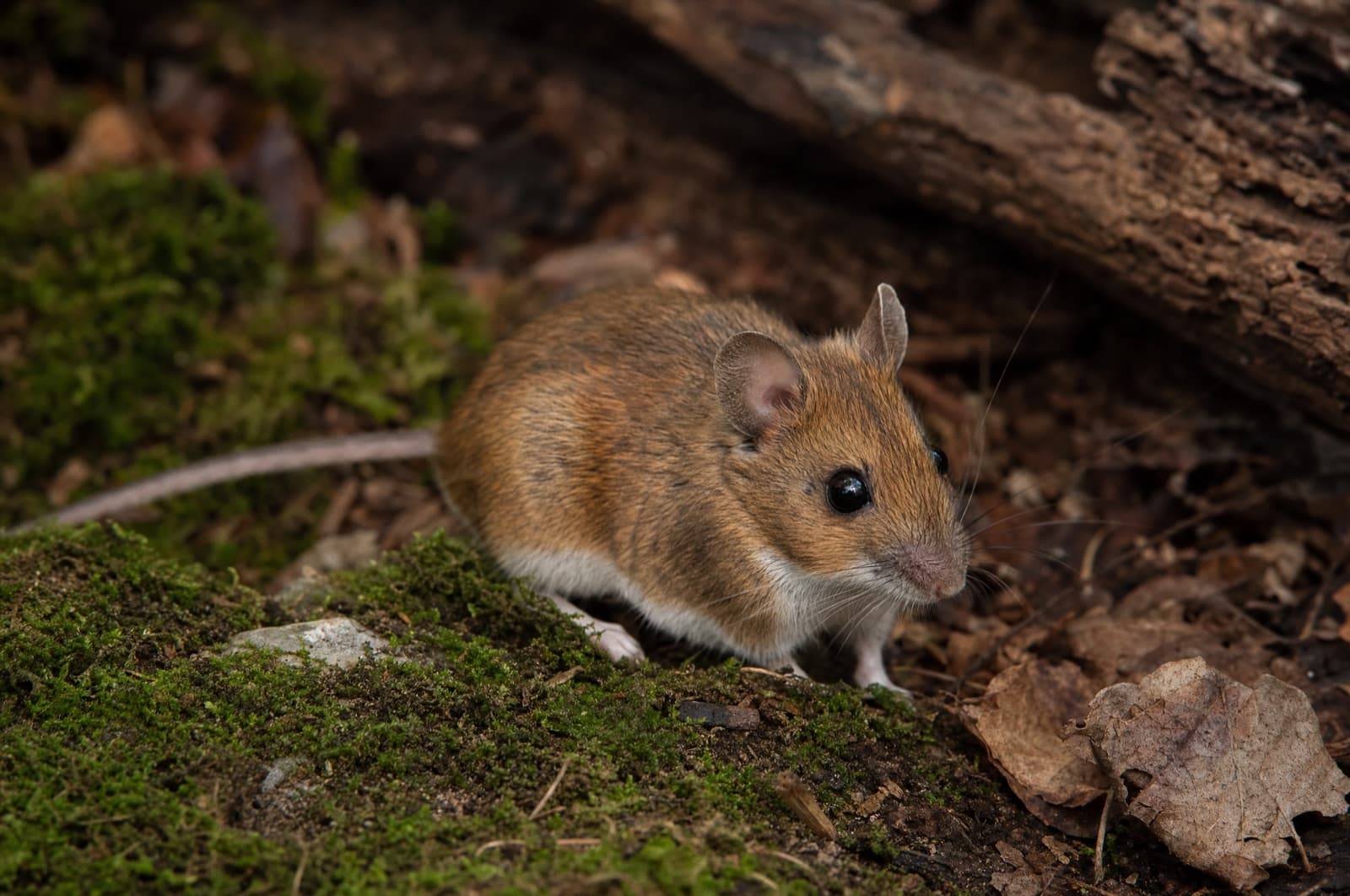
White-Footed Mouse — NH's Key Lyme Disease Reservoir
The white-footed mouse (Peromyscus leucopus) is a native woodland mouse and the single most important reservoir of Lyme disease (Borrelia burgdorferi) in New Hampshire — a state with one of the highest Lyme incidences in the country. It is nearly identical to the deer mouse and can also carry hantavirus. Controlling mice and tick habitat together around the home reduces the local pool of infected ticks.
- Best tell
- Tail shorter and less sharply bicolor than the deer mouse
- Animal Diversity Web / Montana Field Guide
- Total length
- 145–205 mm total; tail 62–97 mm; 16–29 g (NE U.S.)
- Animal Diversity Web
- Lyme role
- Major NH Lyme disease reservoir host
- UNH Cooperative Extension
- NH tick infection
- ~60% of NH adult blacklegged ticks carry Lyme bacterium
- UNH Extension / NH DHHS 2007–2010 sampling
- Also carries
- Hantavirus; anaplasmosis; babesiosis; Powassan virus
- PMC / CDC
- NH presence
- Native; common statewide in wooded and edge habitat
- UNH Cooperative Extension
NH's most important Lyme disease reservoir — and how to reduce your risk
The white-footed mouse (Peromyscus leucopus) is a native woodland mouse and the single most important reservoir of the Lyme disease bacterium (Borrelia burgdorferi) in New Hampshire. UNH Cooperative Extension states it plainly in their tick management guide: 'The white-footed mouse is the major reservoir host for Lyme disease in New Hampshire.'
Why this mouse matters more than deer: it is a widespread misconception that deer spread Lyme disease. Deer feed adult ticks, but the white-footed mouse is where immature (larval and nymphal) blacklegged ticks acquire the Lyme bacterium — and those infected nymphs are the primary source of human disease. Statewide, UNH Extension and NH DHHS data show that nearly 60% of NH adult blacklegged ticks carry B. burgdorferi, with the heaviest burden in Rockingham, Hillsborough, and Strafford Counties — squarely within Anchor's service area.
The white-footed mouse also carries hantavirus (the same wet-cleanup protocol applies to its droppings), anaplasmosis, babesiosis, and Powassan virus — making it the most disease-relevant small mammal in southern NH. Controlling this mouse, managing tick habitat on the property, and the link between the two is what this page is about.
How to identify a white-footed mouse — and separate it from the deer mouse
The white-footed mouse is one of the most commonly misidentified small mammals in New Hampshire because it is nearly identical to the deer mouse. The most reliable separator is the tail: the white-footed mouse has a shorter tail that is only indistinctly bicolor, while the deer mouse has a longer, sharply bicolor (dark above, white below) tail. Both have white bellies and feet, large eyes, and large ears.
White-footed mouse
- Scientific name
- Peromyscus leucopus
- Family
- Cricetidae
- Size
- 145–205 mm total; tail 62–97 mm (shorter than head+body); 16–29 g in NE U.S.
- Coloration
- Light to reddish-brown above; white belly and feet; tail indistinctly bicolor (vs. deer mouse's sharp two-tone)
- Habitat
- Warm dry forests, brushland, suburban edges, stone walls, woodpiles, outbuildings
- Active season
- Year-round; enters structures in fall
- Diet
- Seeds, nuts, insects; more omnivorous than most field mice
- Reproduction
- 2–4 litters per year of 2–9 young; average lifespan 12–24 months in northern climates
- Lifespan
- 12–24 months in northern climates
Native across eastern and central North America; common and expanding northward in NH
The tells — key ID features
- White belly and feet with a brown to reddish-brown back — shared with the deer mouse.
- Tail shorter than head+body and only indistinctly bicolor — the key separator from the deer mouse.
- Large eyes and ears; delicate, pointed nose.
- No musky ammonia odor (vs. house mouse, which has a pronounced smell).
- Found in wooded/edge habitats and suburban yards near stone walls and woodpiles in NH.
Size, to scale
145–205 mm total; tail 62–97 mm; 16–29 g
Body about the length of a AA battery; the tail is a bit shorter than the body.
Deer mouse
How to tell — Longer tail that is sharply bicolor (dark above, crisp white below); the deer mouse tail is more distinctly two-toned and often longer relative to the body. Both are disease-relevant.
House mouse
How to tell — Uniform gray-brown coat with no white belly or feet; hairy (not bicolor) tail; musky ammonia odor; does NOT carry hantavirus or Lyme.
Signs of a problem
White-footed mouse activity often overlaps with deer mouse signs. The outdoor sign — activity along stone walls and woodpiles near the home — is the most important indicator of local tick infection risk.
Rice-grain droppings in sheds, outbuildings, or wall voids
What it means — Active feeding; use the CDC wet-cleanup protocol — hantavirus is possible with this species.
Seed and nut caches in drawers, equipment bays, or wall cavities
What it means — Established nest nearby; the mouse has staked territory in the structure.
Activity observed along stone walls, woodpiles, or leaf-litter edges
What it means — Prime mouse-tick habitat — this mouse-tick interface near the home is where infected ticks are most concentrated.
Nests of plant fibers and insulation in outbuildings or crawl spaces
What it means — Breeding site established in or near the structure.
The real risks, calibrated
The white-footed mouse is NH's most disease-relevant small mammal. The tick link is the primary risk for most southern NH homeowners.
Lyme disease reservoir
HighOnset: Seasonal peak May–mid-July (nymph-stage ticks are most active)
The white-footed mouse infects larval and nymphal blacklegged ticks with B. burgdorferi, creating the local pool of infected ticks that bite people. Controlling mice and tick habitat together is the most effective landscape intervention.
Hantavirus Pulmonary Syndrome (HPS)
SevereOnset: 1–8 weeks post-exposure via aerosolized droppings
Potentially fatal respiratory disease. Apply the same wet-cleanup protocol as for deer mouse droppings — ventilate, wet with bleach solution, N95, wipe with gloves. Route illness concerns to a doctor and NH DHHS.
Anaplasmosis and babesiosis reservoir
ModerateOnset: Seasonal
The white-footed mouse is a confirmed reservoir for at least five tickborne human pathogens including anaplasmosis and babesiosis — both reported in NH. PMC research documents its reservoir role for multiple co-infecting pathogens.
DIY — what works, what backfires
Two parallel workstreams address white-footed mouse risk: mouse exclusion and tick habitat management around the home.
What actually works
- Reduce tick habitat: keep stone walls, leaf litter, and woodpiles away from the immediate home perimeter — these are the zones where mouse-tick contact is highest.
- Seal entry gaps (¼ inch or larger) to prevent mice from nesting in the structure.
- Apply the CDC wet-cleanup protocol for any droppings found — ventilate, wet with bleach solution, N95, wipe with disposable gloves.
- Set snap traps along walls in outbuildings and garages in fall when mice move in.
- Create a 3-foot woodchip or gravel buffer between lawn and wooded/stone-wall areas — this reduces tick nymph movement toward the home.
What backfires
- Don't sweep or vacuum dry droppings — same hantavirus risk as for deer mouse droppings.
- Don't assume deer are the Lyme reservoir — the white-footed mouse infects ticks; deer mainly carry adult ticks and do not infect them with B. burgdorferi.
- Don't ignore the mouse-tick connection when planning home tick management — mouse control and tick spraying are most effective when combined.
- Don't route disease concerns through this page — any illness following tick bite or rodent exposure should be addressed by a doctor and NH DHHS.
White-footed mice in New Hampshire — the Lyme connection
The white-footed mouse thrives in the wooded and edge habitats that dominate southern and central NH — along stone walls, woodpiles, brushy field edges, and the fieldstone foundations common in older NH homes. NH DHHS and UNH Extension data confirm that Rockingham, Hillsborough, and Strafford Counties — squarely within Anchor's service area — account for the majority of NH Lyme disease cases. Nearly 60% of adult blacklegged ticks in NH were found to carry B. burgdorferi in 2007–2010 DHHS sampling, with prevalence remaining close to 60% in 2013–2014 follow-up data. This is not a remote-woods problem; white-footed mice live in suburban yards anywhere stone walls, woodpiles, or leaf-litter edge habitat is present.
Peak season
Year-round; fall invasion of structures tied to NH frost window
You might actually have
- Deer mouse (near-identical; longer, more sharply bicolor tail; primary U.S. hantavirus carrier)
- House mouse (uniform gray, musky odor, hairy tail — does NOT carry hantavirus or Lyme)
We serve these communities
- NH-licensed applicator · #782664
- Same-day service
- Family-owned since 2017
Service Area Map
Southern New Hampshire
When to call Anchor for mouse and tick management
For properties with recurring white-footed mouse pressure and high tick exposure, an integrated rodent-control and tick-management approach is more effective than either program alone. Anchor's Rodent Control technicians work in concert with tick management to address the mouse-tick interface.
When to call a pro
- Recurring mouse activity in outbuildings or the home near wooded or stone-wall habitat.
- High tick exposure on a property with documented white-footed mouse activity.
- Large droppings accumulations in enclosed crawl spaces or outbuildings where DIY cleanup carries the highest exposure risk.
Landscape tick-habitat management
Keep the 9 feet closest to the home clear of leaf litter, stone wall gaps, and dense ground cover — the tick nymph hot zones around stone walls and woodpile edges are where white-footed mouse activity is highest.
Structural exclusion
Seal gaps ¼ inch and larger in outbuildings, sheds, and foundation openings before the NH fall frost push to prevent fall invasion.
Woodpile and debris management
Stack firewood 20+ feet from the home on raised platforms; remove debris and brush piles that give mice shelter close to entry points.
Not sure it's a white-footed mouse?
A licensed NH technician can confirm the species and tell you honestly whether it's a DIY fix or a job for a pro — free inspection, same-day service across Southern New Hampshire.
Frequently asked questions
Sources(6)
- [1]
- [2]Animal Diversity Web — Peromyscus leucopus
total length, tail length, weight, NE U.S. size range
academicverified 2026-06-30 - [3]BioKIDS — Peromyscus leucopus
reproduction: 2–4 litters; 2–9 young; lifespan 12–24 months in northern climates
academicverified 2026-06-30 - [4]UNH Cooperative Extension — Biology and Management of Ticks in New Hampshire
white-footed mouse as major NH Lyme reservoir; ~60% tick infection rate; NH Lyme case distribution by county
extensionverified 2026-06-30 - [5]PMC — Tickborne Pathogen Reservoir Review
reservoir for Lyme, anaplasmosis, babesiosis, Powassan — five tickborne human pathogens
academicverified 2026-06-30 - [6]CDC — Lyme Disease
NH as high-incidence Lyme state; tick infection reservoir biology
govverified 2026-06-30
Written & reviewed by
VerifiedDaniel Brady
NH-Licensed Pesticide Applicator · License #782664 (NHDAMF, RSA 430)
Daniel Brady is the New Hampshire–licensed applicator behind Anchor Pest Services, a family-owned pest control company serving the Manchester area since 2017.
Last updated 2026-06-30

New Hampshire pest control
Dealing with white-footed mouses in your home?
Anchor Pest Services identifies and handles white-footed mouse problems across southern and central New Hampshire. Family-owned since 2017, NH license #782664.
- NH-licensed applicators (#782664)
- Same-day service · free inspection
- Family-owned since 2017
Your next step
- Book a NH pro
Rodent Control in New Hampshire
Mice and rats move indoors every fall. We trap, seal entry points and keep them out.
Book now - Next step
What Cleaning Products Kill Rodent Bacteria and Viruses?
Read the answer - What to do next
How to Get Rid of Deer Mice
Read the answer - What to do next
How to Get Rid of Field Mice
Read the answer - Related guide
Deer Mouse in New Hampshire — Hantavirus & Safe Cleanup
Read the answer - Related guide
House Mouse in New Hampshire — ID, Signs & Control
Read the answer