
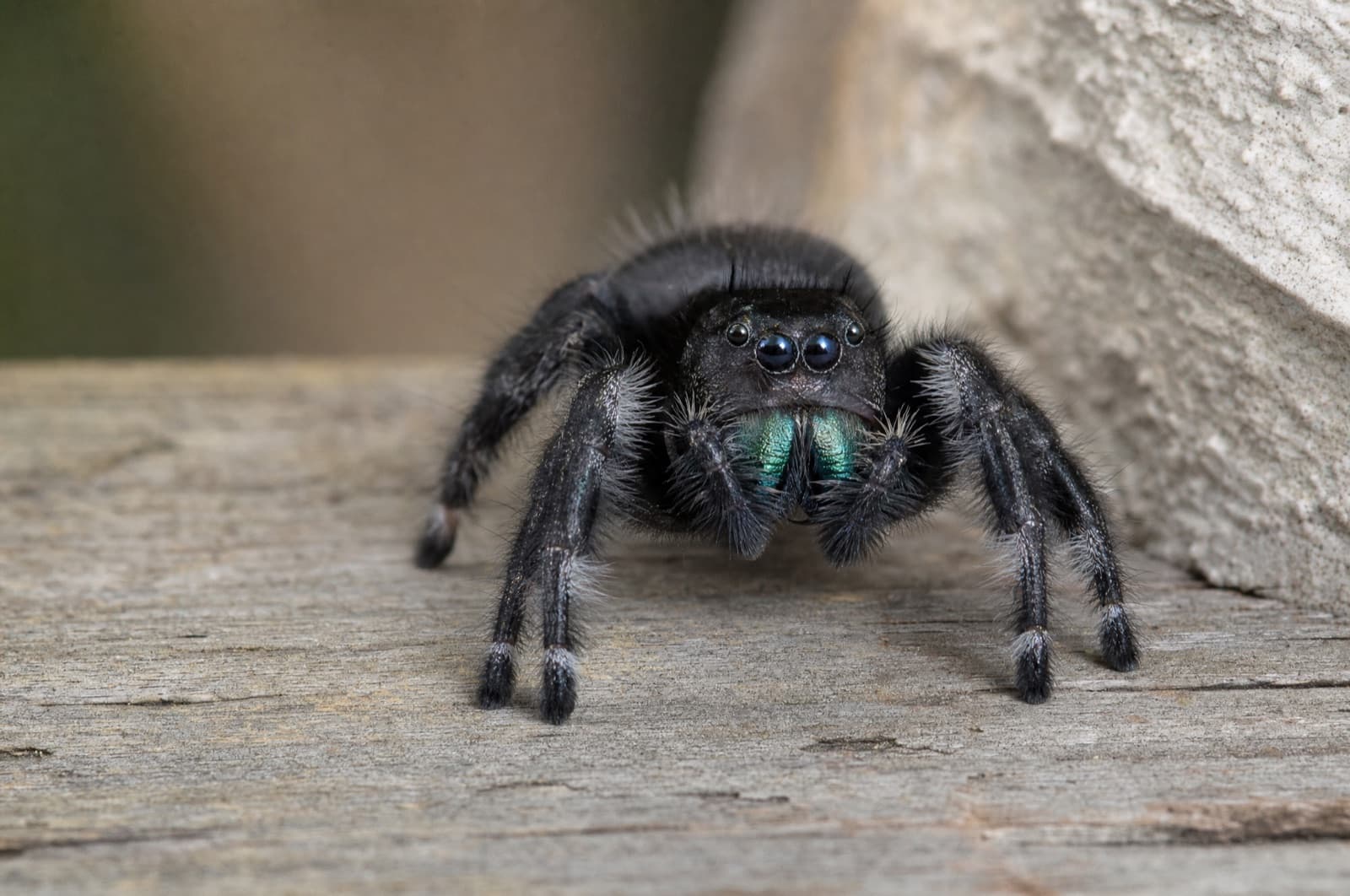
Jumping Spider in NH: ID, Bite Risk & State Spider
Also called Daring jumping spider · White-spotted jumper · Bold jumper
The bold jumping spider (Phidippus audax) is New Hampshire's official state spider since June 11, 2021 — a fuzzy, compact, iridescent-fanged hunter that stalks prey by sight instead of building a capture web. Despite its habit of facing you directly with large forward-facing eyes, it is harmless; bites to humans are rare and not dangerous. It is one of the most beneficial spider species in the state and earned its official designation through a campaign by a Hollis, NH elementary school class.
- NH designation
- Official state spider (June 11, 2021)
- NH General Court — HB 318 (2021)
- Body size
- Female 8–19 mm; male 6–13 mm
- Penn State Extension
- Signature feature
- Iridescent green chelicerae (fangs)
- Animal Diversity Web — Phidippus audax
- Bite risk
- Rare; not dangerous
- Animal Diversity Web
- Web?
- None — active hunter (silk dragline only)
- Penn State Extension
- Vision
- Best of any spider species
- Animal Diversity Web — Phidippus audax
New Hampshire's official state spider — fuzzy, curious, and completely harmless
If a small, compact, fuzzy black spider has frozen in place and turned its enormous front eyes directly toward you, you are being observed by New Hampshire's official state spider: the bold jumping spider (Phidippus audax). Despite looking as though it is about to do something alarming, it is entirely harmless. Bites to humans are rare and, at worst, produce minor local irritation. The spider's apparent boldness is curiosity, not aggression — it has the best vision of any spider species, and it is genuinely watching you.
Phidippus audax earned its official NH designation on June 11, 2021, when Governor Chris Sununu signed HB 318, a bill championed by a third-grade class from Hollis, New Hampshire. The state spider title made national news and introduced many NH residents to a spider that had been hunting insects on their windowsills and fence posts all along.
Unlike most spiders, bold jumping spiders do not build a capture web. They actively stalk prey with their extraordinary vision, pouncing with a silk safety dragline attached, then retreat to a small silk sac under a windowsill or piece of bark to rest and molt. That combination — no web, active daytime hunter, striking appearance — makes them unlike any other common NH spider.
How to identify the bold jumping spider
Phidippus audax is one of the most distinctive spiders in New Hampshire: the large forward-facing eyes, iridescent green fangs (chelicerae), compact fuzzy black body, and white or orange abdominal spots together form a combination that no other common NH spider matches. The habit of turning to face and track your movement is also unique.
Bold jumping spider
- Scientific name
- Phidippus audax
- Family
- Salticidae
- Size
- Female 8–19 mm; male 6–13 mm
- Coloration
- Compact black body densely covered in iridescent hairs; large white or orange triangular spot on abdomen; two smaller white spots flanking it. Iridescent green chelicerae (fangs) visible at close range.
- Habitat
- Sunny exterior walls, window frames, fences, decks, gardens, and forest edges; also ventures indoors, especially in fall.
- Active season
- Spring through fall outdoors; adults may overwinter in sheltered silk retreats or indoors.
- Diet
- Wide variety of insects and other spiders — flies, moths, beetles, crickets, and prey up to three times the spider's body length.
- Reproduction
- Female builds a silk egg sac in a hidden retreat (under bark, siding, or a rock); guards eggs until hatching.
- Lifespan
- Approximately one year; some females live longer.
Common throughout the eastern and central United States including all of New Hampshire; designated NH state spider June 11, 2021 (HB 318).
The tells — key ID features
- Four large forward-facing eyes dominating the face — the single most distinctive feature; the principal pair are the largest eyes of any spider relative to body size.
- Iridescent green chelicerae (fangs) that flash in sunlight — unmistakable at close range.
- Compact, densely fuzzy black body with a large white or orange triangular spot on the abdomen.
- Jerky, deliberate movements with the habit of turning to face and track any nearby observer.
- No capture web — hunts actively by stalking prey, pouncing with a silk dragline safety line.
- Small silk retreat (not a capture web) tucked under a windowsill, piece of bark, or siding for resting and molting.
Size, to scale
Female 8–19 mm; male 6–13 mm
Body about the size of a pencil eraser (average female); looks larger than it is because it faces you directly
Regal jumping spider (Phidippus regius)
How to tell — Larger, more oval white spots, southern range — rare to absent in NH; same family and equally harmless.
Zebra jumping spider (Salticus scenicus)
How to tell — Much smaller, black-and-white striped pattern, no green fangs; same active-hunter behavior, same family, also harmless.
Wolf spider (Lycosidae)
How to tell — Larger and ground-running; does not jump or turn to face you; eye pattern is very different (two large eyes on top of head, not forward-facing).
Signs of a problem
The bold jumping spider is easy to spot once you know the behavior. These are the signs that confirm you have Phidippus audax — and that you have a beneficial free hunter on the premises.
Small spider 'watching' you from a sunny windowsill, fence rail, or siding
What it means — The bold jumper's habit of tracking movement with its principal eyes is unique among NH spiders — this behavior is curiosity, not aggression.
Spider executing precise jumps with a fine silk thread trailing behind
What it means — The dragline is a safety line the spider attaches before every jump; this is the signature hunting behavior of all jumping spiders.
Compact black spider with a white or orange triangular spot and green-flashing fangs
What it means — Almost certainly Phidippus audax — no other common NH spider combines these features.
Small dense silk sac tucked under a windowsill, door frame, or piece of loose siding
What it means — Resting or molting retreat — not a capture web; the spider is using this as a safe shelter between hunts.
Spider entering the home in fall through window gaps or door frames
What it means — Bold jumpers seek sheltered overwintering spots; sealing window and door gaps prevents entry.
The real risks, calibrated
The bold jumping spider is harmless to people and pets. The risk profile below reflects the full picture — which is one of very low concern.
Defensive bite if handled or trapped
Low riskOnset: Immediate
Usually asymptomatic or produces a small local papule (wheal) and brief mild pain; not medically significant. No systemic effects documented for this species. (Animal Diversity Web.)
Alarming appearance triggering unnecessary interventions
Low riskOnset: On sight
The spider's size, iridescent fangs, and habit of facing the observer cause many people to mistake it for a dangerous species and apply unnecessary pesticides against a beneficial predator.
DIY — what works, what backfires
Because Phidippus audax is NH's state spider, harmless, and actively hunts pest insects, the recommended DIY response is almost always appreciation rather than action. Here is what makes sense — and what to avoid.
What actually works
- Relocate by hand or cup-and-paper if the spider needs to move — it is safe to handle, though it may brace its fangs as a bluff.
- Allow it to continue hunting on window frames, fences, and garden plants; it is consuming flies, moths, and other pests.
- Seal window and door gaps in fall to prevent uninvited interior overwintering without harming outdoor populations.
- Photograph it — the bold jumper is widely considered one of the most photogenic spiders in North America and is NH's official state animal in this class.
What backfires
- Don't fog or spray for a spider that is harmless, beneficial, and New Hampshire's own state species.
- Don't swat a spider that is simply watching you — its forward-facing gaze is curiosity, not a threat posture.
- Don't confuse it with a black widow or brown recluse; it shares no identifying features with either.
- Don't assume iridescent green fangs mean danger — their color is structural, not a venom indicator.
Jumping spiders in New Hampshire — the state's official spider
Phidippus audax is abundant throughout southern NH on sunny exterior walls, decks, fences, window frames, and garden vegetation wherever insect prey is plentiful. Manchester, Nashua, Derry, and Bedford residents regularly encounter them on south-facing siding and deck railings from spring through fall. The species became part of NH civic identity on June 11, 2021, when HB 318 — initiated by a Hollis Elementary School class — designated it the official state spider. It remains one of the most photographed and shared spider sightings in the state.
Peak season
Spring through fall outdoors; may overwinter indoors as adults or in silk retreats
You might actually have
- Zebra jumping spider (Salticus scenicus — smaller, black-and-white striped, same family)
- Dimorphic jumping spider (Maevia inclemens — sexually dimorphic; smaller than P. audax)
- Wolf spider (Lycosidae — larger, ground-hunting, no jumping; often confused with jumpers)
We serve these communities
- NH-licensed applicator · #782664
- Same-day service
- Family-owned since 2017
Service Area Map
Southern New Hampshire
When to call a pro about jumping spiders
A bold jumping spider almost never requires professional pest control — it is harmless and beneficial. If you are seeing large numbers indoors and want to reduce the interior population, or if you cannot confirm the spider's identity, Anchor Pest Services can help with a professional assessment and spider treatment.
When to call a pro
- Large numbers of jumping spiders are entering and living inside the home.
- You are uncertain of the spider's identity and want a professional ID before deciding on action.
- You want a general exterior spider treatment to reduce the overall population around the home's perimeter.
Seal window and door gaps
Bold jumpers enter homes in fall through gaps around window frames, door thresholds, and utility penetrations. Weatherstripping, door sweeps, and caulk reduce entry points without affecting the outdoor population.
Manage indoor flies and flying insects
Jumping spiders follow prey indoors. Fixing window screens, keeping drains clean, and eliminating indoor fruit fly or fungus gnat sources removes the food supply that draws jumpers inside.
Reduce exterior clutter near entry points
Firewood, leaf piles, and stored items near exterior walls provide daytime shelter and overwintering spots. Moving these away from the foundation reduces the local population that eventually works its way indoors.
Not sure it's a bold jumping spider?
A licensed NH technician can confirm the species and tell you honestly whether it's a DIY fix or a job for a pro — free inspection, same-day service across Southern New Hampshire.
Frequently asked questions
Sources(3)
- [1]Penn State Extension — Bold Jumping Spider
body size, web behavior (dragline only), diet, prevention
extensionverified 2026-06-30 - [2]Animal Diversity Web — Phidippus audax
bite risk (rare, not dangerous), diet, ecological role, iridescent green chelicerae, acute vision (best of any spider species)
academicverified 2026-06-30 - [3]NH General Court — HB 318 (2021)
official state spider designation (June 11, 2021), Hollis NH class campaign
govverified 2026-06-30
Written & reviewed by
VerifiedDaniel Brady
NH-Licensed Pesticide Applicator · License #782664 (NHDAMF, RSA 430)
Daniel Brady is the New Hampshire–licensed applicator behind Anchor Pest Services, a family-owned pest control company serving the Manchester area since 2017.
Last updated 2026-06-30

New Hampshire pest control
Dealing with bold jumping spiders in your home?
Anchor Pest Services identifies and handles bold jumping spider problems across southern and central New Hampshire. Family-owned since 2017, NH license #782664.
- NH-licensed applicators (#782664)
- Same-day service · free inspection
- Family-owned since 2017
Your next step
- Book a NH pro
Spider Control in New Hampshire
Spider sightings peak in fall. We treat hiding spots and seal the gaps they use.
Book now - Next step
Do spiders cause property damage?
Read the answer - What to do next
How to Get Rid of Jumping Spiders
Read the answer - What to do next
Mechanical Spider Control: Web Removal That Actually Works
Read the answer - Related guide
House Spider in New Hampshire: ID, Webs & Control
Read the answer - Related guide
Common Garden Spider in NH: ID, Web & Is It Dangerous
Read the answer